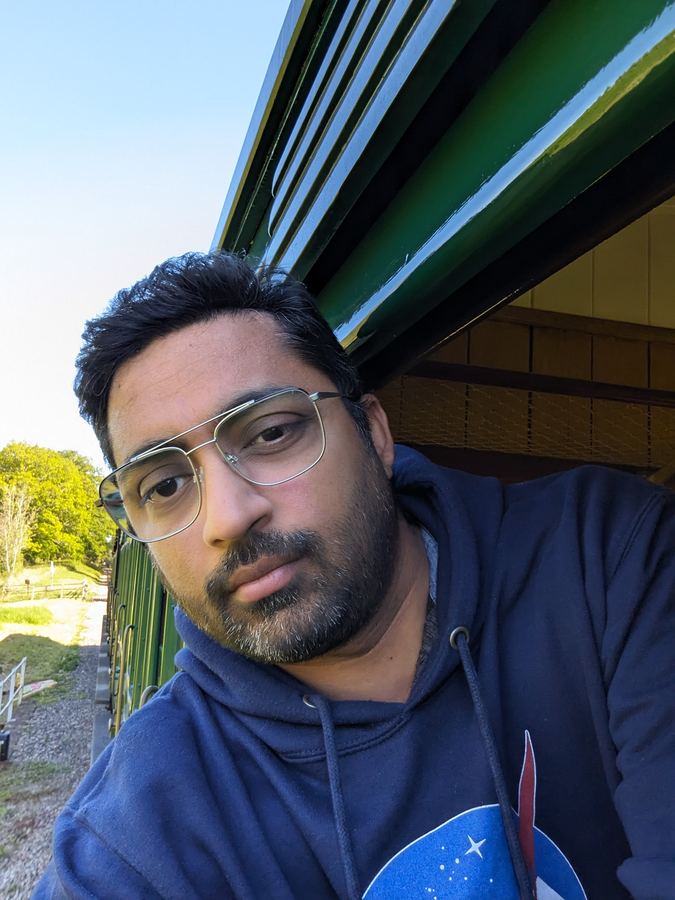
This was the finale of my Luxembourg series, and I wanted to end it properly: cross six countries in a single day, starting with breakfast in Luxembourg and finishing with dinner back home in the UK. It only works because of one thing — Schengen. Luxembourg, Belgium, Germany, the Netherlands and France all share open borders, so most of this day was just driving and walking across lines on a map with nobody checking a passport. The one border that did check passports was, fittingly, the very last one.
The full day: two tripoints, Baarle's split houses, and the ferry home.
7:30 AM: breakfast in Luxembourg
The day started with the most reliable comfort food I own: poha, carried from home as a ready-to-cook packet, made by just adding hot water. Coffee alongside it, at around 17-18°C outside — cool enough that hot poha felt like exactly the right call before a day of driving and walking. Simple start, ambitious plan: six countries before the sun went down.
Tripoint one: the obscure Belgium–Luxembourg–Germany corner
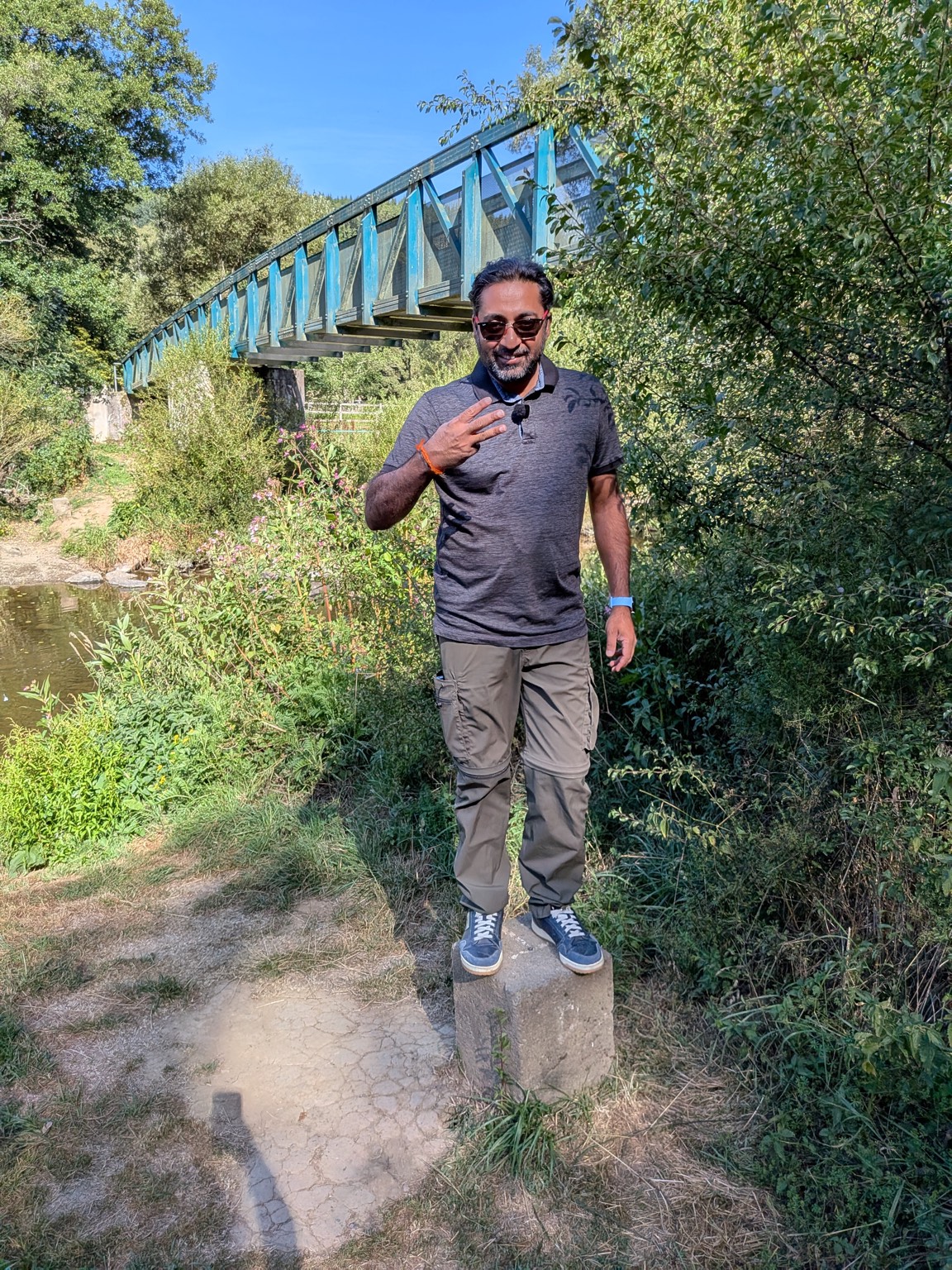
A previous stop on this same trip had taken me to a France–Belgium–Germany tripoint that turned out to be sitting in the middle of a river — close, but not quite touchable. This one was better: a genuine Belgium–Luxembourg–Germany tripoint, reachable on foot through the woods, down some genuinely narrow roads that made it clear almost nobody bothers coming here.
Along the way, boundary stones marked each country — a "D" for Deutschland, a "B" for Belgium, an "L" for Luxembourg — with the amusing detail that the German stone technically stands on Belgian soil. There's also a small EU monument here, marking the 1957 Treaty of Rome, signed by the six founding members of what became the European Union. A river called the Our splits two of the countries, with a small footbridge connecting them; walk across it and you're technically in Germany. I did, and celebrated with a proper German drink: tap water.
Tripoint two: Drielandenpunt, the touristy version
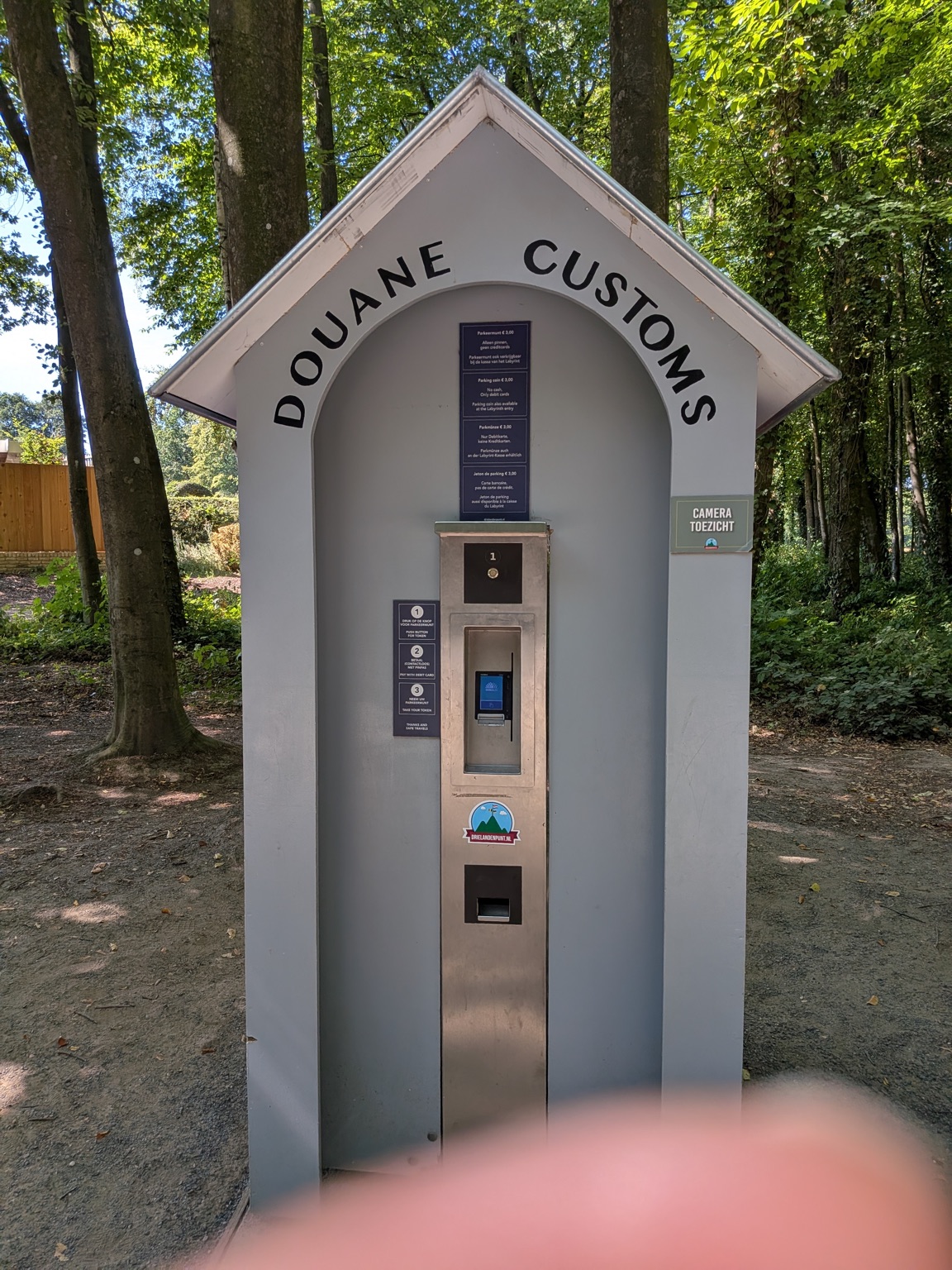
The second tripoint of the day — Belgium, the Netherlands and Germany meeting at Drielandenpunt — could not have felt more different. Instead of empty forest roads, there was a full car park charging 3 euros, crowds of visitors, and a payment booth dressed up as a mini customs house, complete with a "Douane / Customs" sign over the door even though all it does is sell parking tokens.
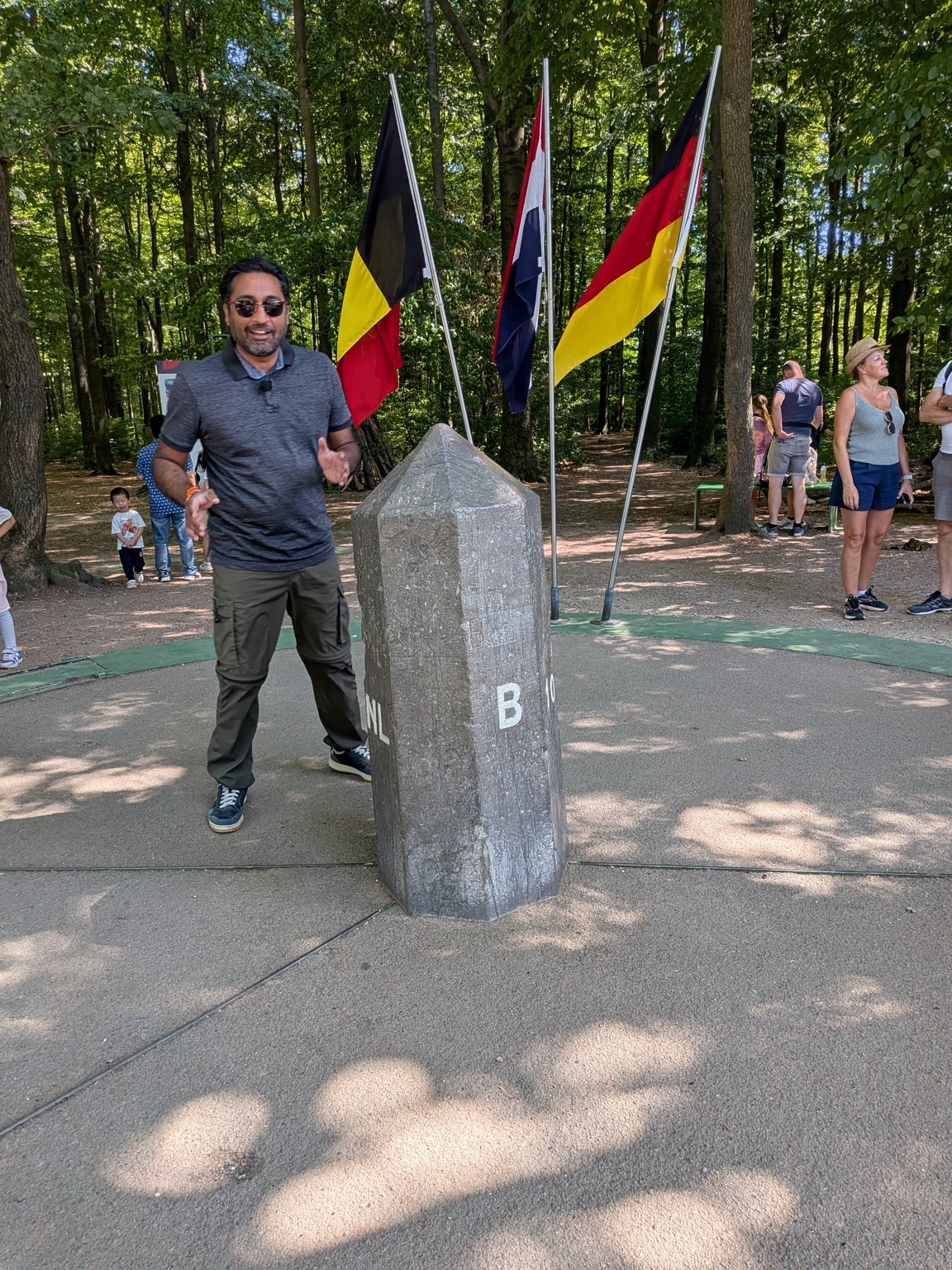
Inside the grounds there's a labyrinth (a maze — think of it as a life-size version of those puzzle pages from childhood magazines) laid out with each of the three countries' flags marking its own section, and a tall observation tower you can climb for the view. The actual tripoint itself is a stone marker with all three flags planted around it; walk in a slow circle around the stone and you pass through Belgium, the Netherlands and Germany in about four steps. It's touristy for a reason — this is the one you've probably already seen in a dozen travel reels.
Lunch happened right here, split across two countries: fresh, hot Belgian fries from the Belgian side of the tripoint (worth remembering — French fries were actually invented in Belgium, so "Belgian fries" is the more accurate name), and on the Dutch side, a stall selling wooden clogs as souvenirs — still genuinely worn by some Dutch farmers, not purely a tourist prop. I have a soft spot for the Netherlands after working for a Dutch company for years, and small details like properly built cycle paths running alongside every road are usually the first sign you've crossed into it. Dessert was a fruit waffle, strawberries and blueberries piled on top, eaten standing in the Dutch section of the same food court.
Baarle: one town, two countries, one very confused front door
The main event of the day was Baarle — not two towns with similar names, but literally one town split between Belgium (Baarle-Hertog) and the Netherlands (Baarle-Nassau), stitched together into a single patchwork. The story goes back centuries: two feudal landlords carved up territory between themselves, and generations of inheritance later, the result is a scatter of small Belgian and Dutch enclaves inside each other — Belgian pockets inside Dutch land, and Dutch pockets inside Belgian land, in a pattern that looks almost accidental.
You can see the actual border running down the middle of streets and pavements, marked with small white crosses set into the paving stones, with a "B" on one side and "NL" on the other. Most houses are simple: wherever the front door happens to sit determines which country the whole house belongs to, even if part of the building technically leans into the other side. But one house breaks even that rule — the border runs straight through the front door itself, and the same door carries two separate house numbers, one Belgian, one Dutch, with the owners reportedly paying property tax to both countries in proportion to how much of the house sits on each side.
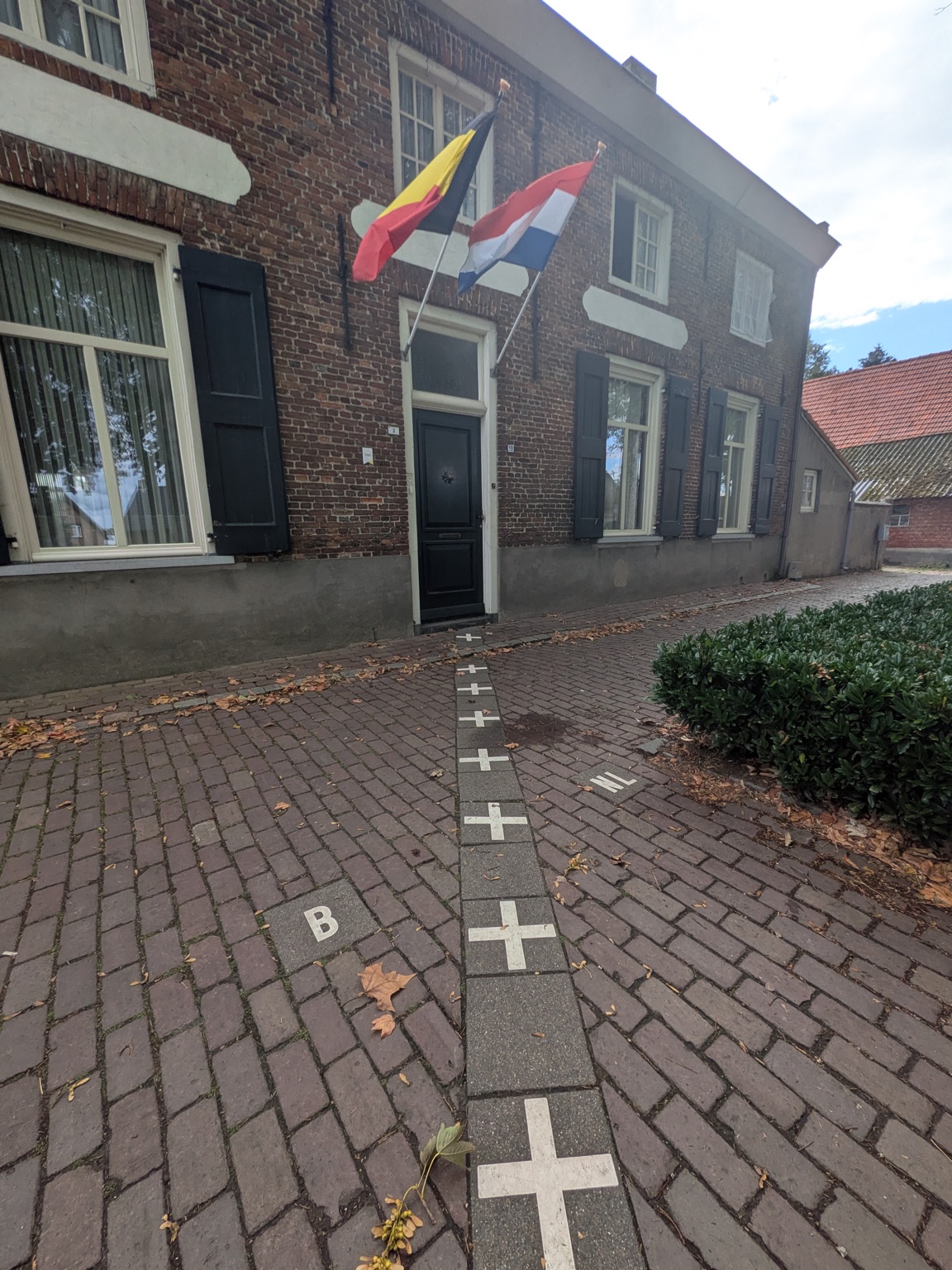
I stopped a local for a quick chat about what it's actually like living somewhere like this. He introduced himself as Rob, born in the Netherlands but living on the Belgian side of Baarle:
"For me it's just normal, because I already live here my whole life... This is also Belgium... No, I feel 100% Netherlands."
He also walked me through the local specialties worth trying: the Bicky Burger (a Belgian staple, bread with a distinct sauce) and bitterballen (a very Dutch deep-fried snack). To keep the tradition of the day going — eating or drinking something in every country — I settled for coffee and a biscuit in a Baarle café, which counted as ticking off both Belgium and the Netherlands at once, since technically I couldn't be sure which side of the enclave line I was sitting on.
Eating my way across the border, country by country
- Luxembourg: Homemade poha and coffee, 7:30 AM.
- Germany: A bottle of water at the quiet Belgium–Luxembourg–Germany tripoint.
- Belgium: Fresh Belgian fries at Drielandenpunt.
- Netherlands: A strawberry-and-blueberry fruit waffle, same food court, other flag.
- France: Coffee at the ferry terminal, waiting to board.
- UK: Dinner, at home, country number six.
Goodbye Schengen, hello immigration queue
Everything up to this point had one thing in common: no border checks, no passport stamps, nobody stopping the car. That ended at the French coast. I'd taken the Eurotunnel train on the way out to Luxembourg, but for the return I chose the ferry from France to England instead — slower at roughly 1 hour 40 minutes versus about 30 minutes through the tunnel, but usually available at a fraction of the train's price if you catch a deal, and with a very different kind of payoff.
There was a proper immigration queue at the port, with a real chance of being bumped to a later sailing if border checks ran long — I got lucky and made it onto my intended departure. Once on board, there was more to see than I expected: a sit-down restaurant (with a Malaysian vegetable curry on the menu, among other options), sandwiches, a small kids' play area, a duty-free shop, a premium lounge for an upgrade fee, and an open outdoor deck.
That open deck is where the ferry earns its extra time. As France fell away behind us, the white cliffs came into view — first the French coast's own chalk cliffs, then, as we got closer, the much larger White Cliffs of Dover on the English side, all lit up in a proper sunset. It's a view the Eurotunnel train simply cannot offer you; down in that tunnel, there's nothing to see at all.
Back in the UK: country number six
Driving off the ferry came with one instinctive adjustment: after a full day of driving on the right across continental Europe, the UK meant switching straight back to the left. No further checks after immigration at the port — just road, all the way home. I'd left Luxembourg around 7:30-8:30 AM and rolled back into the UK by about 9:00 PM: roughly 13 hours, six countries, and a proper dinner at home to close out the day — and the entire Luxembourg series with it.
What's next
This was the last video of the Luxembourg series, and — fittingly, given how much of this trip was made up on the go — I genuinely didn't know yet where the next one would take me.
Practical tips if you want to attempt this
- It only works because of Schengen: Luxembourg, Belgium, Germany, the Netherlands and France have open borders between them — no checks, no stamps. The UK is the exception; budget real time for immigration there.
- Currency: Euro everywhere except the UK, which uses the British Pound.
- Two tripoints, two moods: Go to the Belgium–Luxembourg–Germany one for solitude and narrow forest roads; go to Drielandenpunt for the tower, the maze and the easy photo.
- Ferry vs Eurotunnel: The train is faster (about 30 minutes) and pricier; the ferry takes longer (about 1 hour 40 minutes) but is often cheaper and gives you the White Cliffs at sunset.
- In Baarle: Look down — the white crosses set into the pavement are the actual national border. Follow them to find the house with two door numbers.
Most travel days have one country and one pace. This one had six countries, two tripoints, a town that can't decide which nation it belongs to, and a very deliberate ferry detour just for the view — and somehow still ended with dinner at a normal hour, at home.