
Most people cross into a new country by flight, train or bus. I decided to make it a boat trip instead, taking the Danube directly from Vienna into Bratislava, Slovakia's capital, just 60 kilometres away and an easy day trip for anyone already in Vienna.
A boat ride from Vienna, Bratislava Castle, the Blue Church, and the city's odd street statues.
The Twin City Liner, a boat built for exactly this trip
The boat itself is a catamaran called the Twin City Liner, flying both the Austrian and Slovak flags, purpose-built for the Vienna-to-Bratislava route, hence the name. Screens onboard track the route via GPS in real time. The first stretch runs through the Danube Canal, with limited views until it opens into the main Danube River itself, a river I'd already followed once before, in an earlier video from Budapest, and would go on to cross for a third time by the end of this trip.
This wasn't my first river border crossing by boat either, I'd crossed between continents on the water in Istanbul, and now, a Danube crossing was taking me between two countries instead. Out on the open deck, wind and cold eventually won out, and I retreated indoors for the rest of the ride, tracking the river as it later marked the Austria-Slovakia border directly, Slovakia on the left bank, Austria on the right, right up until the boat crossed fully into Slovak waters.
A castle shaped like an upside-down table
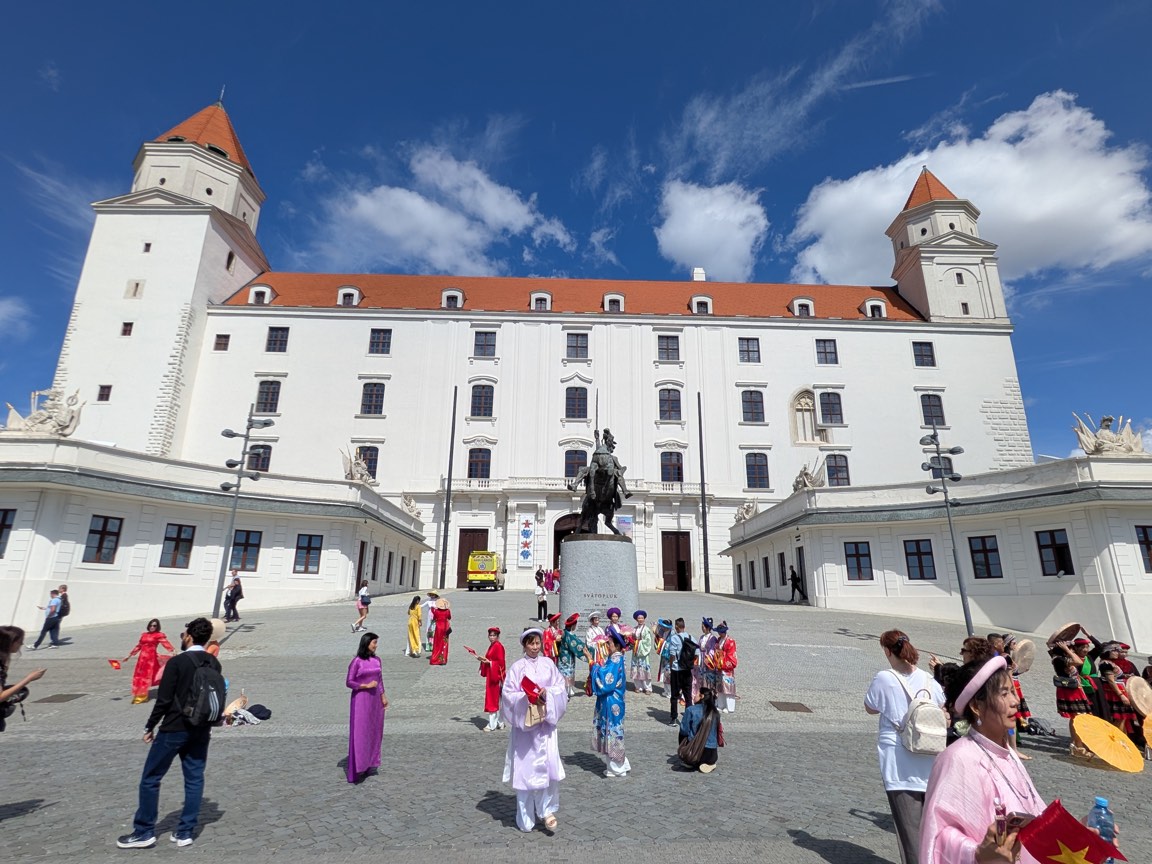
Bratislava Castle was the first stop, built as far back as the 9th century and home to every ruler of this city and region since. A 1950s reconstruction gave it much of its current form. Structurally, it's distinctive: four flat walls in a perfect square with a tower at each corner, which has earned it the nickname "the upside-down table," since flipping a table over gives you roughly this same shape. The view from the castle grounds takes in the Danube below, similar in spirit to the view from Buda Castle in Budapest, and on a clear day, both Austria and Hungary are visible from up here, Austria behind where the boat came from, Hungary in the direction the Danube continues toward Budapest.
The UFO Bridge, named for what it isn't
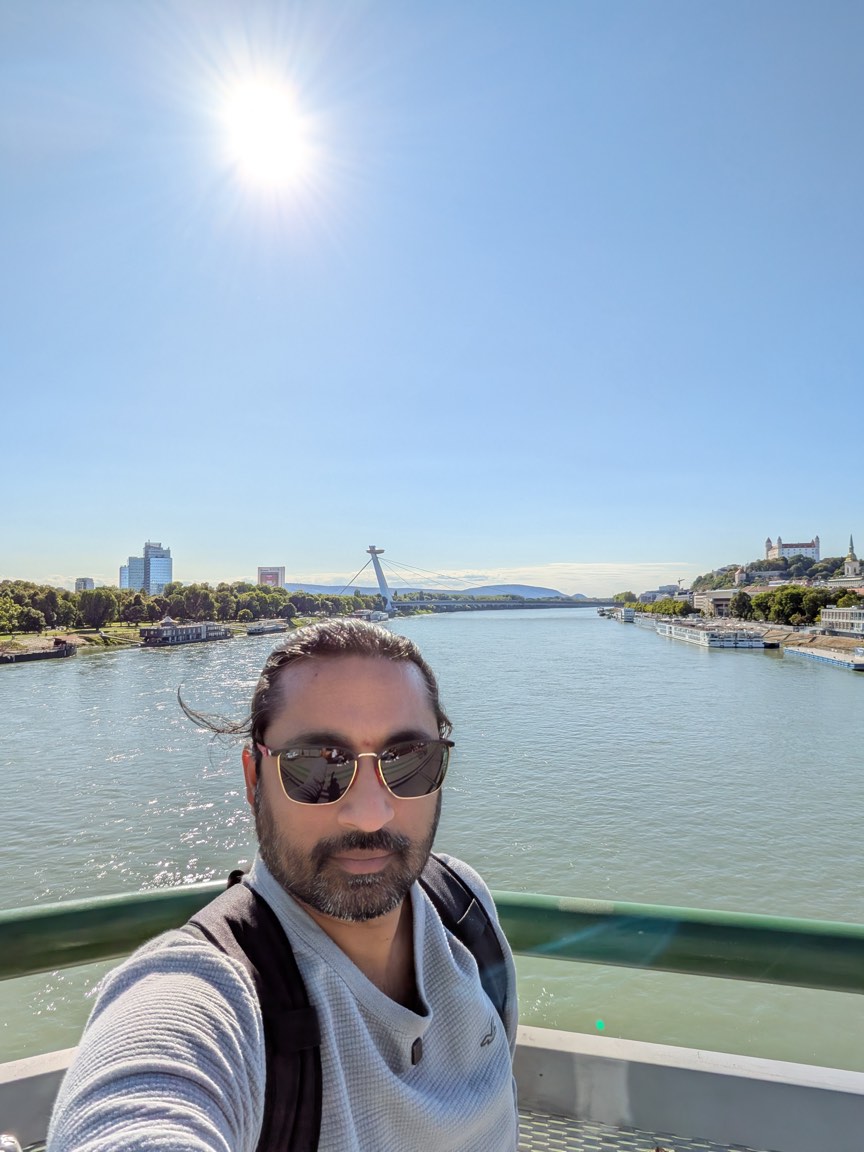
A bridge over the Danube carries what's now popularly called the UFO Tower, though that wasn't its original name. Built in the 1960s with a restaurant structure at the top, it was officially named SNP Most (Slovak National Uprising Bridge). A 2000s refurbishment gave the top structure a saucer-like shape, and the UFO nickname stuck from there, unofficial for the bridge, though the restaurant itself now uses the name officially.
A modest parliament, and an empty Jewish quarter
Slovakia's parliament building sits nearby, notably compact, described best as small but not tiny, longer toward the back than its narrow front suggests. Security was almost nonexistent, a single guard patrolling alone. Close by, a large Star of David marks a site with a difficult history: a synagogue once stood here, though unlike many similar stories across this region, it wasn't destroyed during the war itself. Instead, it was demolished afterward, officially for road widening, though by then Bratislava's Jewish population had already left the city, a pattern I'd also covered in an earlier Sofia video, and nobody was left to object or preserve it. A separate Jewish quarter nearby was lost to fire, and with the community gone, nobody rebuilt it either.
Michael's Gate, and a main square with a rough history
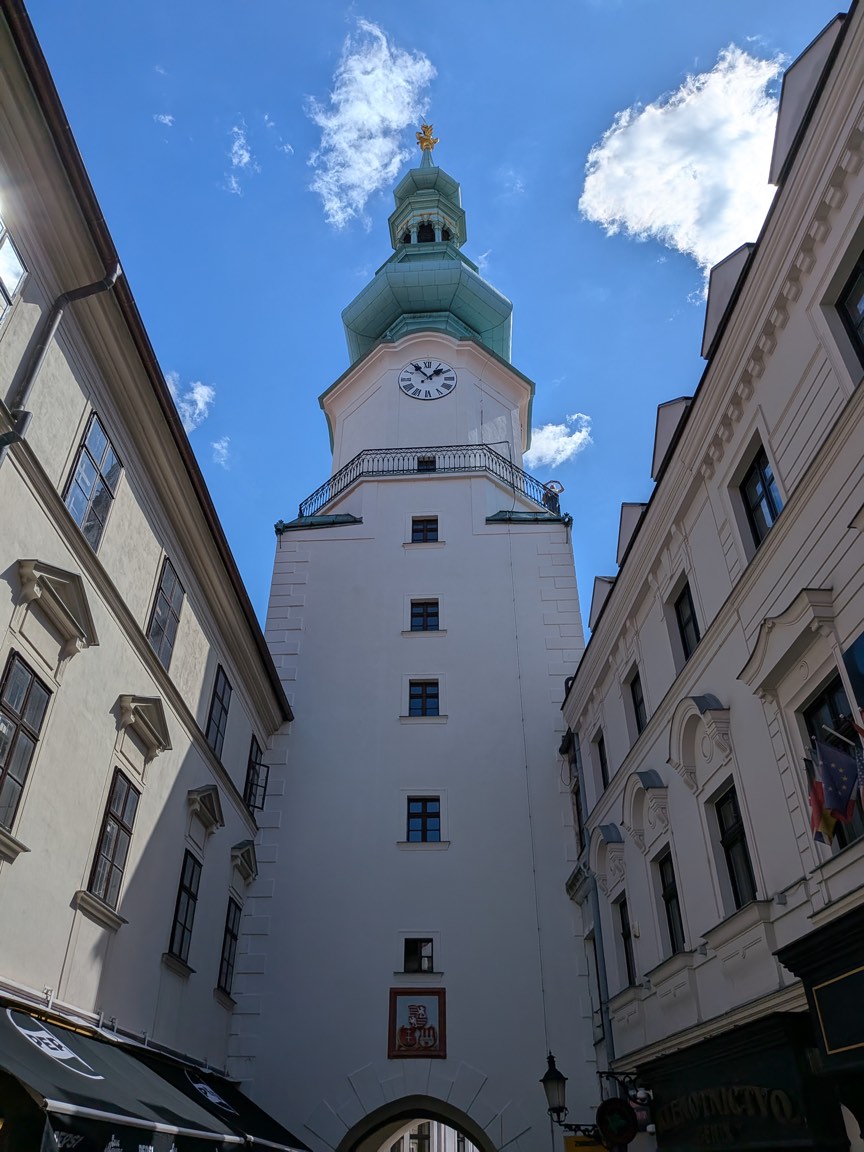
Michael's Gate marks the entrance to Bratislava's Old Town, and it's the only surviving gate from the city's original fortifications, every other gate is gone. Just inside, distance markers list how far various world cities sit from here (a curious detail: no Indian city appears on the list, though Beijing does). The Old Town itself is dense with restaurants, and its Main Square, literally named "Main Square" with no further embellishment, is anchored by the city's oldest surviving tower, standing alongside the Old Town Hall. Historically, this square doubled as a site for royal processions and, less pleasantly, public executions. None of that history is visible today, replaced instead by pastel-coloured buildings in the soft tones this part of Europe favours, several of which now house embassies, Japan, Greece and Slovenia among them, along with a well-known fountain at the square's centre.
Quirky statues, a lighter kind of "weird" than Skopje's
Scattered around the Old Town are a handful of genuinely odd statues, a lighter, more playful kind of unusual compared to the more unsettling statues I'd seen in Skopje's city centre. One depicts a Napoleonic soldier leaning casually against a bench, seemingly inviting a photo alongside him. Another honours a real local figure, Schöner Náci (born Ignác Lamár), remembered for dressing sharply and greeting women warmly while wandering the square, colourful enough in life to earn his own statue after death. A third, Čumil ("The Watcher" or "The Peeper"), peers up out of a manhole cover at street level, purely fictional, but popular enough that a "men at work" warning sign was later added above it after one too many pedestrians tripped over the statue without noticing it.
A pizza cousin to last week's pasta, and Slovakia's National Theatre
Having eaten pasta in Vienna the week before, pizza felt like the natural next step, and a shop selling pizza by the slice, jalapeño and olive, delivered two of the better slices I've had, better than I'd expected walking in. Nearby stands the Slovak National Theatre, a building that, fairly or not, doesn't quite match the grandeur of Sofia's National Theatre or Vienna's own Austrian National Theatre, the latter of which happened to have a classic car rally parked out front on the day I'd visited it the week before.
The Blue Church, straight out of a fairy tale
Nothing quite prepared me for the Blue Church (Church of St. Elizabeth), a building that looks more like a Disney castle or an elaborately iced cake than a traditional church, viewed from one angle it reads as a fairy-tale tower, from another, a stack of pastel cake tiers. Istanbul's Blue Mosque, despite the name, isn't actually blue in any obvious way, but this church delivers exactly the colour its name promises, a genuinely striking, saturated blue unlike anything else I'd seen on this trip. It was closed by the time I arrived, but even from outside, through the entrance, it was clearly worth the detour.
A second river crossing, and Slovakia's presidential palace
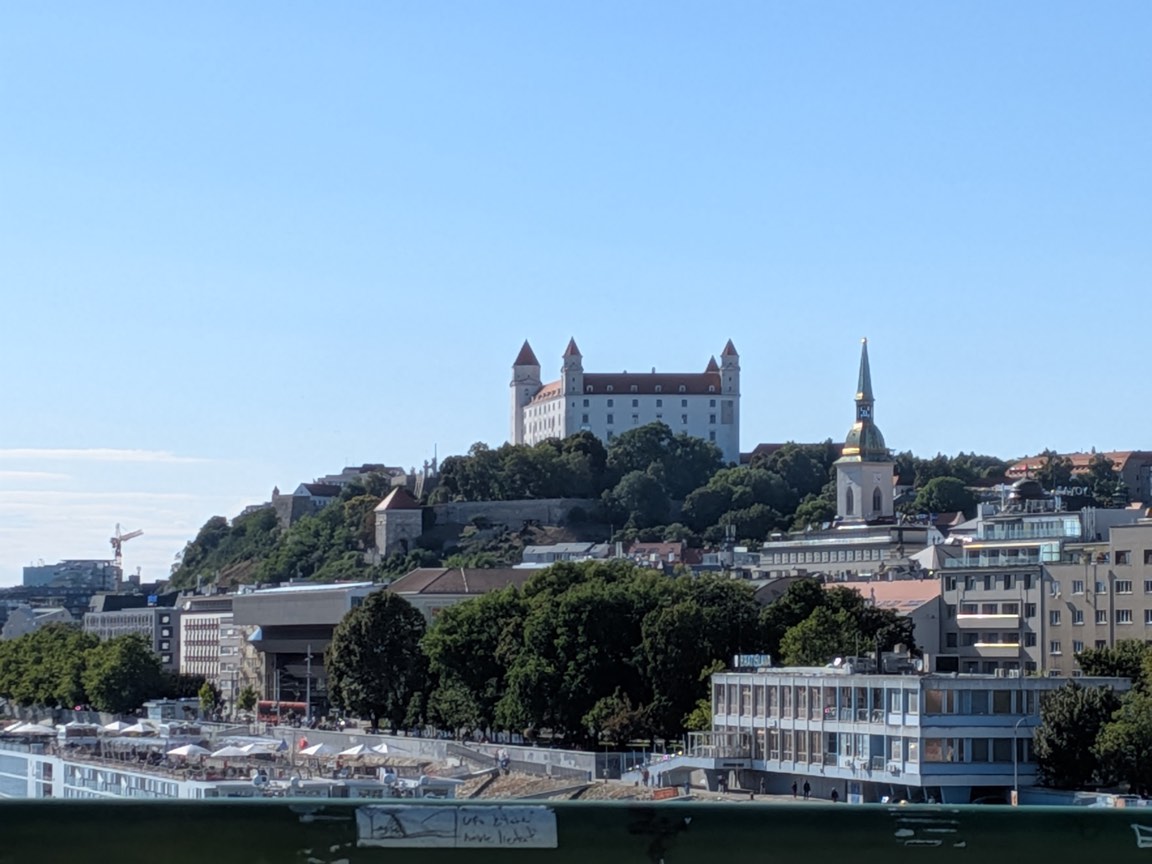
Crossing back over the Danube on the Old Bridge, distinct from the newer bridge carrying the UFO Tower, gave one more look at the full skyline: the castle on one side, the river's three bridges laid out much like Budapest's own three-bridge skyline. Most of Bratislava's population, I learned, actually lives on this side of the river, while the opposite bank leans more toward tourist attractions.
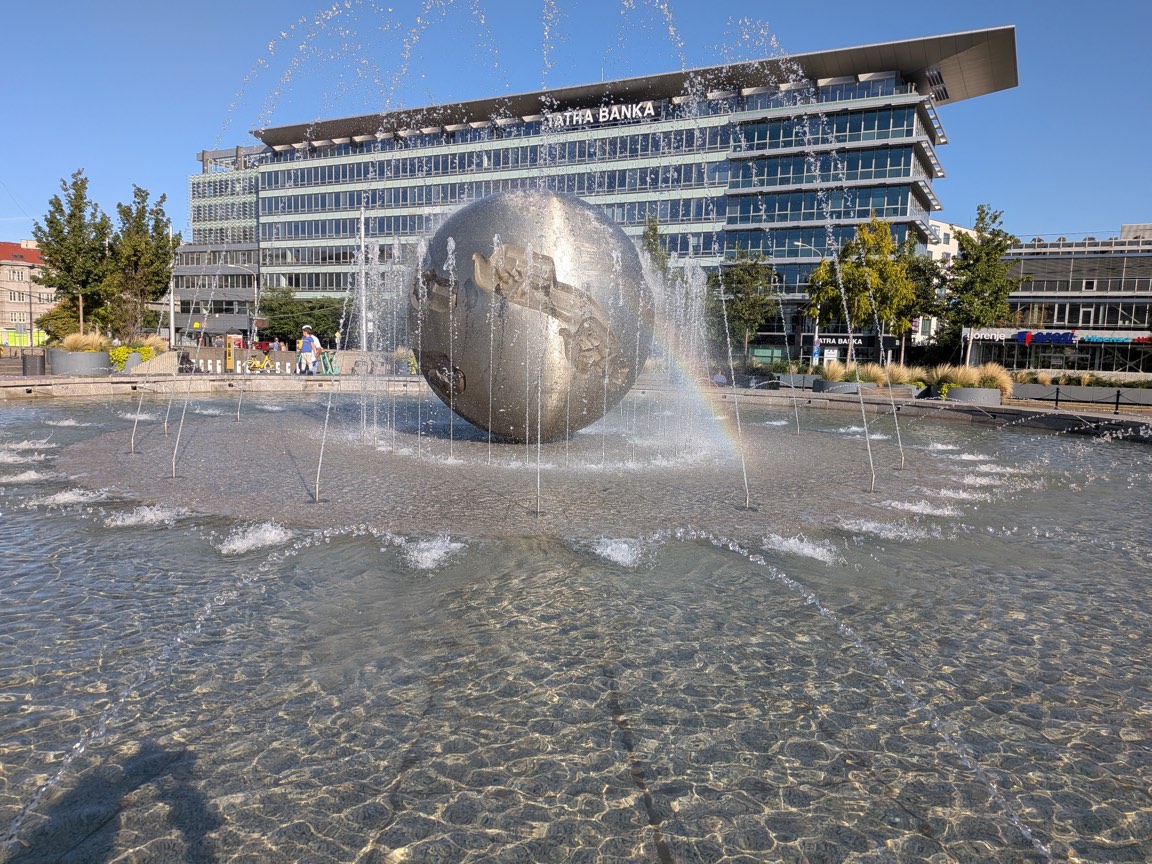
Slovakia's Presidential Palace sits nearby, originally built in 1760 for a noble family rather than as a government building. A brief history explains how it became one: Slovakia existed as part of Czechoslovakia (a name familiar to anyone roughly my age) until the two split peacefully in 1995. Slovak monarchy itself had already ended back in 1918, following the First World War, and once Slovakia became fully independent in 1995, this building was repurposed as the President's official residence. In front of it, the Globe Fountain, a peace monument, threw off a faint rainbow in the afternoon sun, on the right side, if the light and your eyes cooperate.
Dinner and a first ride on Flixbus
For dinner, rather than a restaurant, a shopping mall near the bus stop had a full food court with genuinely international options, and true to habit, I ended up at an Indian restaurant, Bombay Express, styled inside like an actual train carriage, complete with train-style bench seating (though noticeably more comfortable than they looked). A vegetable biryani and sweetened lime water were both solid, though the lime water, ordered "with sugar," somehow arrived without any, working out fine either way.
The trip back to Brno was my first time on a Flixbus, a long-distance coach service several Telugu YouTubers had already recommended, and it held up: genuinely spacious compared to flying, clean, with onboard toilets and no complaints worth mentioning.
What made Bratislava stand out
Of all the Slavic-language countries on this leg of the trip, Bratislava was the one I liked best, largely because English is spoken confidently and widely here, a result of mandatory English education in schools. That's not something you can count on in countries like Germany, France or Spain, where English fluency outside tourist zones and major cities is far less guaranteed.
Practical tips for Bratislava
- Getting there from Vienna: the Twin City Liner boat is a scenic, unusual way to make the 60km trip, though a bus is faster if time is tight.
- Bratislava Castle: free to walk the grounds, with views over the Danube toward both Austria and Hungary on a clear day.
- Old Town statues: look for Čumil peeking out of a manhole cover and the Napoleonic soldier statue near the French Embassy.
- Blue Church: check opening hours in advance if you want to see the interior, not just the striking exterior.
- Onward travel: Flixbus is a comfortable, affordable option for continuing on to nearby cities like Brno.