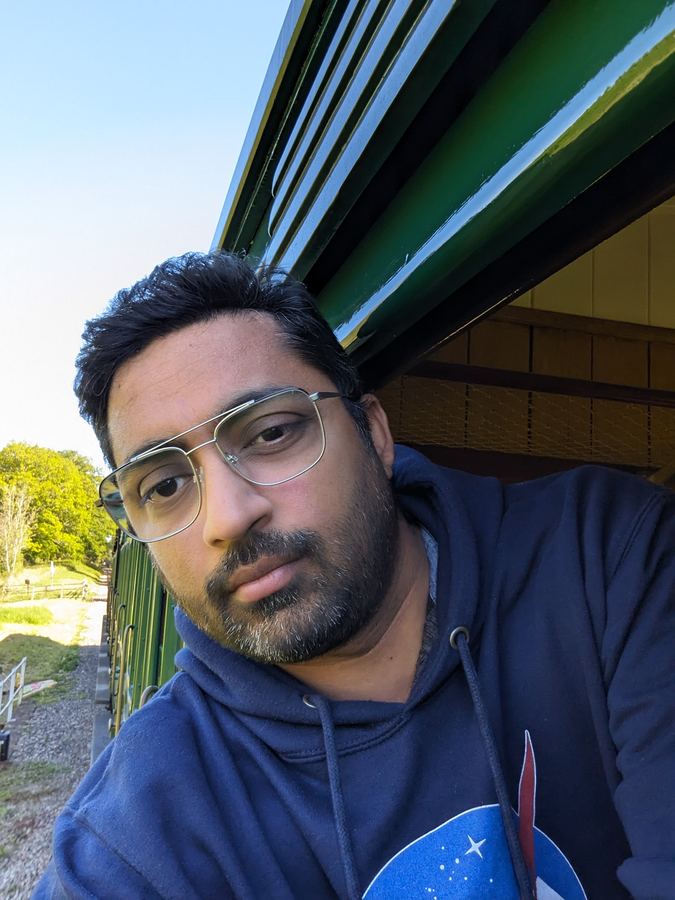
Ask most people what Czech Republic means and the answer is Prague, every time. I skipped it entirely and went to Brno instead, the country's second-largest city, in the Moravia region rather than Prague's own region, and one that turned out to have plenty worth covering on its own terms.
Spilberk Castle, the astronomical clock, and Brno's ossuary of real human bones.
A peaceful split, unlike some others I know
Having covered Slovakia the week before, Czech Republic felt like the natural next stop, the two used to be one country, Czechoslovakia, formed in 1918 when the monarchy that preceded it ended. Various rulers followed, Hitler's occupation among them, then communist rule, before the two halves agreed to split peacefully in 1995, none of the tension that, say, a state split back home might carry. Slovak and Czech are distinct but mutually intelligible languages, and the two nations differ meaningfully in outlook too, Slovaks lean notably more religious, while roughly 90% of Czechs identify as atheist, different enough in culture and language that an amicable separation made sense to both sides.
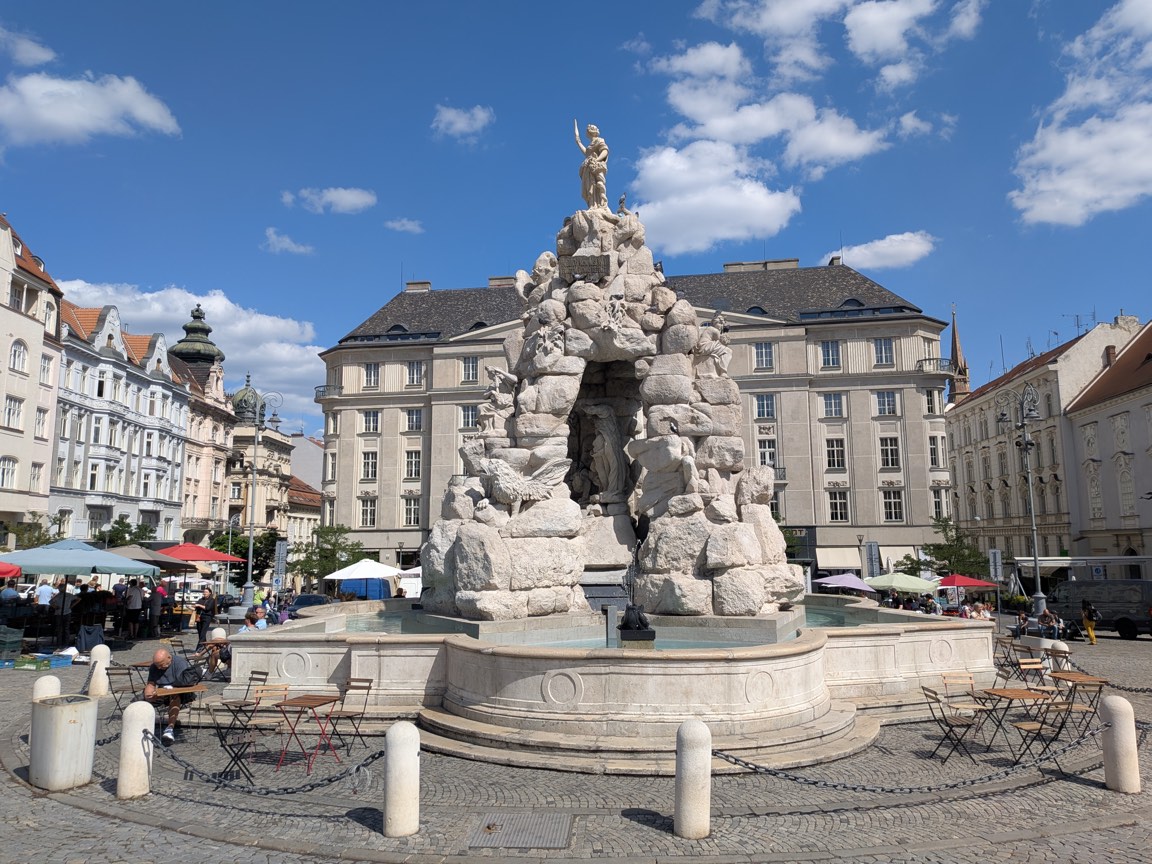
Cabbage Market Square, still selling more than cabbage
The main square is still called Cabbage Market Square, a name held over from when cabbage was the primary product sold here; today it's flowers, fruit and a full range of vegetables, the cabbage-specific trade long gone but the name unchanged. Museums covering the wider Moravia region sit nearby, unfortunately closed on the Monday I visited, along with an underground labyrinth beneath the vegetable market that stayed locked for the same reason.
An astronomical clock shaped like a bullet
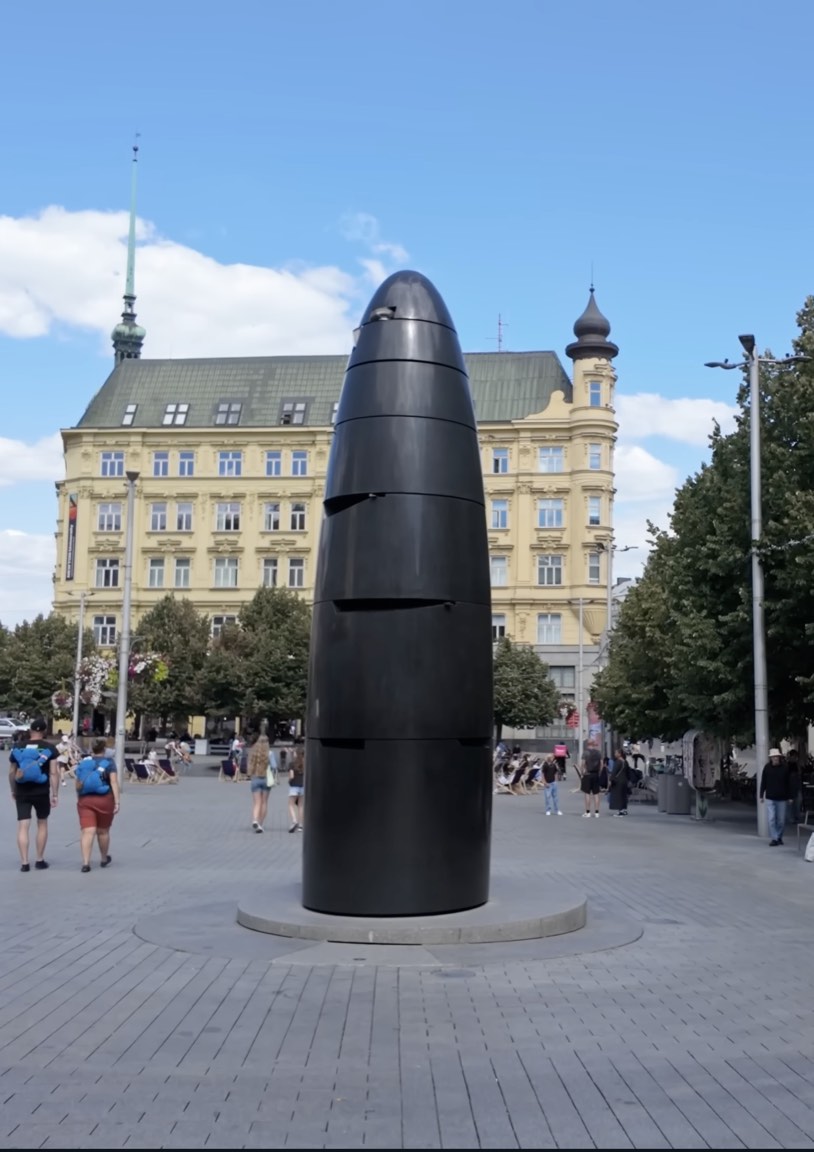
St. James Square, more modern in feel than the vegetable-market square, holds one of Brno's stranger landmarks: a bullet-shaped astronomical clock. A small opening near its base releases a marble (more precisely, a glass orb) every day at 11am, first come, first served for whoever's standing there to catch it. Figuring out how to actually read the time from it took some trial and error (turning to face true east, then aligning with the clock face) before another, more conventional clock tower nearby turned out to be the simpler way to check the time after all.
The Old Town Hall, a crooked horn and an accidental dragon
The Old Town Hall's entrance tower stands 63 metres tall, with 200 steps to the top for anyone willing to climb. A small decorative horn near the entrance sits noticeably crooked, according to local legend, because the mason who built it wasn't paid properly and twisted it out of spite on purpose. Just past the entrance hangs what's known as the Brno Dragon, in reality a stuffed crocodile, once used to frighten locals, which is presumably why it ended up hanging in the town hall rather than anywhere less dramatic. Beside it hangs a large wooden wheel, supposedly built by a carpenter roughly 50 kilometres away who wheeled it into the city himself and died from exhaustion shortly after arriving, leaving the wheel behind as the only trace of the story.
Climbing the tower itself is straightforward, if less museum-heavy than expected, mostly a narrow spiral stair rather than themed exhibits at every level, but the view from the top delivers: the full old town spread out below, including the square where the walk had started and the twin towers of a nearby evangelical church visible from a new angle.
Vietnamese food, and Spilberk Castle's long list of former uses
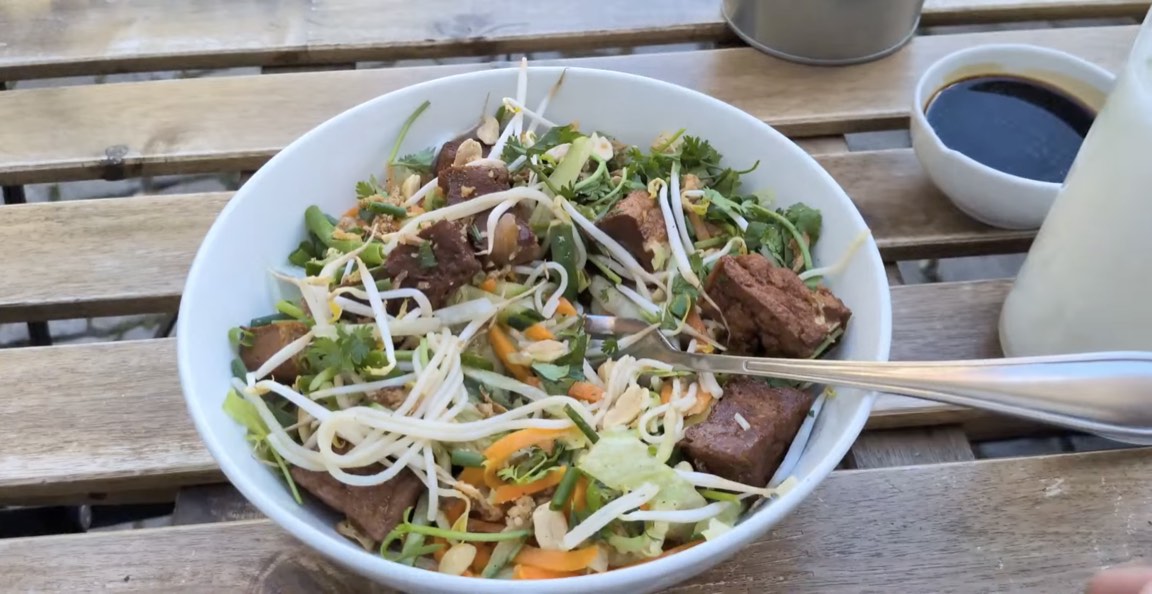
Lunch was Vietnamese, a genuinely good decision in a city not exactly known for that cuisine, before heading up the hill to Spilberk Castle, following the same familiar pattern from Málaga's viewpoint climb earlier on this trip: up and down, morning and evening, sunrise and sunset chasing included there, sunrise this time only.
Spilberk Castle dates to the 13th century, built by Moravian rulers specifically to protect what was then their capital. Later, Habsburg emperors took control (the same dynasty behind the Hofburg Palace I'd already covered in Vienna), and the castle's role shifted dramatically over time: a prison for political detainees, briefly used by Napoleon's forces during their own campaigns, and later converted into military barracks during the World Wars. Today it's a well-maintained museum, viewable from outside without a ticket if, like me, you didn't plan far enough ahead to catch the actual exhibits, plague inspection here was tighter on museum-only days than I'd accounted for. An observation tower and a WWII-era nuclear bunker nearby, similar in spirit to one I'd visited in Budapest, were both closed for the same reason, a lesson in better Monday planning for next time.
New Town Hall Square, and a swing that isn't a swing
Past the castle grounds, New Town Hall Square offers a lighter stop: deck chairs scattered everywhere in typical Brno fashion, plus a large circular swing bench, more of a spinning seating installation than a proper swing, that draws both kids and, honestly, adults happy to sit and spin for a while.
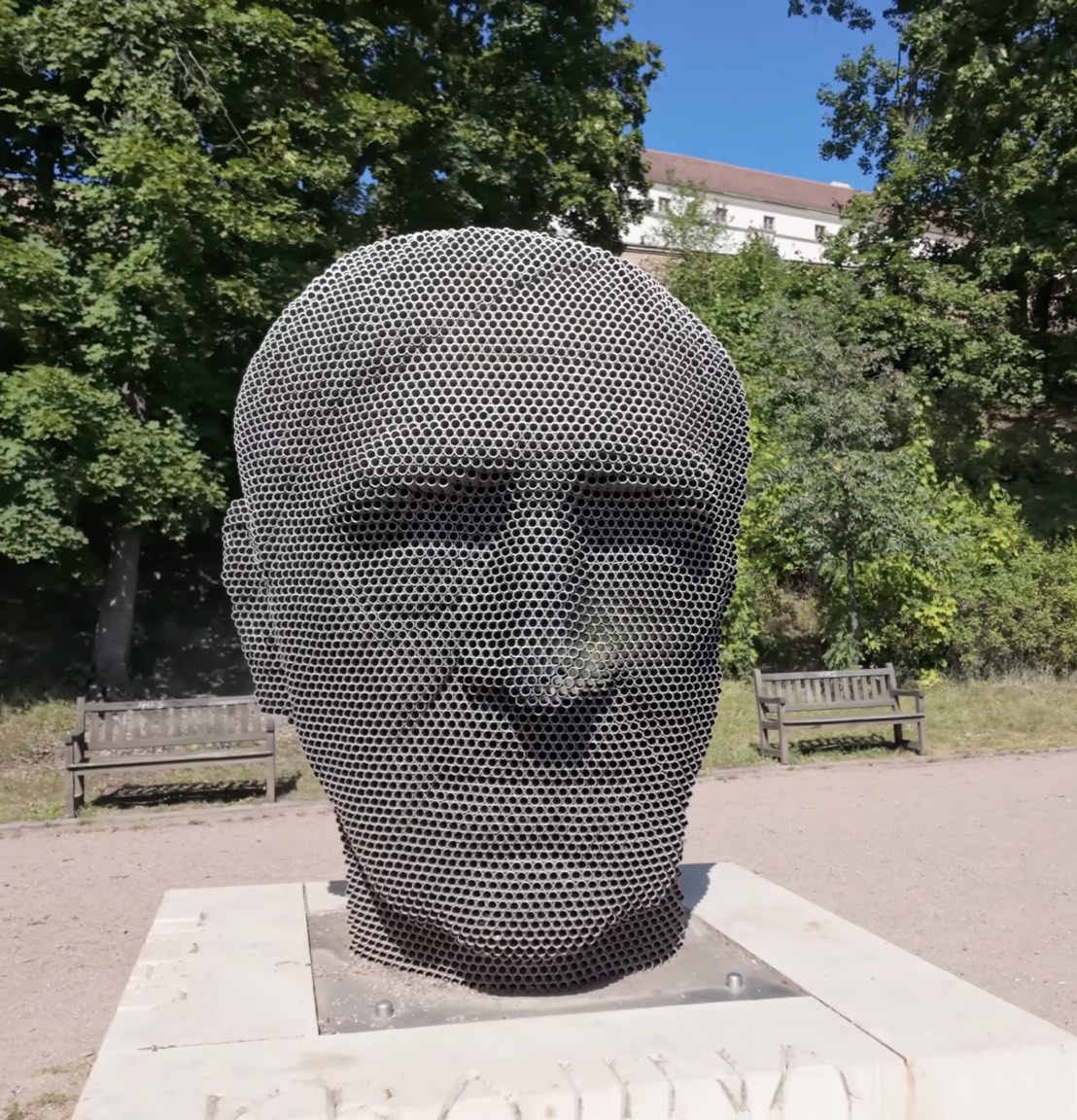
Saints Peter and Paul Cathedral, and a bell that rings an hour early
The city's Gothic cathedral, Saints Peter and Paul, dates to construction that continued into the 20th century and carries enough local significance to appear on the Czech 10-crown coin. It comes with a genuinely charming piece of local history: church bells traditionally ring the noon bell at 12, but here it rings at 11 instead, a tradition dating back to a 17th-century Swedish siege, when defenders reportedly rang the noon bell an hour early, tricking the attacking Swedish forces (who'd vowed to withdraw if they hadn't taken the city by noon) into retreating before the actual deadline. Whether entirely true or embellished over the centuries, it's stuck as local tradition regardless. Brno's National Theatre sits nearby too, grand in the way seemingly every regional capital across this part of Europe insists on having its own grand National Theatre.
The Ossuary of St. James Church, real bones and a genuinely eerie walk
The last stop, and the one that stuck with me most, was the Ossuary beneath St. James Church. Walking in, not knowing quite what to expect, felt genuinely unsettling, walls lined, floor to ceiling in places, with real human skulls and bones, arranged deliberately rather than scattered.
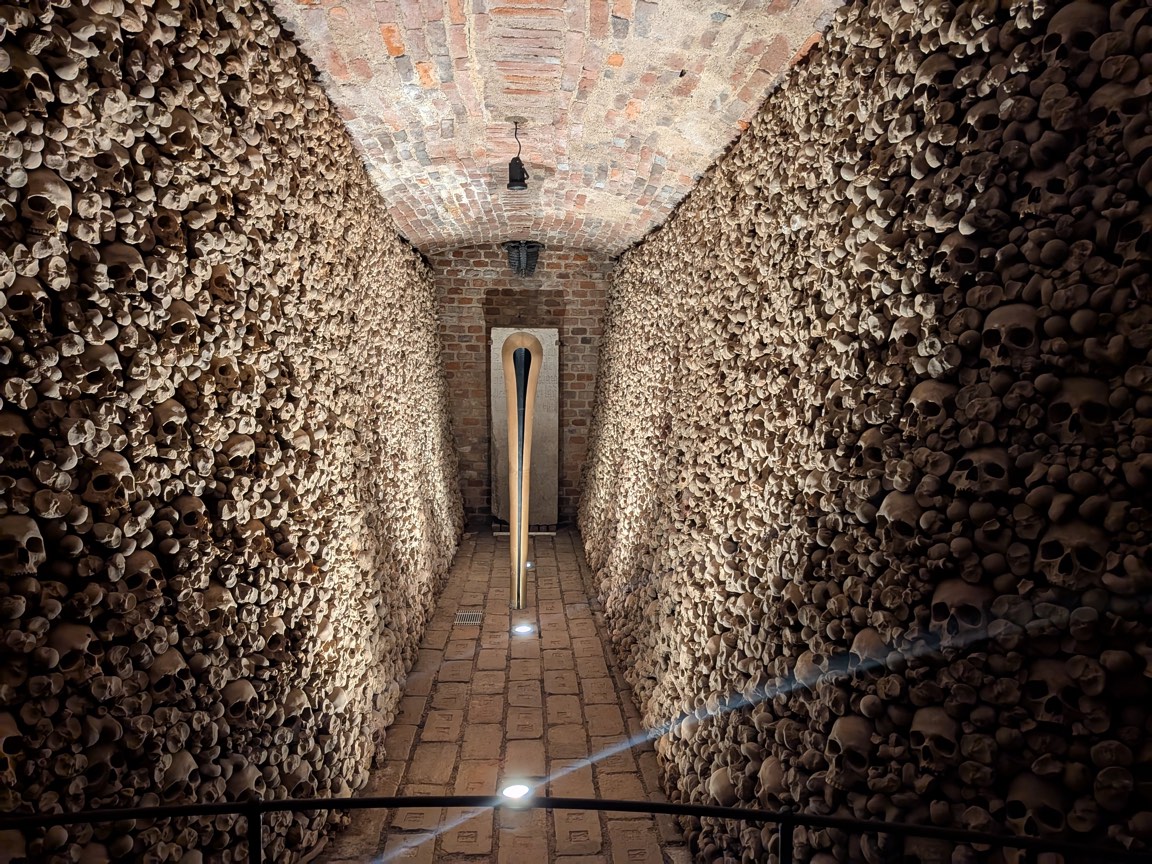
The history: as the city's population grew through plagues and wars, existing burial space ran out entirely, so remains were exhumed and relocated here instead, a practical solution to a very real space problem. The ossuary itself was effectively forgotten until archaeologists rediscovered it in 2001, and after a proper cleaning and disinfection process, it opened to the public in 2012, now standing as something between a memorial and an unusually direct piece of local history, remains of adults and children alike, without pretending otherwise. Once the initial unease wears off, walking through feels less like a horror stop and more like a genuinely sobering memorial, worth the visit precisely because it doesn't soften what it's showing you.
How Brno compares
Brno felt small and genuinely likeable, without the tourist density of bigger regional capitals, and most of the visitors I did see were domestic Czech travellers rather than international tourists. English proved noticeably harder to rely on here than in Slovakia, and the reason turned out to be straightforward: Slovakia made English compulsory in schools back in 2010, while Czech Republic is only making it compulsory nationwide from 2027, some individual schools already teach it, but it isn't universal yet, a small but telling gap between two countries that split from the same union just thirty years ago.
Practical tips for Brno
- Avoid Mondays: several major sights, the Moravia museum, the vegetable market labyrinth, and parts of Spilberk Castle, are closed that day.
- Astronomical clock: arrive close to 11am if you want a shot at catching the daily marble drop.
- Old Town Hall Tower: 200 steps for a full panoramic view over the old town, worth the climb.
- Spilberk Castle: book museum and observation tower tickets in advance if you want more than the exterior grounds.
- The Ossuary: genuinely worth visiting despite (or because of) how unsettling it feels at first, treat it as a memorial rather than a curiosity.