
Flying from India with a six-hour gap between connecting flights at Frankfurt Airport, I had two choices: sit at the gate, or actually go see the city. I chose the second one, and this is exactly how that day went, city centre and back, with time to spare before boarding.
The full layover route: cathedral, Romerberg, the Main riverfront, the Euro sign, and the Alte Oper.
Getting from the airport into the city
From Frankfurt Airport, there are two obvious ways into the centre: taxi, or the train from the airport's own station. The train is the better option by far, taking only about 15 minutes to reach the city. A single ticket costs around 6 euros, but a full-day ticket runs about 13.20 euros, and since I'd need to make the same trip back to the airport a few hours later anyway, the day ticket was clearly the better deal.
Konstablerwache: a quiet square on the wrong day
Fifteen minutes later, I was in the city, right around Konstablerwache square. It was completely empty when I visited, being a Sunday, but on a Tuesday, Thursday or Saturday this entire square turns into a full market, packed with stalls and shoppers. Empty as it was, the weather was pleasant, the square was ringed with shops, and I noticed the entire city is remarkably cycle-friendly, stand after stand of public bicycle racks, with locals clearly preferring two wheels over cars for getting around. Rental cycles are available too if you'd rather not walk the whole route yourself. A small fountain nearby wasn't running, but the square still had a certain charm, and I got the feeling it would look even better lit up at night.
Frankfurt Cathedral: 95 metres of Gothic sandstone
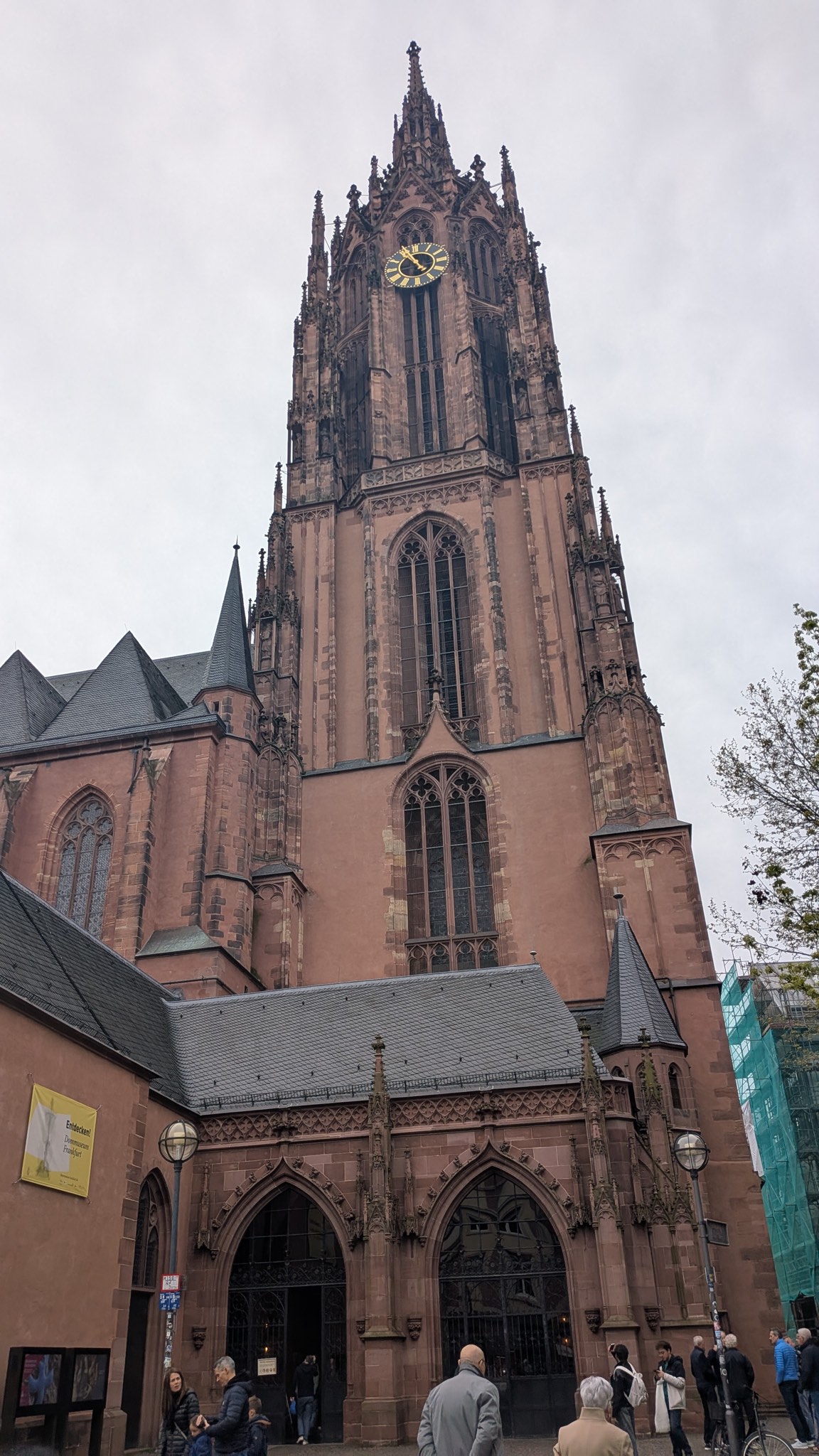
My first real stop was the Frankfurt Cathedral (Kaiserdom), and it's an imposing sight, roughly 95 metres tall, built originally in the 1550s and dedicated to Saint Bartholomew. Like most of the city, the original structure was badly damaged during the Second World War and had to be extensively restored. The Gothic style is unmistakable from the ground: soaring spires, ornate stonework, and rows of saint figures carved into the entrance gate. One detail that genuinely surprised me: parking near the cathedral, right in the middle of a major city like Frankfurt, is free, which I hadn't expected at all going in.
The House of the Golden Scales, and a city rebuilt twice over
Right next to the cathedral stands a striking building known as the House of the Golden Scales, a bakery occupies the ground floor today, but the upper floors are the real draw. Like practically the entire building, it was destroyed during the war and rebuilt afterward, and this turns out to be the theme of the whole city centre: every historic-looking building here is, in some sense, a careful reconstruction. Every European city I've covered on this channel, Budapest included, tells some version of the same story, World War Two flattened most of it, and what stands today was rebuilt to look the way it did before. Frankfurt is no exception. What makes it a little different is the choice its planners made afterward: rather than rebuild the whole city centre in period style, they modernised almost everything, tall glass-and-steel towers now dominate the skyline, except for one deliberately preserved pocket, built and maintained to look exactly as it did before the destruction.
Romerberg: the one square rebuilt old-style
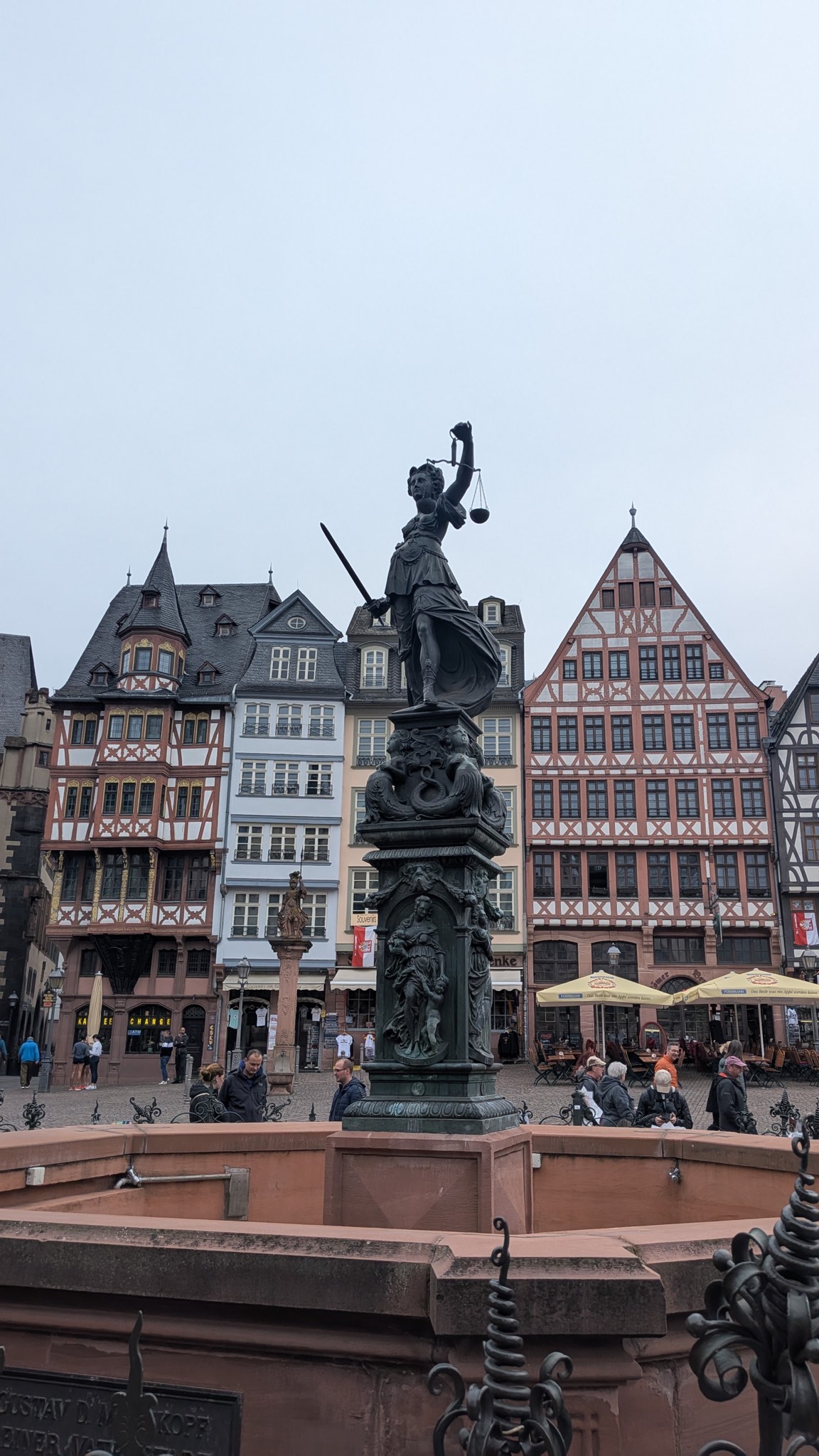
That preserved pocket is Romerberg square, and it's the most photogenic part of the whole city. The buildings around it are wooden-framed, half-timbered structures in deep red, maroon and black, a completely different architectural language from the glass towers just a few streets away. The main building behind the square, called Romer, gives the square its name; "Romer" translates to "Roman," and as it turns out, that's not a coincidence, because Roman ruins genuinely exist just beneath this part of the city, unearthed during excavations and now displayed on-site with information on what the original Roman-era structures here looked like.
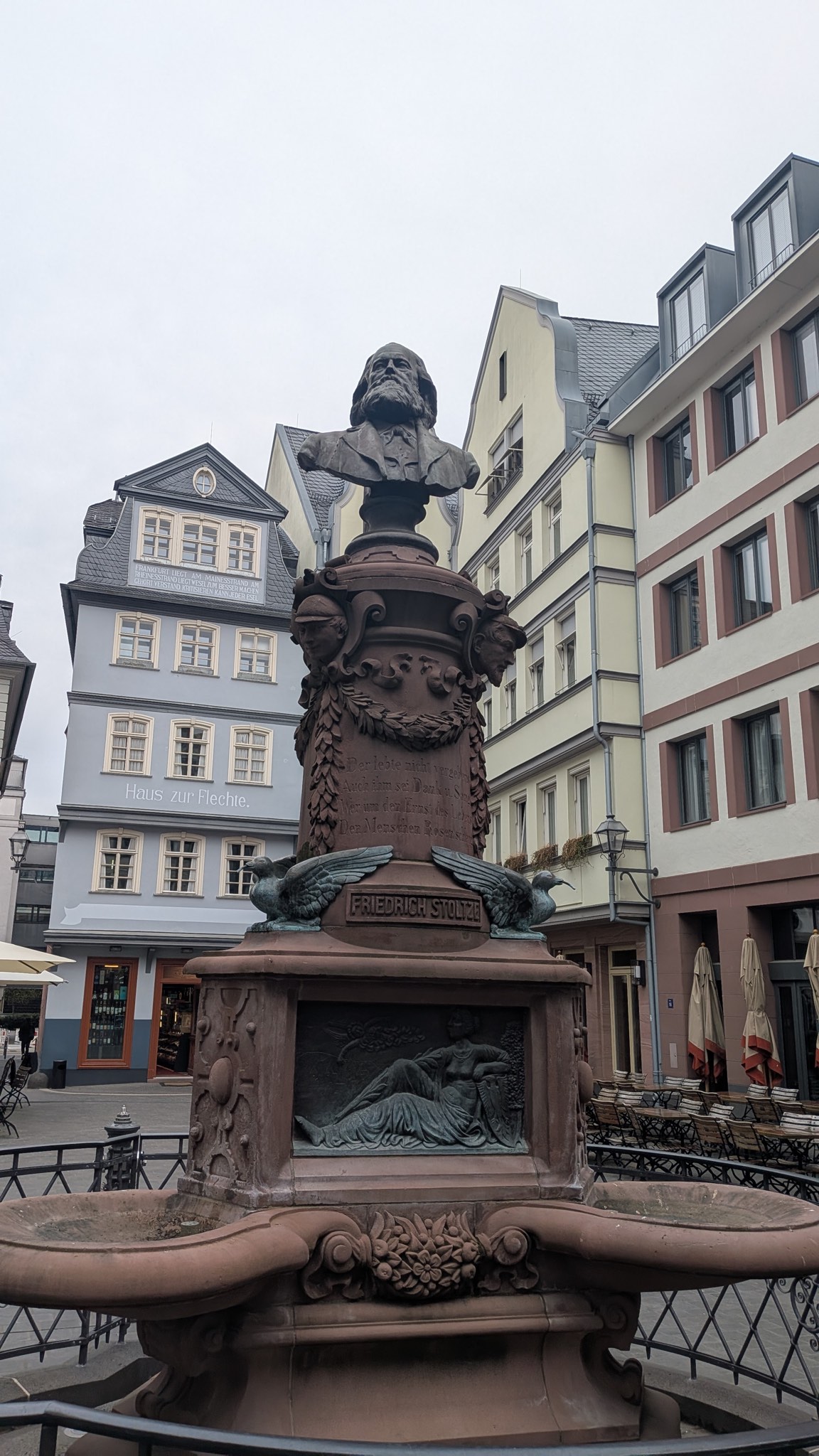
In the middle of the square stands a striking statue of Justitia, Lady Justice, holding her scales and sword, facing the Romer building. Along the way I also passed a working fountain topped with a bust of Friedrich Stoltze, a local poet and writer, decorated with birds and floral reliefs at its base, one of several such monuments scattered through the old town.
Klein Markthalle and a very Frankfurt drink
A short walk away is the Kleinmarkthalle, a famous indoor market hall holding somewhere between 200 and 300 individual shops when it's fully open: spice stalls, fresh chillies, produce of every kind, and notably several dedicated to Apfelwein, apple wine, which is something of a Frankfurt speciality. It's closed on Sundays, which meant the halls I walked through were nearly empty, apparently on a Saturday the same space is completely packed. Outside, ornamental apple trees stand as a nod to the drink the city is known for, whether the wine is actually made from these specific trees, I genuinely don't know, but the symbolism was clear enough. A fountain nearby, topped with a sun motif, marks what locals call the Altstadt, the Old Town, new buildings and old ones alike, all constructed in the same period after the war to recreate a consistent old-town feel.
Along the river Main, and the Eiserner Steg
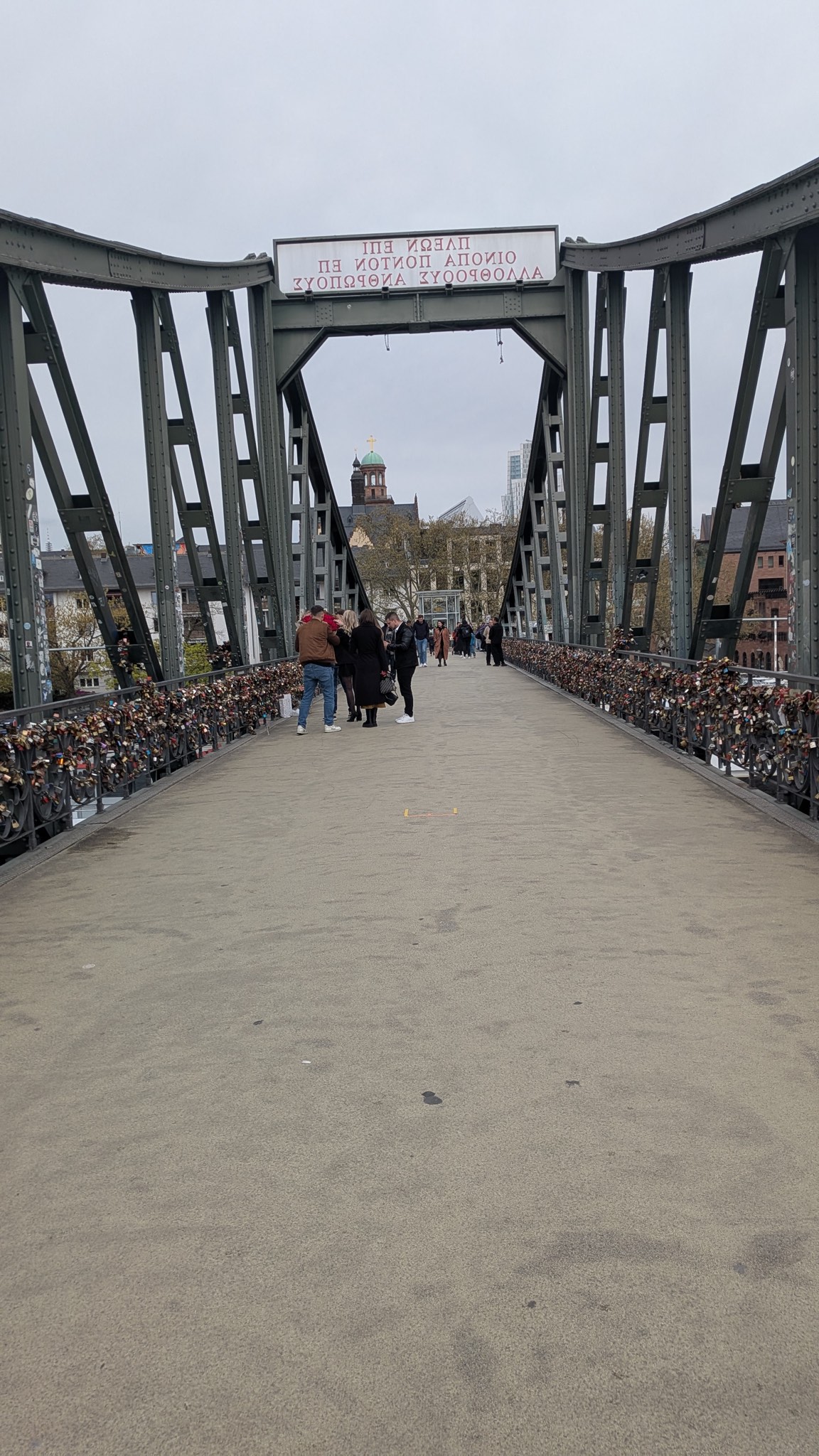
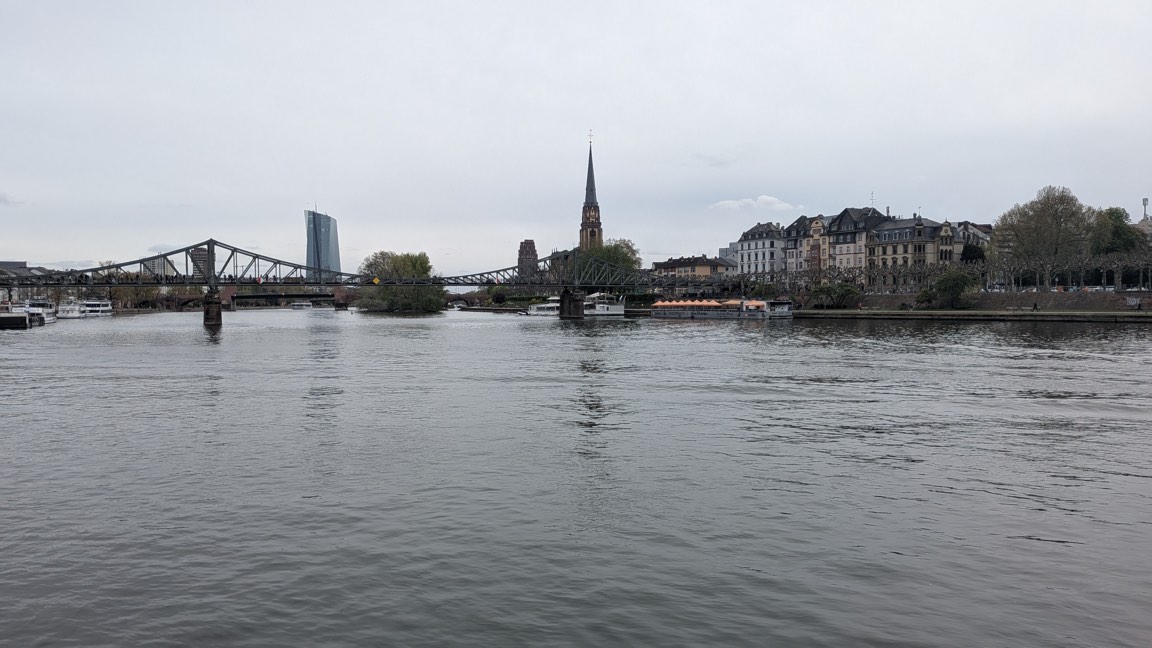
Every European city seems to sit beside a river, and Frankfurt is no different, its river is the Main, which is also why you'll often hear the city called "Frankfurt am Main" or simply "Frankfurt Main" to distinguish it from other places sharing the Frankfurt name. On one bank stood a handsome old church; on the other, the walking route led toward a footbridge, the Eiserner Steg, a pedestrian bridge fitted with a lift for anyone who can't manage the stairs up to it. Crossing it, one side showed the modern Frankfurt skyline stretching up in glass and steel, the other, the older city I'd just walked through. Like nearly every bridge I've seen across Europe, this one was completely covered in love locks, initials and names scratched or painted onto every free space, a modern-day version of carving names into stone.
"Mainhattan" and the Frankfurt postcard view
Frankfurt carries two nicknames, and both come from the same fact: this is the financial capital of continental Europe, or at least it was until the European Central Bank's operations shifted toward Brussels (I'm not entirely sure where that stands today, but that's the sense I got). The first nickname, Mainhattan, plays on the Main river and the city's Manhattan-style skyline of high-rise towers. The second, more directly, is Bankfurt. Most of the tall buildings ringing the skyline are exactly what you'd expect for a financial hub, headquarters and offices for major banks.
The Eiserner Steg itself was destroyed in the war too, like almost everything else on this list, and rebuilt in 1946. It's often called the "Frankfurt postcard" bridge, because from its centre you get modern Frankfurt on one side and old Frankfurt on the other, in a single frame.
The Euro sign, and Frankfurt's financial district
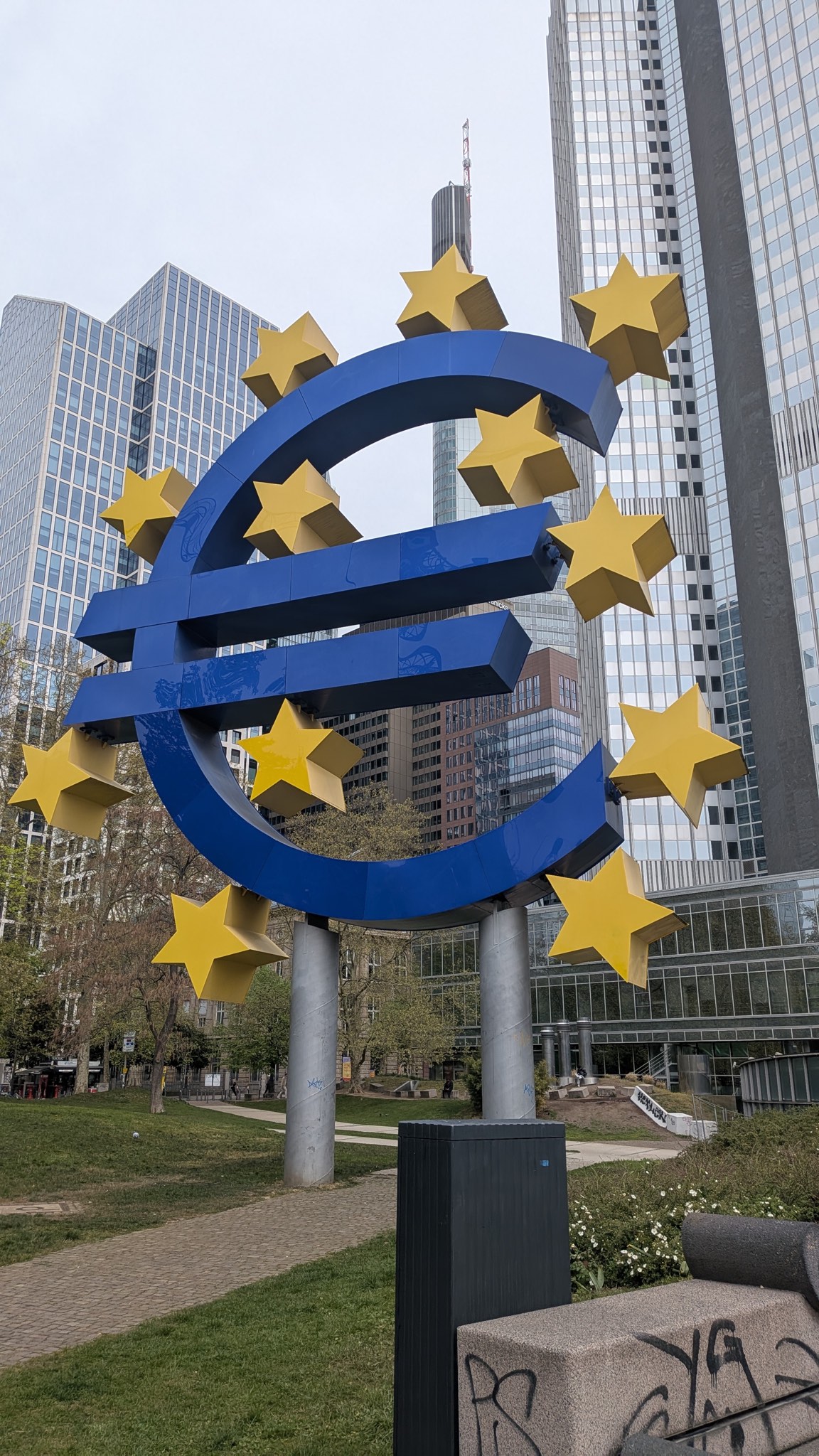
A little further on stands one of Frankfurt's most photographed landmarks: the giant sculpture of the Euro sign, blue and ringed with gold stars, set against a backdrop of glass skyscrapers. This was once positioned right by the European Central Bank's original headquarters, a fitting symbol for the city that effectively bankrolled the currency it represents. Around it sits a genuinely pleasant park, easy walking paths, good weather on the day I visited, and a real sense of calm despite being surrounded by the offices of some of Europe's biggest banks.
The Alte Oper, and a good excuse to close the loop
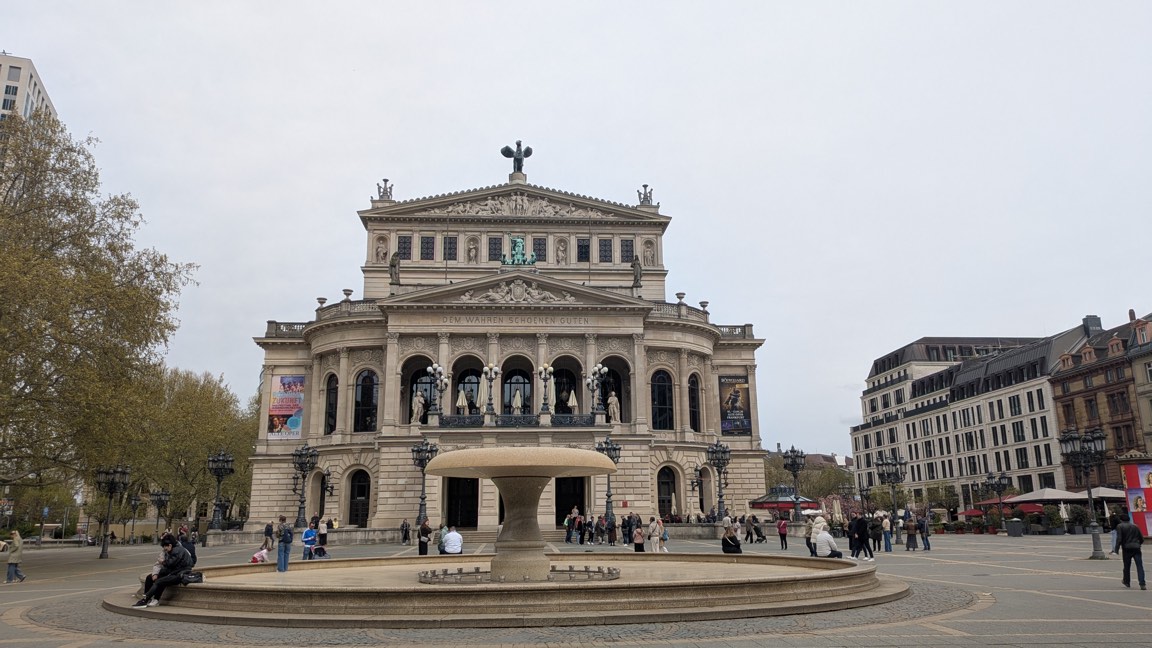
The last stop was the Alte Oper, Frankfurt's grand old opera house, still hosting theatre performances and shows regularly, and genuinely one of the most impressive buildings I've filmed across any of my European videos. In front of it sits a large fountain, unlit while I was there, but I'd guess it puts on a proper show once evening sets in. The circular plaza around it is known simply as Opernplatz, the opera square. If you've followed this channel for a while, you might remember I actually closed out my Budapest video at that city's opera house too, not a planned pattern, just a coincidence I only noticed after the fact.
Making the return flight with time to spare
Past the opera house, the city shifts back into full modern mode: tall buildings on every side, nothing more to really cover on foot. Which, if I'm honest, worked out well, since covering Frankfurt entirely within the layover rather than as a separate dedicated trip meant I didn't need much more time than I had. I'd budgeted four to five hours and ended up spending around three and a half in the city itself, leaving a comfortable two-hour buffer before my connecting flight, exactly the margin you want at an airport as large as Frankfurt's.
Worth the effort, even in a rush
A six-hour layover doesn't sound like much to work with, but Frankfurt's airport-to-city train made it genuinely worthwhile: a cathedral, a perfectly preserved old square sitting beside a modern financial skyline, a landmark bridge, and an opera house, all covered on foot in one loop, with time to spare before boarding again. If your next connection through Frankfurt gives you anything over four hours, it's worth stepping out rather than waiting it out at the gate.
Practical tips for a Frankfurt layover
- Minimum time needed: budget at least 4 to 5 hours total, including the train both ways and a buffer before your next flight.
- Getting into the city: take the train from the airport station rather than a taxi, it's about 15 minutes and far cheaper.
- Tickets: a full-day transport ticket (around 13 euros) is worth it if you'll be making the return trip to the airport the same day.
- Best day to visit: Tuesday, Thursday or Saturday, when Konstablerwache and the Kleinmarkthalle are in full swing; both are much quieter on Sundays.
- Route: cathedral, Romerberg, Kleinmarkthalle, the Eiserner Steg, the Euro sign, and the Alte Oper form a natural walking loop through the centre.