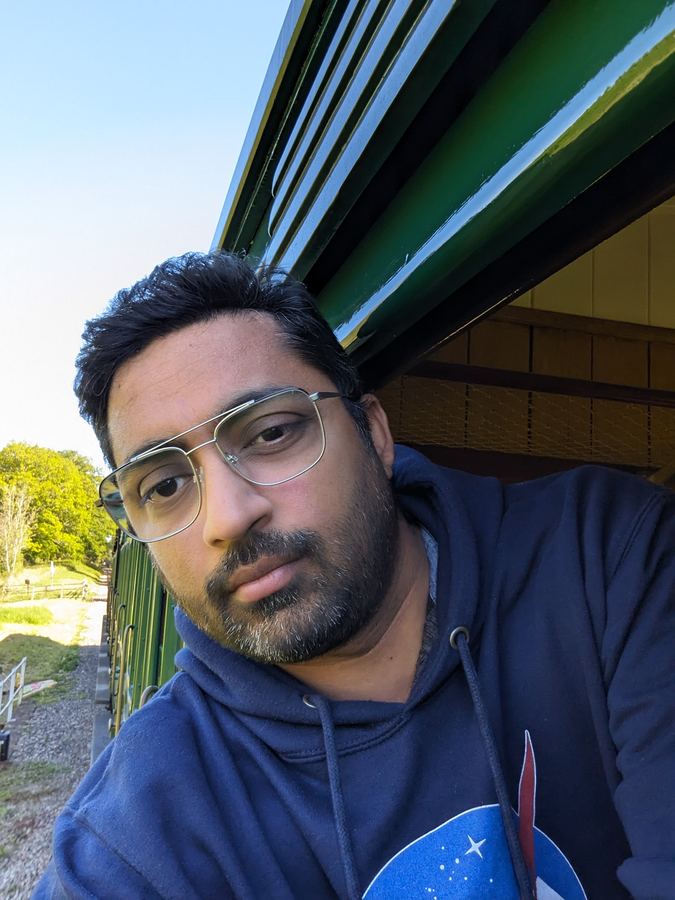
Grenoble, or Grenoble the way locals actually pronounce it (my French accent isn't quite there yet), carries a personal history for me. Thirteen years ago, I came here regularly for about two months on a work project, a week here, a couple of days there. This visit was as much about checking what had changed as it was a normal city tour.
Alps views from the Bastille cable car, Notre-Dame Square, and a search for an old favourite restaurant.
Getting in, and a station I used to know well
Grenoble's airport is small, and from there a shuttle bus into the city is the practical choice over a taxi, which runs close to 100 euros. Shuttle companies vary in price, I paid 14.5 euros for mine against a 20-euro option, worth comparing based on your arrival time. The bus dropped me at Grenoble's main station, a stone's throw from the city centre, and also, as it turned out, a stone's throw from where I used to stay: a service apartment in one of the buildings near the World Trade Center and a cluster of Novotel hotels right by the station, alongside the headquarters of ENGIE, the French gas and electric utility. Grenoble is also a ski gateway, which explained the number of winter travellers still passing through the station even outside peak ski season.
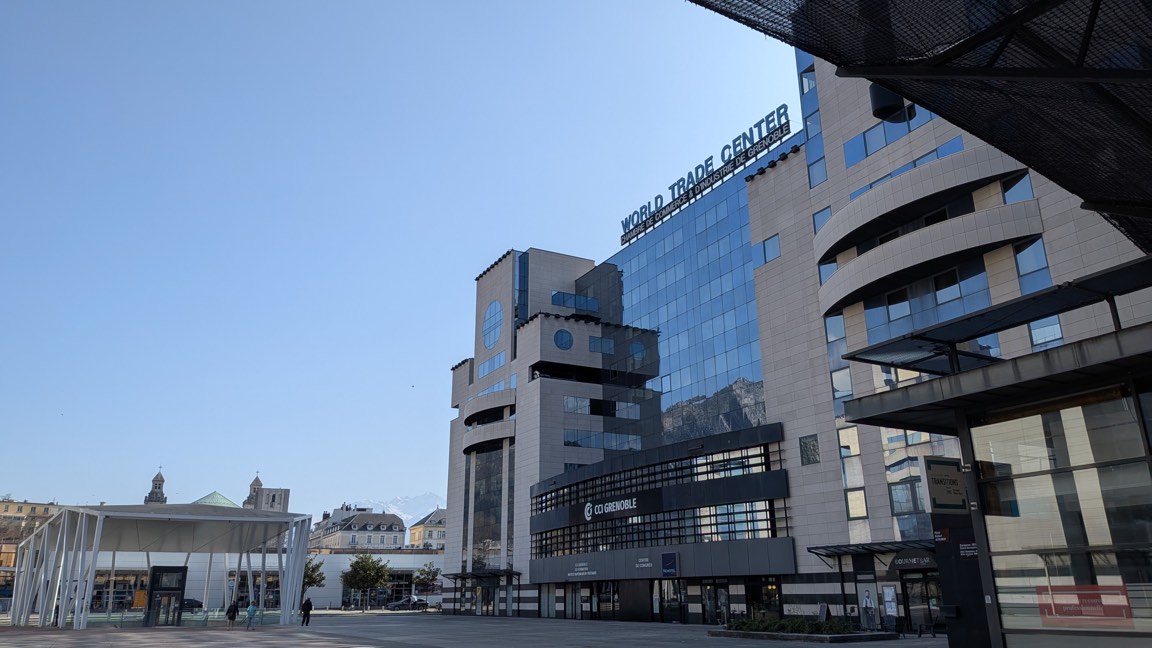
Victor Hugo Square, a familiar lunch spot from years ago
The city centre begins around Victor Hugo Square, named for the French writer, and rebuilt under that name when this part of the city was redeveloped. Thirteen years ago, this was exactly where I'd come to sit during lunch breaks from work, and it hasn't lost that relaxed, restaurant-lined character, especially lively in summer. From here, the city's main shopping stretch begins, including a shop with a name that amused me purely for how it reads in English: "Gandhy."
Grenette Square, and a parliament named after a dolphin
A short walk on is Grenette Square, its name derived from "grenette," meaning grains, since this was historically where grain was traded. No grain trading happens here now, just restaurants, but the name stuck. The building overlooking it still carries the name Parliament of Dauphiné, or sometimes simply the Grenoble Parliament, though it's neither anymore, today it functions more as a government and tourism building. The name traces back to the ruling dynasty of this region, whose coat of arms featured a dolphin, "dauphin" in French, which is also where the French royal title "Dauphin" for the heir apparent originates.
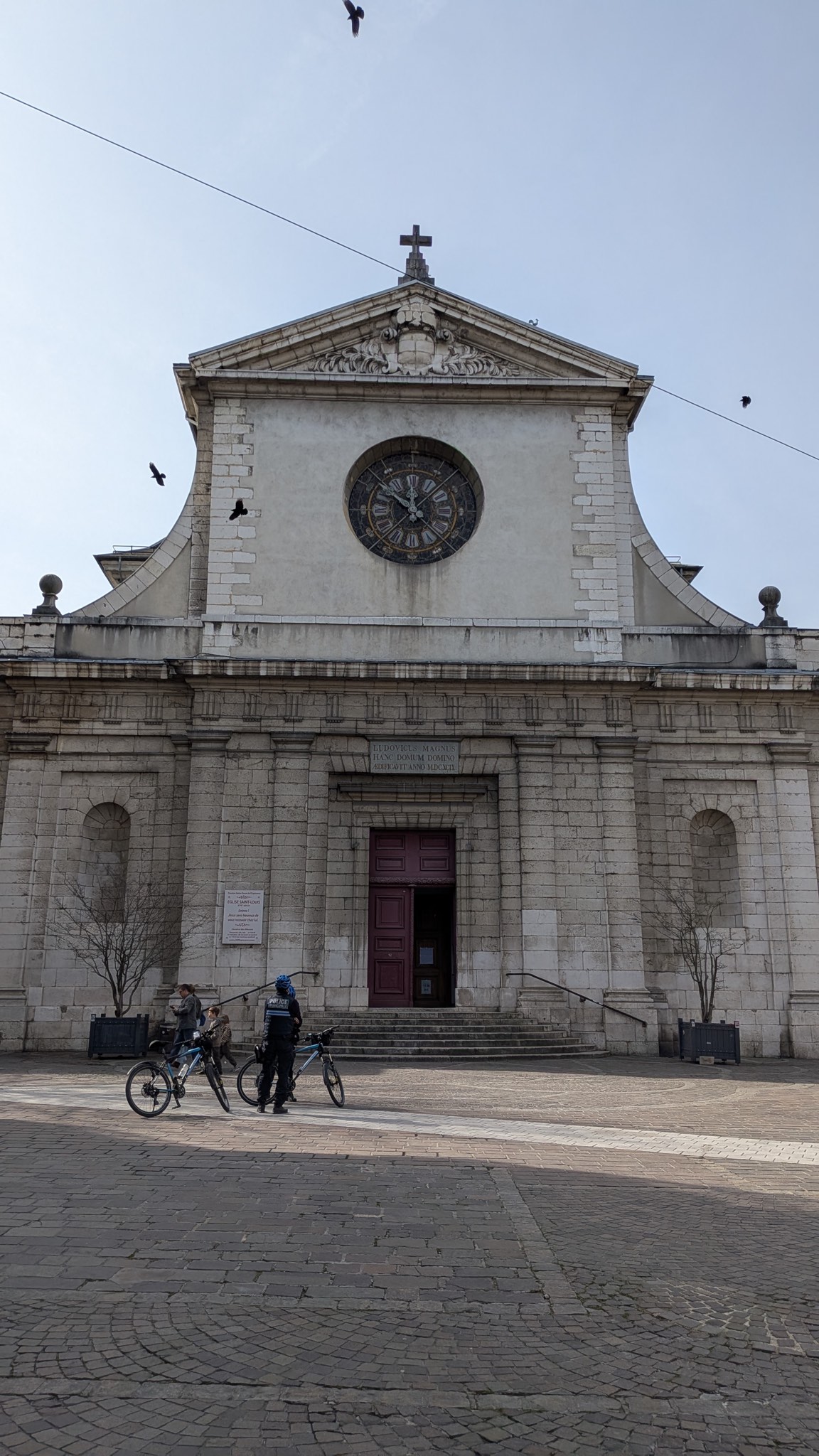
Right nearby, a proper farmers' market was in full swing: meat, dairy, leafy greens, root vegetables, fresh produce, bread, flour, and an entire stall dedicated to different types of honey, all sold directly by the producers themselves. A Grand Théâtre sits tucked into a nearby lane, with what turned out to be a second, separate theatre space right beside it. Just around the corner, the twin bell towers and round clock face of Église Saint-Louis mark another of the old town's church squares, one of several such landmarks that make this part of Grenoble worth wandering slowly rather than rushing through.
Hunting down an old favourite, and finding it gone
Somewhere in the city centre used to sit a restaurant called Pastavia, a place I'd genuinely enjoyed thirteen years ago. Going back to find it, the original location was closed, replaced by something else entirely. A search turned up another branch roughly two miles away, and the tomato pasta there held up: still good, arguably as good as I remembered, with noticeably more vegetarian options on the menu now than the single option available back then.
Notre-Dame Square, and a monument to a protest that sparked a revolution
Notre-Dame Square takes its name from the cathedral standing over it, one of many "Notre-Dame" churches across France (the word simply means "Our Lady," referring to the Virgin Mary), the most famous being the one in Paris. This particular cathedral has a curious history of its own: for a long stretch, most locals didn't even know it was there, hidden until excavations uncovered it, after which the upper sections were rebuilt fresh while portions of the original walls were preserved underneath.
A monument in the square marks something more consequential than the cathedral: on 12 May 1788, the French king dissolved the local parliament, and the protests that followed here became significant enough that they're credited as a spark leading toward the French Revolution itself. A fountain surrounds the monument, not running on the day I visited, but handsome regardless, framed by equally handsome buildings around the square's edges.
A lion, a serpent, and two rivers
Near the river sits a fountain combining a lion and a serpent, representing Grenoble's two waterways: the Isère, the city's main river, and the Drac, a second river I hadn't previously known the name of until translating the inscription on the fountain itself (French signage throughout the city, a phone translator app doing most of the heavy lifting all day). Together, the lion and serpent are meant to symbolise the city itself.
The bridge crossing the Isère nearby is the oldest surviving bridge on the river, pedestrian-only, and a proper hanging bridge, supported entirely by iron cables from each end rather than any central pillars.
A garden with mountain views, a giant chessboard and a working sundial
A museum near the river includes its own garden, and the view from up there was the first real hint of what was coming: the Alps, visible even from this modest elevation, with deck chairs laid out specifically so visitors could lie back and take in the view properly. The garden itself had its own surprises: a full-sized outdoor chessboard, sixty-four squares, tall enough pieces to actually play a proper game (my opening move, by my own admission, was not a good one), an abstract tree-shaped art installation, and a sundial that, checked against the actual time, was telling it correctly to the minute.
The 1934 cable car, and views over the whole Alps range
From the garden, a fortress visible on the hill above marks the next stop, reachable on foot, but far faster by cable car. Grenoble's cable car has genuine history: it opened in 1934, running wooden cabins originally, with the modern bubble-style cars, "les bulles" as locals call them, introduced in 1976. Riding up, the bridge crossed earlier comes into view below, along with a growing view of the entire city and the river's bends catching the sunlight.
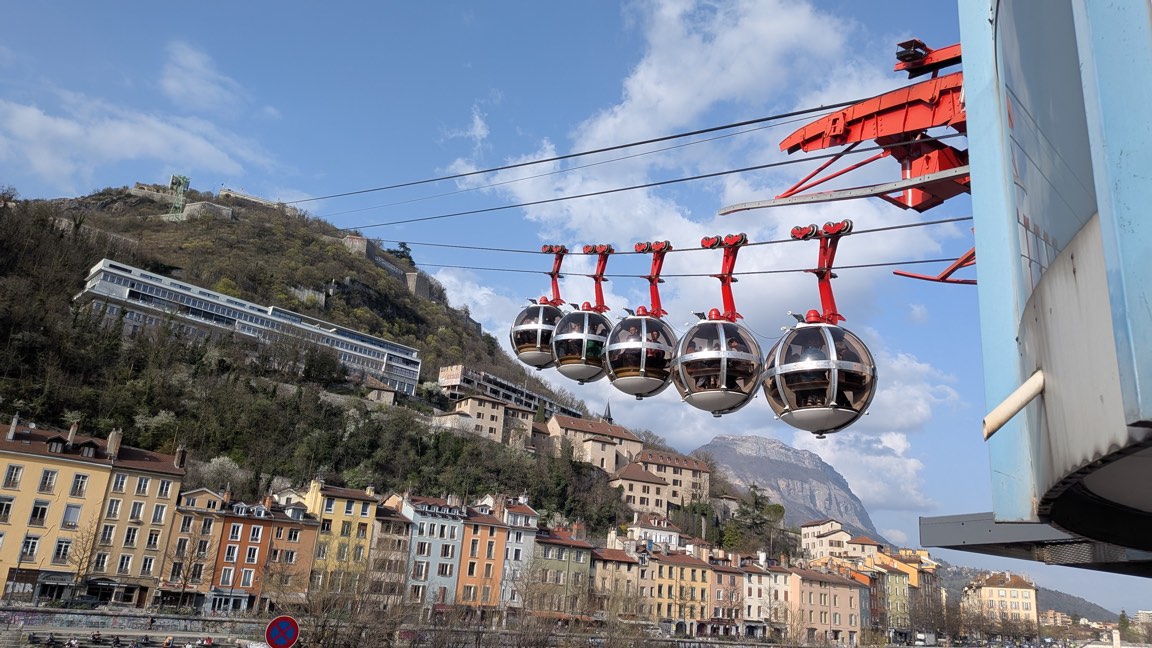
From the top, on a clearer day than the light haze I got, Grenoble spreads out in full, smaller than I'd expected walking through it at street level, but genuinely substantial from above. Multiple distinct mountain ranges are visible from up here, which is exactly why Grenoble is sometimes called the "capital of the Alps," despite having no official status as one: the Alps surround the city on three sides. The range itself touches somewhere around seven or eight countries, France, Italy, Switzerland, Germany, Slovenia, Liechtenstein and Monaco among them, straddling the French-Italian border most prominently from this vantage point. Ski destinations sit further up in the higher reaches of these same mountains, worth a dedicated winter trip on its own.
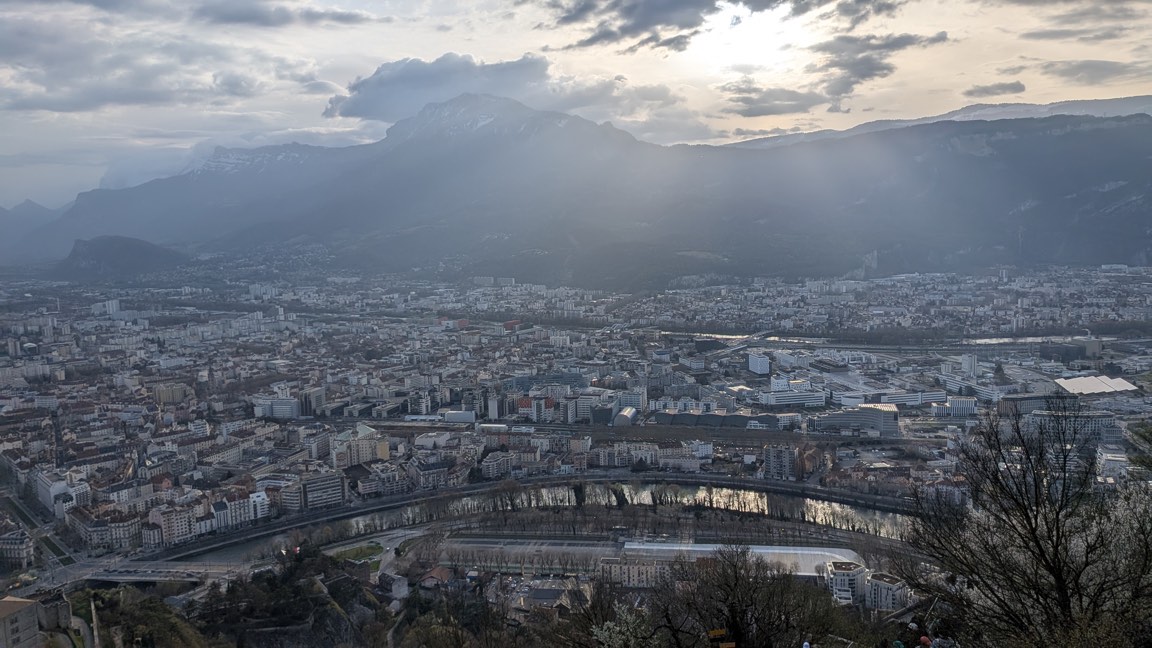
One genuinely interesting fact tied to this cable car and its mountains: Grenoble hosted the 10th Winter Olympics in 1968. A single Indian competitor took part that year, Jeremy Bujakowski, born in India to a diplomat's family and a naturalised Indian citizen, believed to have been the sole participant representing India at that Games.
A student city calling itself Europe's Silicon Valley
The next morning was set aside for a different side of Grenoble entirely: its identity as a major student and technology hub. Grenoble Business School, one of France's top-ranked business schools, and Grenoble INP (a leading technology institute covering engineering postgraduate and undergraduate study) both draw large numbers of international students, Indian students very much included, many pursuing MBA-equivalent or engineering programmes.
Walking through the surrounding technology park by tram gave a real sense of scale: the building where I'd actually worked thirteen years ago, part of the Schneider Electric campus, along with France's national Atomic Energy Commission (CEA), which researches atomic energy, renewable energy and military applications under government funding, an HP research centre, and Minatec, a government-funded micro and nanotechnology research institute. A campus building for Grenoble INP, apparently focused on physics and electronics under the name Phelma, plus visible student residences with their own mountain views, rounded out the walk. It's easy to see why this area has earned its "Silicon Valley of Europe" reputation, this concentration of research institutions and technology companies in one compact district isn't something I'd seen at this density anywhere else on this trip.
I'd hoped to speak with a student or two about what studying or working here is actually like, but a tight schedule and a flight just a couple of hours out ruled that out this time. If you've studied or worked in Grenoble's tech or research scene, I'd genuinely like to hear about it, and I suspect other viewers considering the same path would too.
Dinner, the second time around
Dinner turned into its own small saga. Thirteen years ago, a restaurant called Punjabi Dhaba was, by some distance, the best Indian food I'd had in the city. It's since become something called New India, and on this visit, that too was closed. A second option, a restaurant called Bombay, turned me away without a table, in exactly the same brusque manner I remembered from thirteen years earlier, apparently some things really don't change. A Mexican restaurant nearby ended up filling the gap instead: quesadillas and a drink for around 11 euros, genuinely spicy but manageable, with a solid range of vegetarian and vegan options on the menu, including several vegetarian burrito and quesadilla choices, cheaper and, if I'm honest, probably the healthier option compared to where I'd originally set out to eat.
Why the costs, on screen, all trip
Viewers of a recent collaboration with fellow Telugu traveller Sagar, covering how to see London on a set budget, asked whether the same kind of cost breakdown could work for trips abroad, not just single cities. This trip has been an attempt at exactly that: tracking real day-to-day costs, shown on screen throughout, as a general reference point for what a similar one or two day city stop might run, understanding costs vary a fair amount from place to place. My room for this stop, a small studio apartment with a bed, table and chair plus a simple breakfast (cake, fruit, tea and coffee facilities), came to 29 euros for the night.
Practical tips for Grenoble
- Getting in: the airport shuttle bus is far cheaper than a taxi, compare operators for the best price and timing.
- The cable car: ride it for the Alps views alone, and go on a clear day if you can, haze can dull the mountain ranges.
- City centre: Victor Hugo Square, Grenette Square and Notre-Dame Square make a natural walking loop through the old town.
- Tech and research district: worth a walk if you're interested in Grenoble's student and research culture, reachable by tram from the centre.
- Dining: restaurant names and locations change fast here, don't count on a spot from years past still being open.