
Plovdiv is Bulgaria's second-largest city, and at first glance it looks like a fairly ordinary modern European centre. Spend a day actually walking it and that impression falls apart fast: there's a Roman stadium sunk beneath the main shopping street, an ancient theatre still hosting concerts, and locals who insist, with a straight face, that this is the oldest continuously inhabited city in Europe, built across seven hills. I went in with two questions to answer: is any of that actually true, and where exactly are these seven hills?
The full day: the walled Old Town, layers of Roman and Ottoman history, the Ancient Theatre, Kapana, and the hill that answers both opening questions.
Sleeping inside a wall: the Old Town's one gate
I stayed inside the Old Town itself, in a guesthouse built in 1880 that's now a hostel, complete with a welcome sign written out with my name on it at check-in. The Old Town is fully walled, and there's only a single gate in and out, a detail that says a lot about how seriously this part of the city still guards its own boundary. Walk through that gate and the architecture shifts immediately into the Ottoman period style that defines the neighbourhood, houses with overhanging upper floors and timber framing, three flags flying together outside the grandest of them, Bulgaria, the EU, and Plovdiv's own. Two of these houses, the wealthiest ones from that era, are still known today as the Hindliyan House and the Balabanov House.
Layers of civilisation, stacked in plain sight
Locals call this the city's "layers of civilisation," and it's not a metaphor, it's visible in the actual masonry. Look down at the base of several Old Town buildings and you can see Roman-period stone at the foundation, Ottoman-period construction built directly on top of it, and modern repairs layered over that, one era stacked on the next in a single wall. Tucked into this same stretch is a hidden church, deliberately walled in from the outside during Ottoman rule so it wouldn't be visible from the street, the same defensive architecture I'd already seen used for churches in Sofia. Inside, it's an active Orthodox church, serving a population that remains overwhelmingly Orthodox Christian to this day.
A street full of museums, a statue, and a coincidence
The Old Town's cobblestone streets are kept deliberately rough underfoot, a conscious choice to preserve the historic feel rather than smooth them over for comfort. The whole street is lined with museums, including a Museum of Knights (closed the day I visited, frustratingly the free-entry day had been the day before) and an Ethnographic Museum dedicated to preserving older Bulgarian civilisations and cultures. Along the way stands a statue of Saint Cyril, the figure the Cyrillic alphabet is named after, and by complete coincidence I'd landed on the actual Cyrillic Alphabet Day holiday, the same one I'd stumbled into a year earlier on a Sofia trip. It also happened to be graduation and prom day for the city's school leavers, so the streets carried an extra, unplanned buzz.
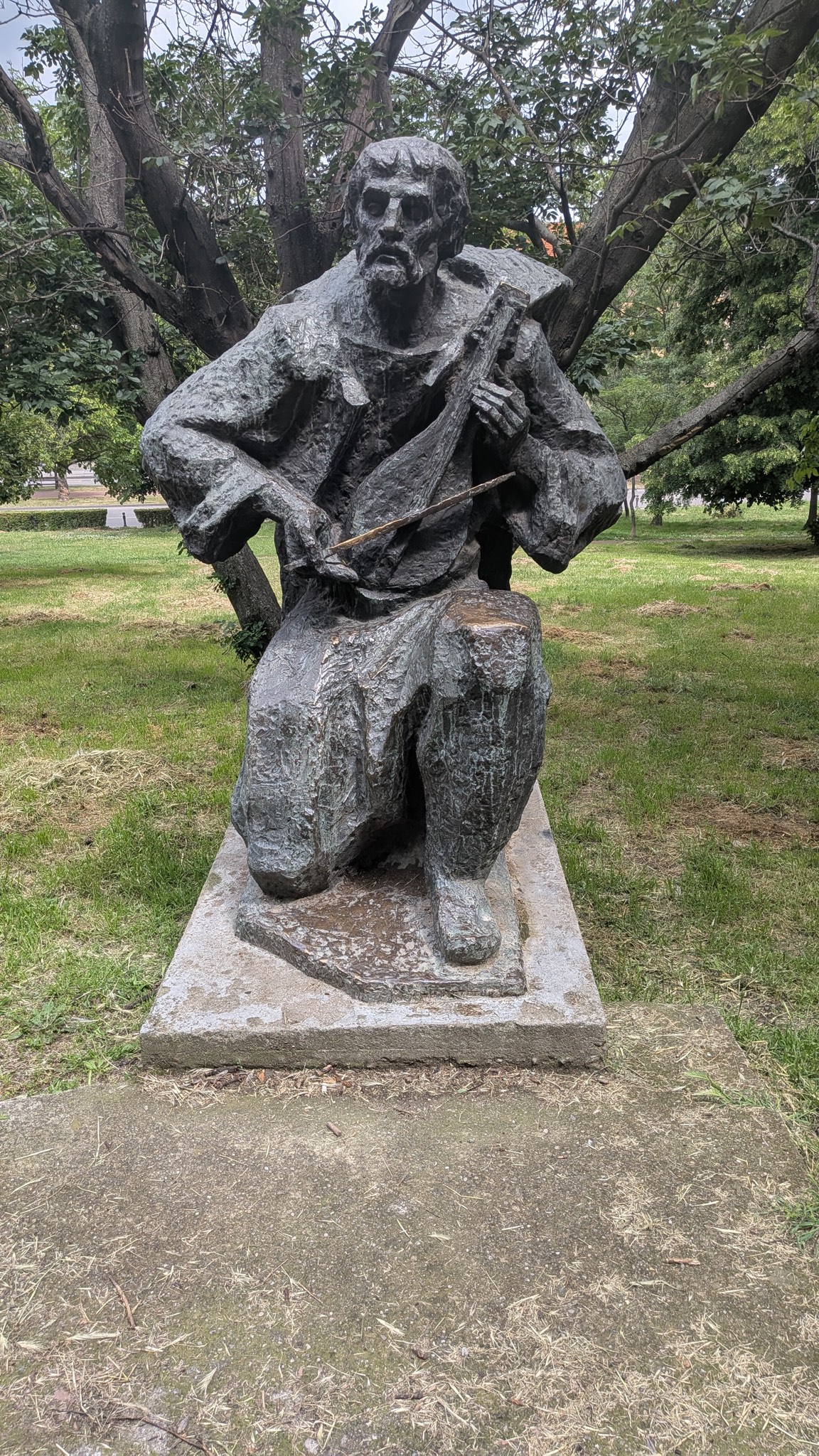
Near the academy of music itself sits this bronze sculpture, one of several art installations scattered through the Old Town, and further along stands another Orthodox church known specifically for its bell tower, built in 1880 and considered one of the most photogenic in the city. Everything up to this point, the walls, the gate, the layered stone, dates roughly from the 1500s onward, the Ottoman-period Old Town proper.
Into the New Town: a square, a fountain, and Roman ruins that never stopped
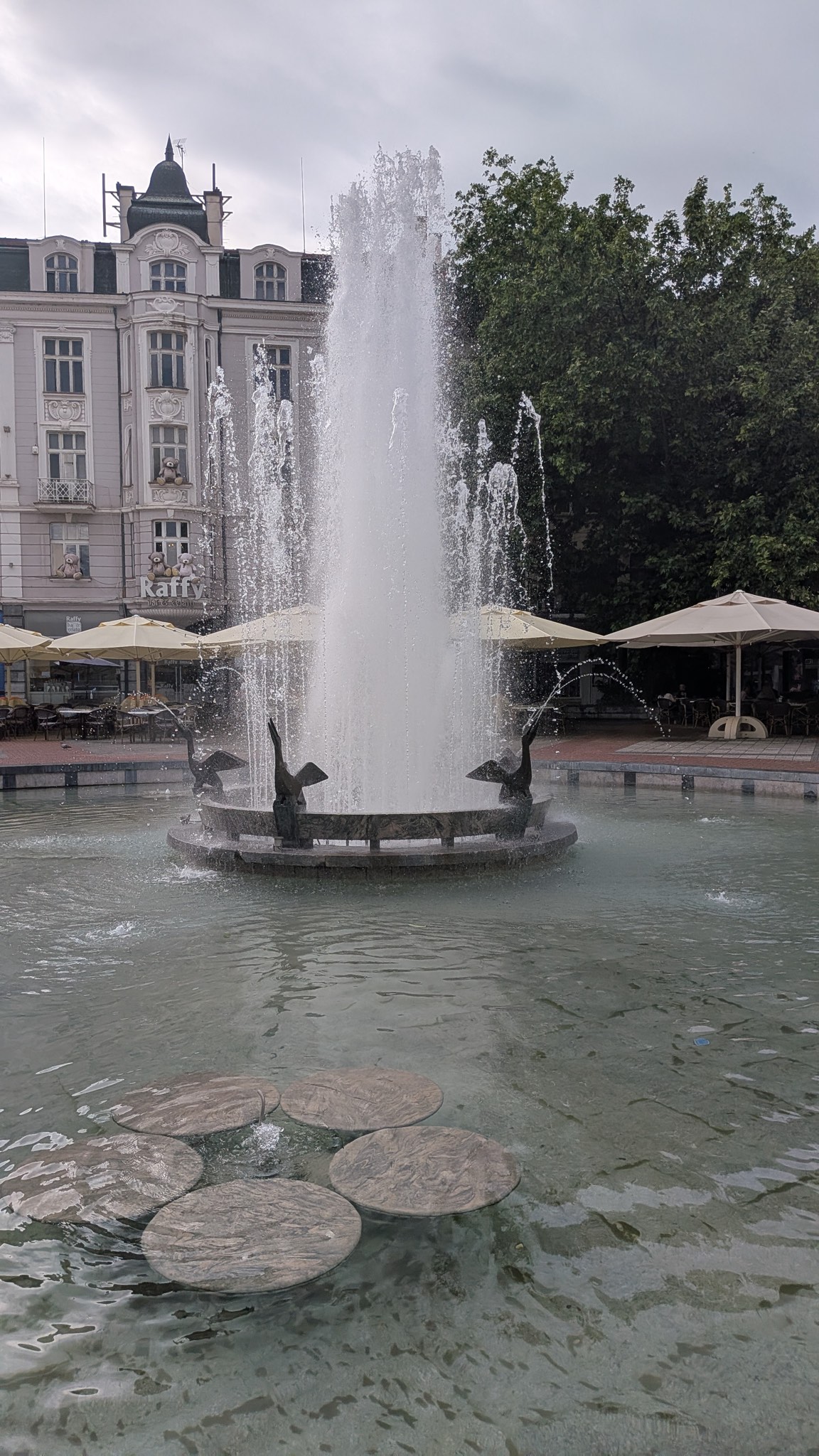
Past the Old Town's boundary is what locals call the New Town, centred on a large open square with a grand fountain and, a little further along, a sizeable casino. "New" here is relative. Right where the main pedestrian walking street begins, Byzantine and Roman ruins sit in the open, a stretch locals call Glavnata, running past a preserved Roman Forum and a small Roman theatre known as the Odeon. Even the city's municipality building, the modern seat of local government, stands surrounded by the same Roman-era ruins, "new" only in comparison to everything underneath it.
Street life, a dancing skeleton, and a statue you whisper to
By afternoon the walking street was genuinely lively, in sharp contrast to how empty the Old Town had felt first thing that morning. A street performer had a life-size skeleton puppet dancing along to "Smooth Criminal" for a crowd of delighted kids, and prom-ready teenagers rode past on balloon-decorated cars and bikes for their graduation photoshoots, a whole mini-tradition happening in real time around us.
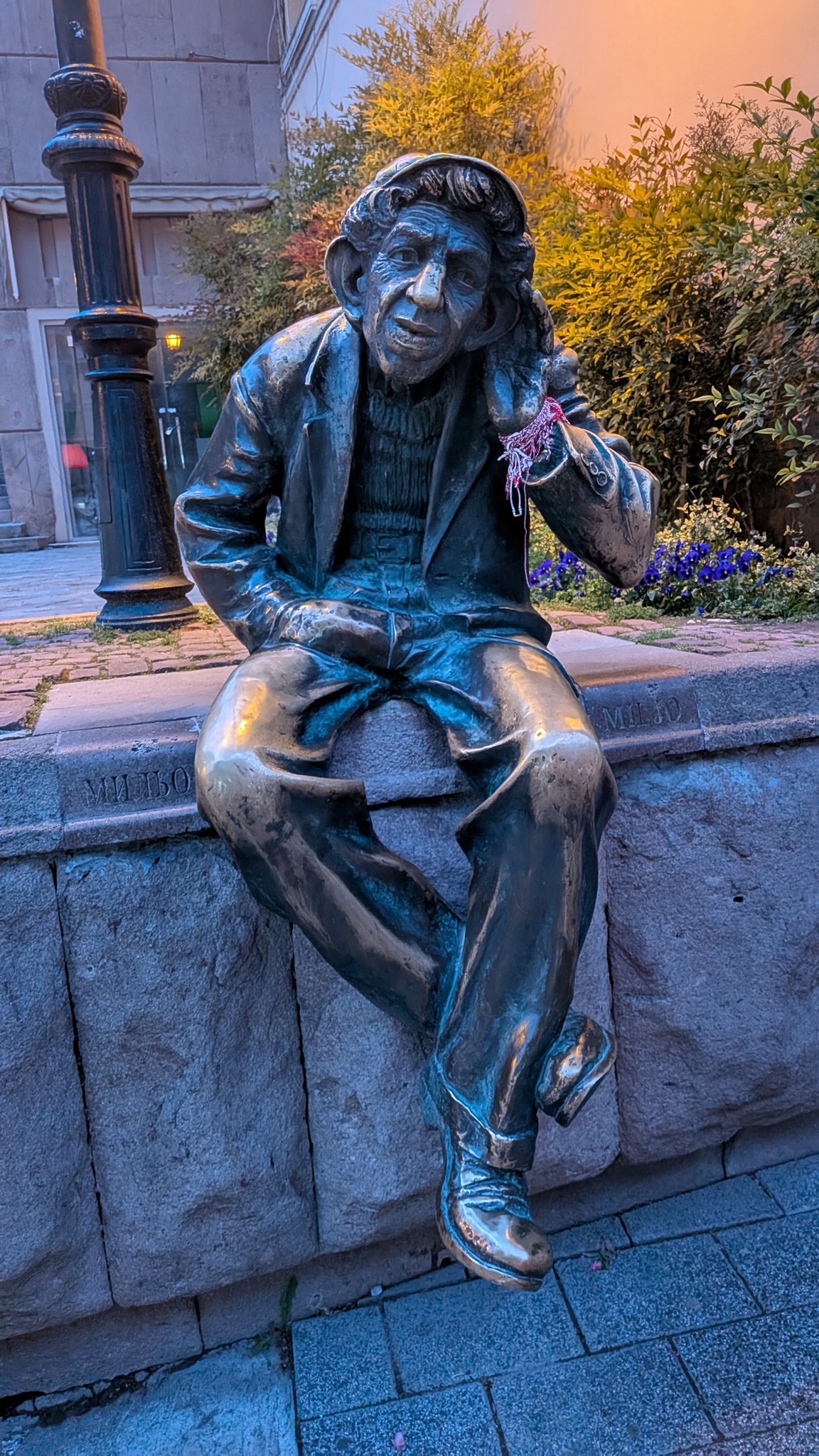
Further down the street sits Milyo, a bronze statue of a local character from the city's past, his hand and legs worn bright by decades of visitors touching them. The tradition: whisper a secret wish directly into his ear, and it's said to come true, as long as you never say it out loud to anyone else afterward.
The Roman Stadium, discovered by accident
Following the walking street further leads to the end of an enormous Roman Stadium, roughly a quarter of a kilometre long, once host to gladiator fights and now, on occasion, real concerts again. What's visible today is only one curved end of it; the rest still runs directly beneath the modern buildings and shops lining the street above, and since excavating further would mean tearing into the current city, nobody has. The whole thing was found completely by accident in the 1960s, when a resident digging under their own house broke into an underground structure that turned out to be part of the buried stadium, which archaeologists then took over and partially uncovered. A scale model on site shows just how much larger the complete stadium originally was.
The Ancient Theatre of Philippopolis
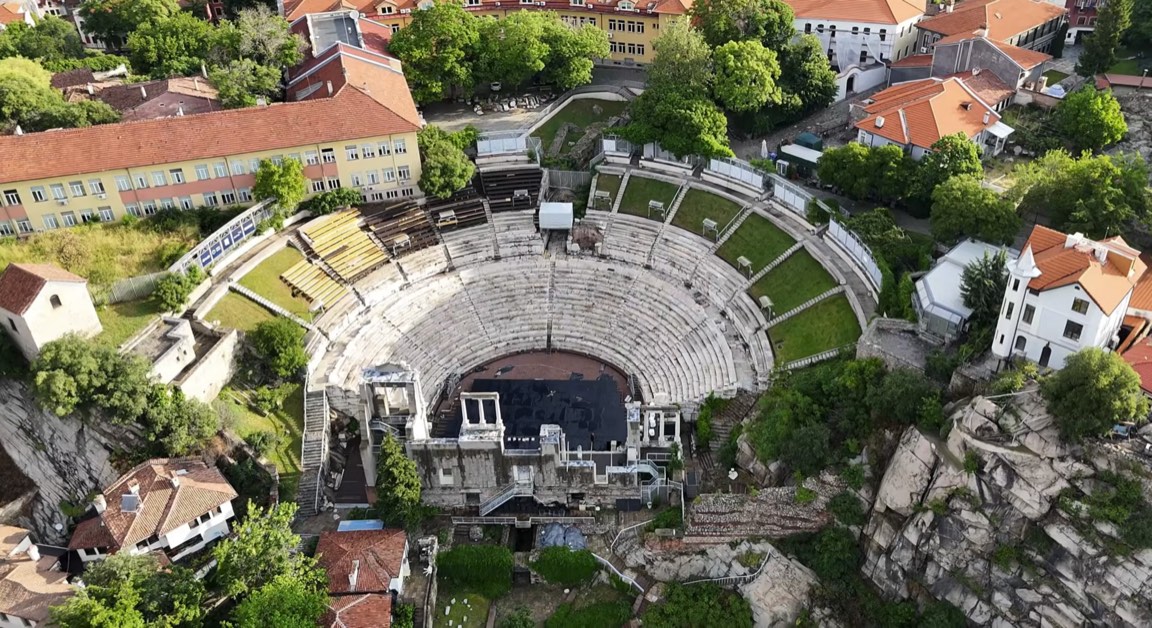
Plovdiv's Roman name was Philippopolis, and its Ancient Theatre, built by the Romans sometime between 98 and 117 AD, still carries that name. Like the stadium, it was rediscovered only in the 1960s after centuries buried, and it's since been restored enough to genuinely host events again, summer concerts and, fittingly, occasional gladiator-fight reenactments to open the season. Seeing it from above by drone, a near-complete stone semicircle cut into the hillside with the Old Town's red rooftops packed in around it, made it obvious why this one site alone is worth the trip to Plovdiv.
Lunch in Kapana, the creative quarter
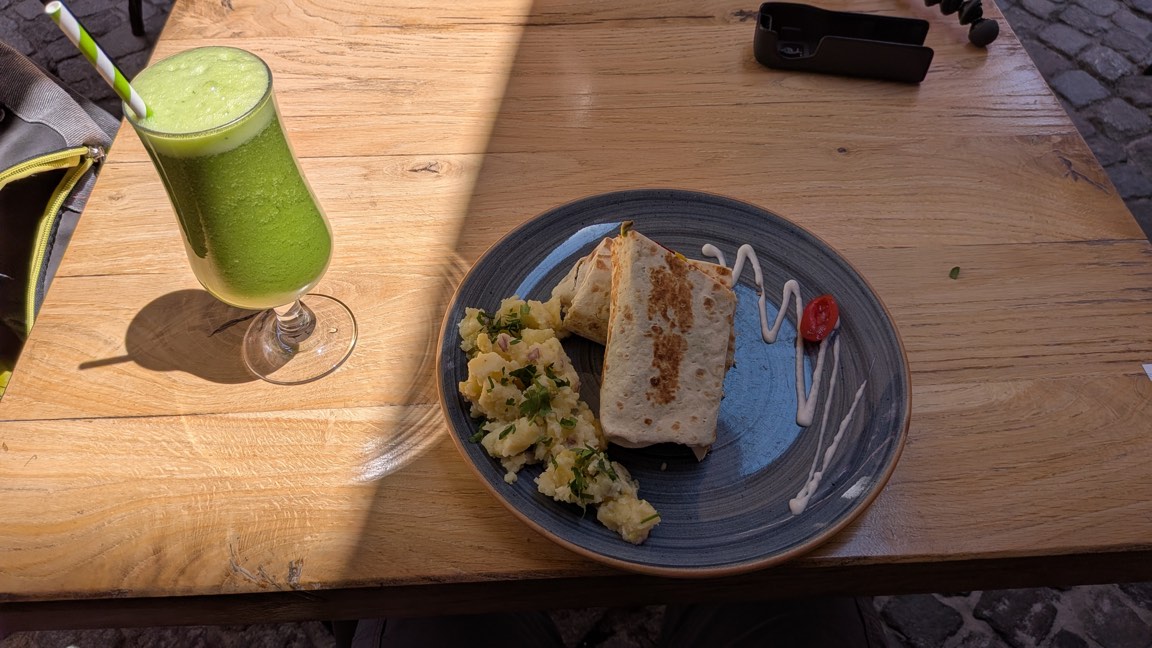
For lunch I headed to Kapana, Plovdiv's old Ottoman-era trading quarter, now reinvented as the city's creative district, narrow lanes packed with restaurants where nearly everyone eats outdoors regardless of how hot the sun gets. I landed at a fully vegan restaurant tucked into one of these lanes and ordered a bean burrito with a side of potato, paired with a green detox smoothie, ginger, lime, cucumber and spinach. It looked a little unusual going in, but easily one of the better burritos I've had recently.
The area around Kapana is also where Plovdiv's graffiti lives, and unlike most cities where street art is technically illegal and painted over on sight, Plovdiv regulates it deliberately, restricting it to approved top-tier artists only. The result is that the graffiti here reads as genuine public art rather than vandalism. Hookah bars are everywhere in this part of town too, a direct carryover from centuries of Ottoman influence, each one with its own long menu of flavours.
Bunardzhik Hill and the Alyosha Monument
Climbing one of the city's hills, Bunardzhik Hill, brings you face to face with the Alyosha Monument, a towering Soviet-built statue of a soldier that dominates Plovdiv's skyline from almost anywhere in the city. It was unveiled in November 1957, designed by architect Vasil Radoslavov, and named after Alyosha Skurlatov, the real Soviet soldier it's modelled on. It's also genuinely contested: the Soviet framing calls it a symbol of liberation from Nazi Germany, but plenty of Bulgarians describe that same arrival as an occupation, not a liberation, and there have been ongoing calls and protests to have it removed entirely. For now it still stands, largely, from what I could tell, because so many people find it simply too striking a landmark to tear down.
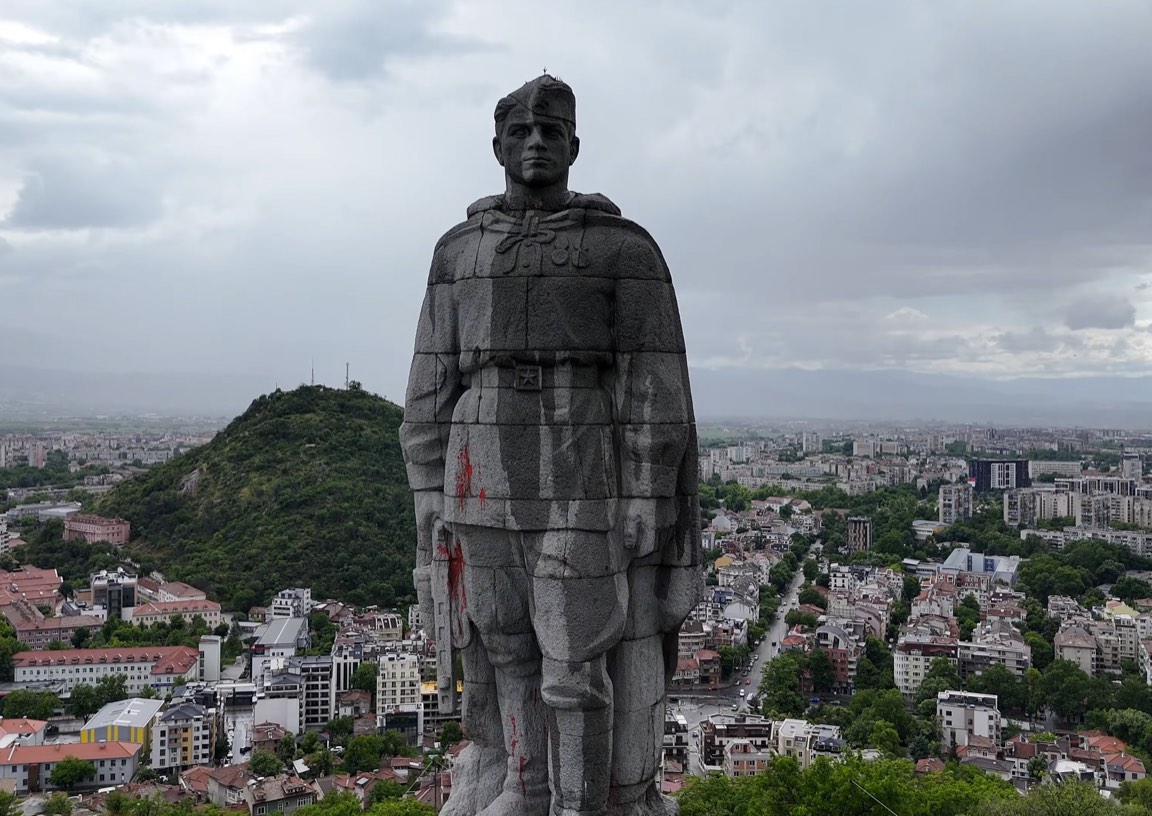
This is also where the day's weather caught up with me. The forecast had promised light rain, so I'd skipped a raincoat entirely, and ended up completely soaked while flying the drone, exactly what happened on my Sofia trip a year earlier. Thankfully the drone itself survived the dousing, and the sun was back out within the hour.
A quiet night, and the walking street after dark
I went back out that evening hoping the walking street would come alive after dark the way Ljubljana's had on an earlier trip, but most shops had already closed for the night. The one exception was the area right around Milyo's statue, still drawing a steady trickle of people, and somewhere nearby a jazz band was playing live in the square. Storm clouds rolled back in not long after, and with no umbrella this time either, that was the cue to head back to the hostel for the night.
Nebet Tepe: where both questions finally get answered
The next morning I climbed Nebet Tepe, a hill overlooking the whole city, specifically to settle the two questions from the start of the trip. Archaeological evidence found on this exact hill confirms continuous human habitation going back to roughly 6000 BC, around 8,000 years of people living on this spot without a gap. That's the real, more precise claim: not the single oldest city in the world outright, since older sites do exist, but the oldest continuously inhabited city in Europe, since those other ancient sites all went through long stretches with no one living there at all.
From the same hilltop, the seven-hills claim also resolves itself. Three hills are visible directly from Nebet Tepe, two more sit just behind the largest of them, and Nebet Tepe itself makes six. The seventh was completely quarried away at some point, its stone used to pave the city's own roads and pavements, which means locals genuinely do walk across the seventh hill every day, they just do it at street level without realising it.
So, is it true?
Both claims check out, with an asterisk. Plovdiv is the oldest continuously inhabited city in Europe, not the single oldest settlement anywhere. And the seven hills are real, six still standing and one dissolved into the streets you're walking on, a very literal way for a city to carry its own history right under your feet.
Practical tips for Plovdiv
- Stay in the Old Town: a guesthouse behind the single gate puts you inside the most atmospheric part of the city for the evening and early morning, before the day-trip crowds arrive.
- Museum days: some museums run periodic free-entry days, check ahead so you don't arrive a day late like I did.
- Kapana for food: the old trading quarter has the widest spread of restaurants, including solid vegan and vegetarian options.
- Nebet Tepe: go early and go last, it's the best spot to actually understand the city's layout and its seven-hills claim.
- Weather: pack a raincoat regardless of the forecast, Plovdiv and Sofia both delivered unexpected downpours on my visits.
I came in half expecting a fairly average modern Bulgarian city and left having watched a stadium and a theatre resurface after centuries underground, walked across a hill that no longer technically exists, and gotten a straight, evidence-backed answer to a claim most cities would just leave as tourist-brochure spin. Plovdiv earned the title.