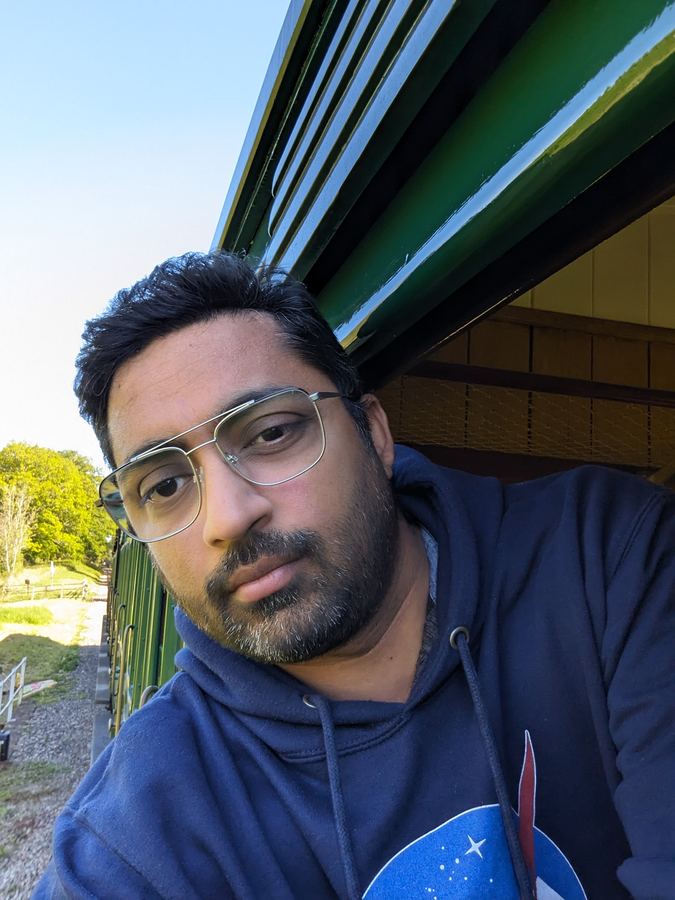
Some days you plan loosely and let the road decide. This wasn't one of them, this was a full-day group tour booked specifically to cover four of Armenia's biggest sights in a single, tightly-packed itinerary: a cave monastery, a volcanic rock formation, a 1,900-year-old temple, and a lake so large it feels like a sea. It mostly went to plan. Then the fog rolled in over Lake Sevan, and it very much didn't.
The full day: Geghard Monastery, the Symphony of Stones, Garni Temple, lavash and lunch, Lake Sevan's panic-mode boat ride, and a rushed stop in Old Dilijan.
Booking a group tour instead of going it alone
Most of my travel days are solo and self-paced, but Armenia's countryside sights are spread out enough, and the roads winding enough, that a full-day group tour made more sense than renting a car and navigating it myself. It also meant company: fellow travellers from China and Cyprus, a shared van, and a driver who knew exactly how much time each stop actually needed. That last part would matter a lot more than I expected by the end of the day.
Our guide for the day was Tatiana, and she was genuinely excellent, sharp on the history at every stop, patient with a van full of questions, and calm in exactly the way you want a guide to be once the Lake Sevan boat ride stopped going to plan. This is the exact tour I booked, if you want to do the same route with Tatiana or another guide from the same operator.
Geghard Monastery: a church carved into the mountain
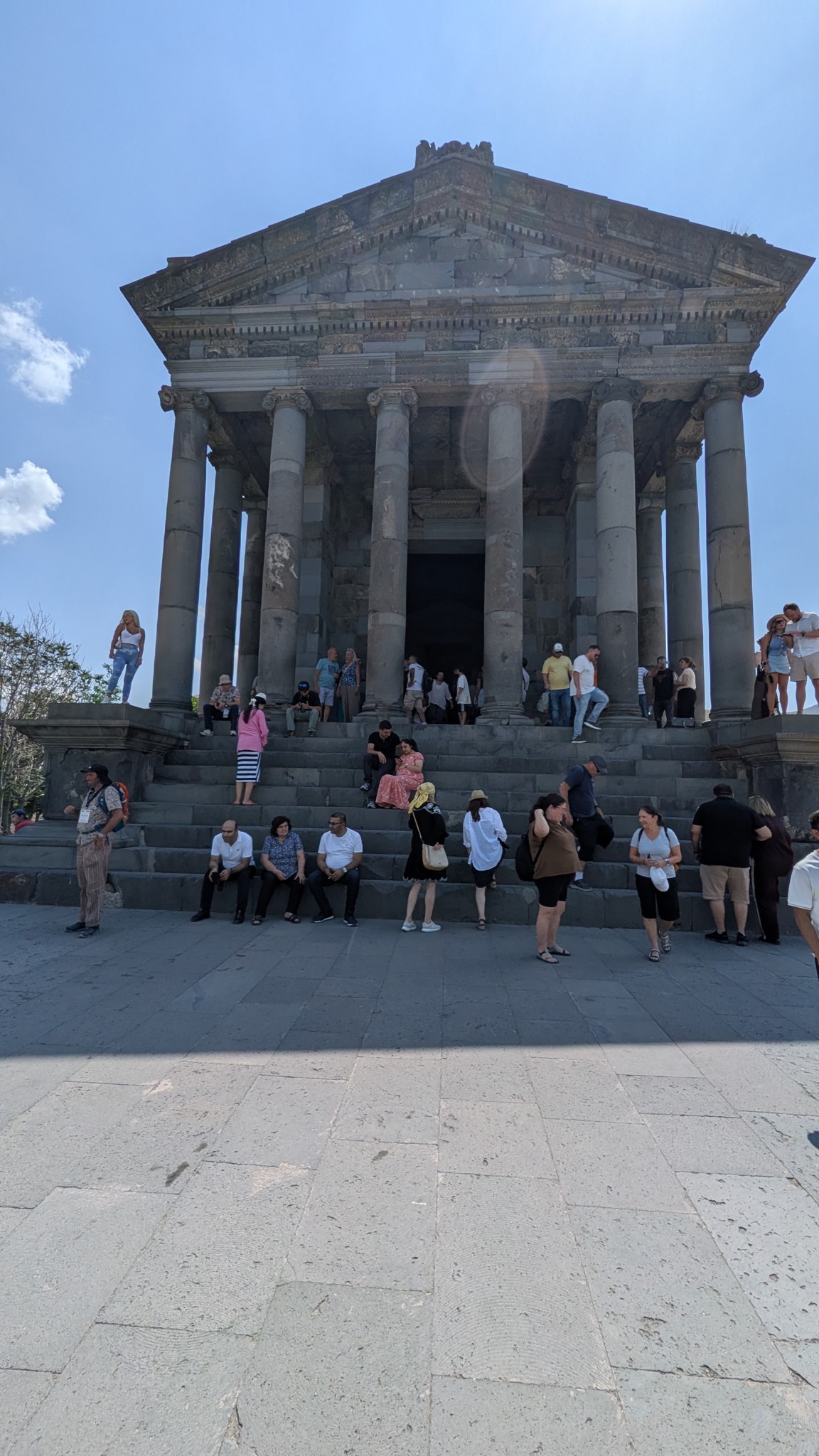
Geghard Monastery was the first stop, and it doesn't look like much from a distance, just a stone roofline against a wall of raw cliff. Walk closer and it becomes obvious why it's a UNESCO World Heritage Site: large sections of the complex aren't built against the mountain, they're carved directly out of it. Chapels, chambers and corridors hollowed straight from solid rock, some of them accessible only through narrow passageways that open unexpectedly into full vaulted rooms.
Inside the main church, a natural spring still runs through the rock, and it's considered holy, visitors cup their hands under it the way you would at a temple tank back home. Standing inside a chamber that's literally part of the mountain, with sunlight only reaching in through a single carved oculus overhead, is a completely different feeling from visiting a monastery built the conventional way. Outside, the rugged, jagged peaks surrounding the complex frame it perfectly, Geghard doesn't just sit in the mountains, it's part of them.
The Symphony of Stones: lava's version of a church organ
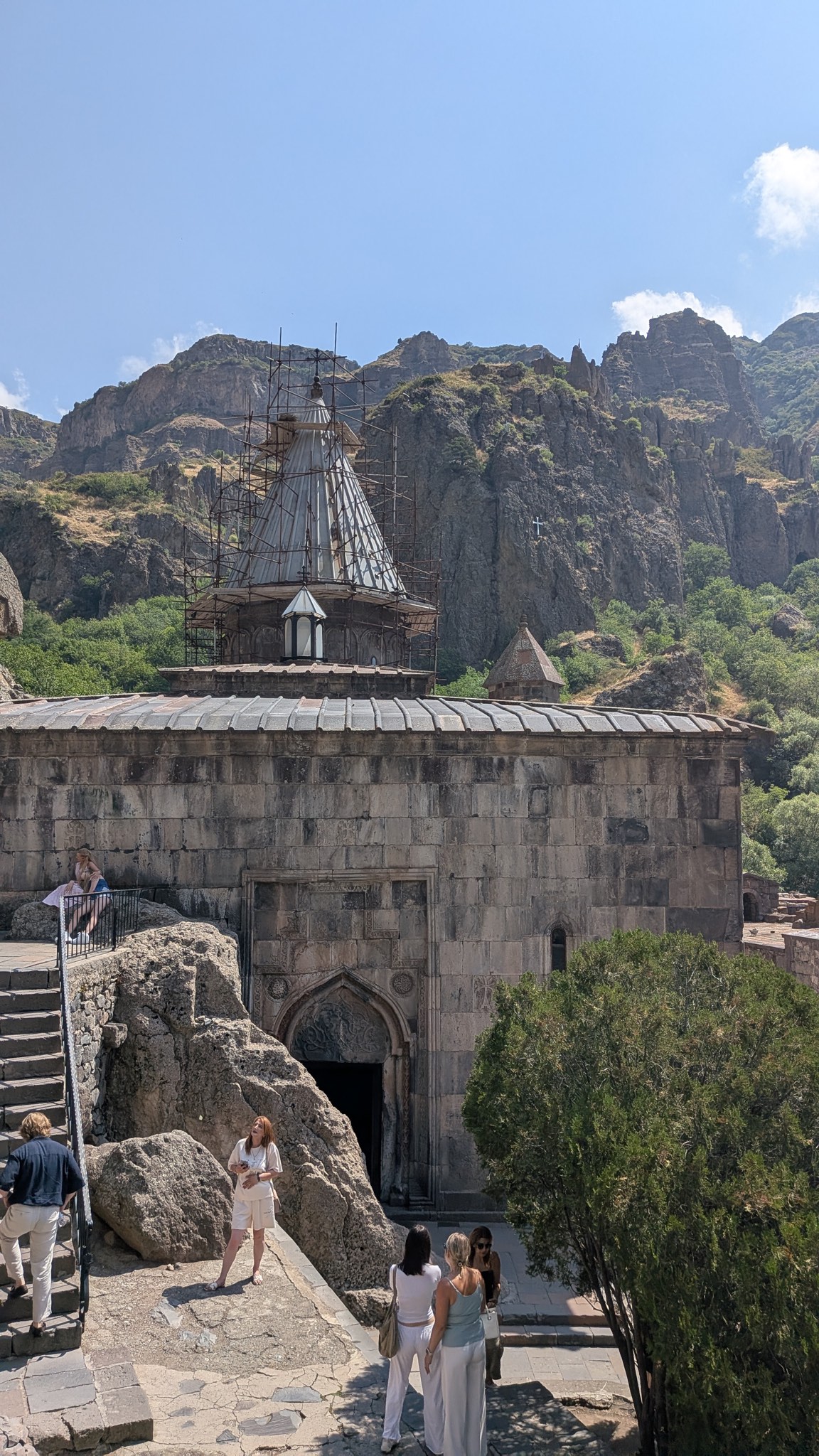
A short drive away is Garni Gorge, and inside it, one of the strangest natural formations I've seen anywhere: the Symphony of Stones, also called the Basalt Organ. Walking alongside the Azat River, the gorge walls suddenly rise into tightly packed, hexagonal basalt columns, dense, vertical rock pipes that genuinely resemble the pipes of a church organ, or a symphony hall's wall panelling turned to stone. It's not a carved monument; it's geology. Millions of years ago, slow-cooling volcanic lava cracked into these uniform columns as it solidified, and the river gorge later exposed the formation for anyone willing to walk down and look up at it.
Garni Temple: the only Greco-Roman temple in the former USSR
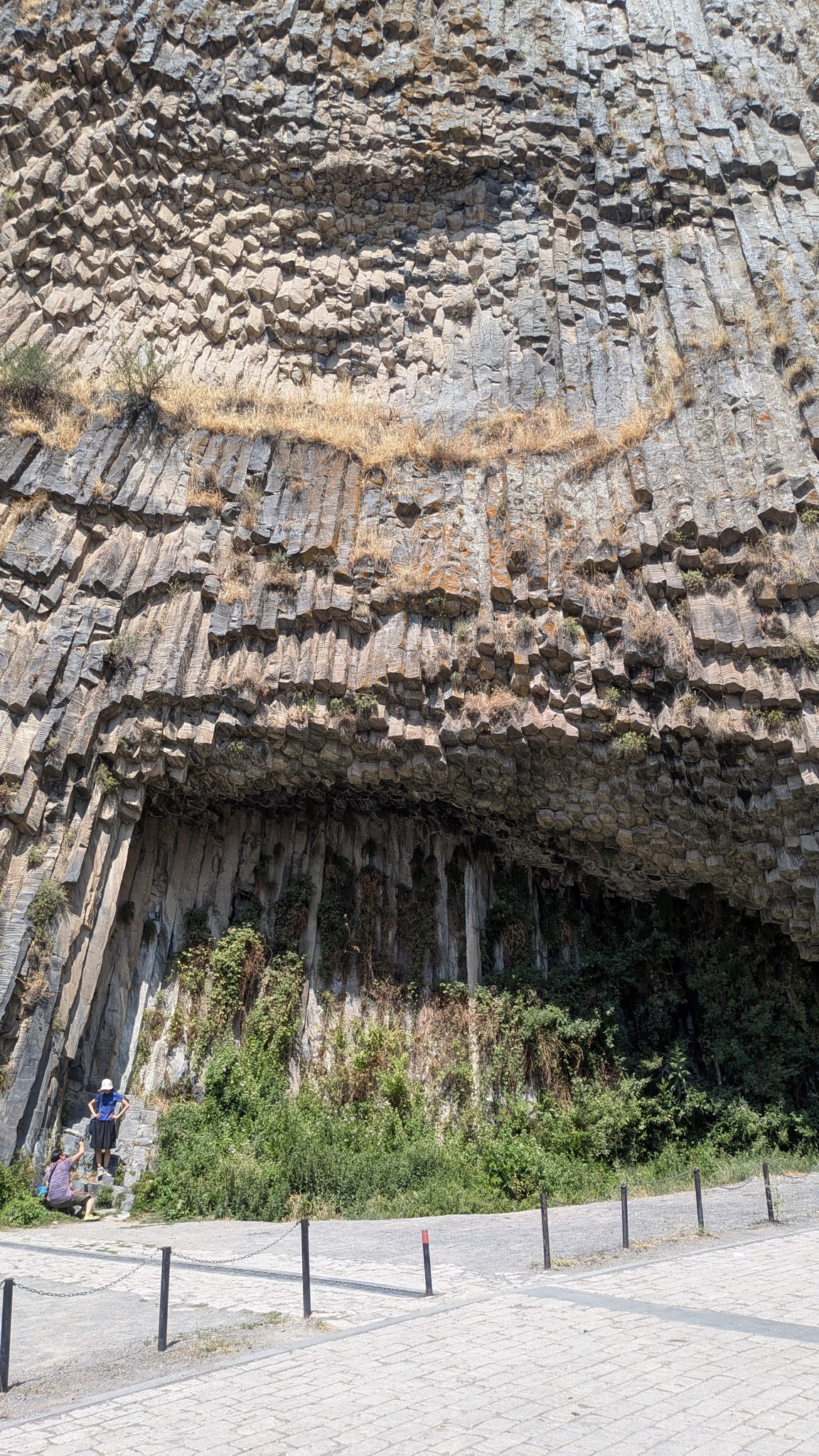
From the gorge, a short climb back up leads to Garni Temple, and this one really did stop me for a second. Classical Ionic columns, a triangular pediment, stone steps leading up to a colonnaded porch: it looks like it was airlifted straight out of Greece or Italy. It's the only surviving Greco-Roman colonnaded building anywhere in Armenia, and in fact anywhere in the former Soviet Union, built in the 1st century AD, originally as a pagan temple, on a cliff edge overlooking the same gorge that hides the basalt organ below. Dramatic gorge views on one side, a 2,000-year-old temple on the other; it's a genuinely striking combination, and it's easy to see why this spot alone justifies the whole day trip for a lot of visitors.
Tonir-baked lavash and being the only vegetarian in the van
Lunch was in Garni village, and it started with a demonstration: local women baking traditional Armenian lavash bread in an underground clay oven called a tonir, the dough slapped against the scorching-hot inner wall of a pit dug into the ground, peeled off minutes later, thin, blistered and unmistakably fresh. Being the only vegetarian in a group otherwise happy to eat whatever was served, my plate looked a little different from everyone else's, warm lavash, a hearty lentil dish, and a spread of salads, but nobody made it a production, and it turned into one of the nicer, slower parts of the day: swapping travel stories with co-travellers from China and Cyprus over a meal that, by the standards of the rest of this trip, felt genuinely home-cooked.
Lake Sevan: a sea in the mountains, 1,900 metres up
The afternoon's big drive was north to Lake Sevan, sitting at close to 1,900 metres above sea level, one of the highest large lakes anywhere in the world, and big enough that from the shore it genuinely reads as a sea rather than a lake. We got on a small boat to head out toward Sevan's rocky islets and gull sanctuaries, where seabirds nest undisturbed away from the mainland. It should have been a straightforward, scenic half hour on calm water.
It wasn't calm for long. The wind started picking up not far from shore, and, a detail that mattered a lot more later, the boat didn't have enough life jackets for everyone on board.
"Panic Mode": the hour nobody on that boat will forget
Out on the open water, a thick fog rolled in with almost no warning and wiped out visibility completely, no shoreline, no islets, nothing but grey in every direction. The boat had no GPS. Waves had turned choppy enough that water was splashing directly into the boat. A few passengers pulled out their phones to try and navigate using whatever signal and maps they could get, and started calling out conflicting directions to the driver, different people convinced the shore was in different directions, all at once, all confidently wrong. That's the "Panic Mode" of the title: no visibility, an under-equipped boat, and a boat full of people who suddenly, genuinely, weren't sure they'd make it back to land in a straight line. Eventually, slowly, we pushed through the fog, spotted land, and got everyone back to shore safely, but it's the kind of thirty minutes that recalibrates how you think about "just a quick boat ride" for a long time afterward.
Old Dilijan, in five borrowed minutes
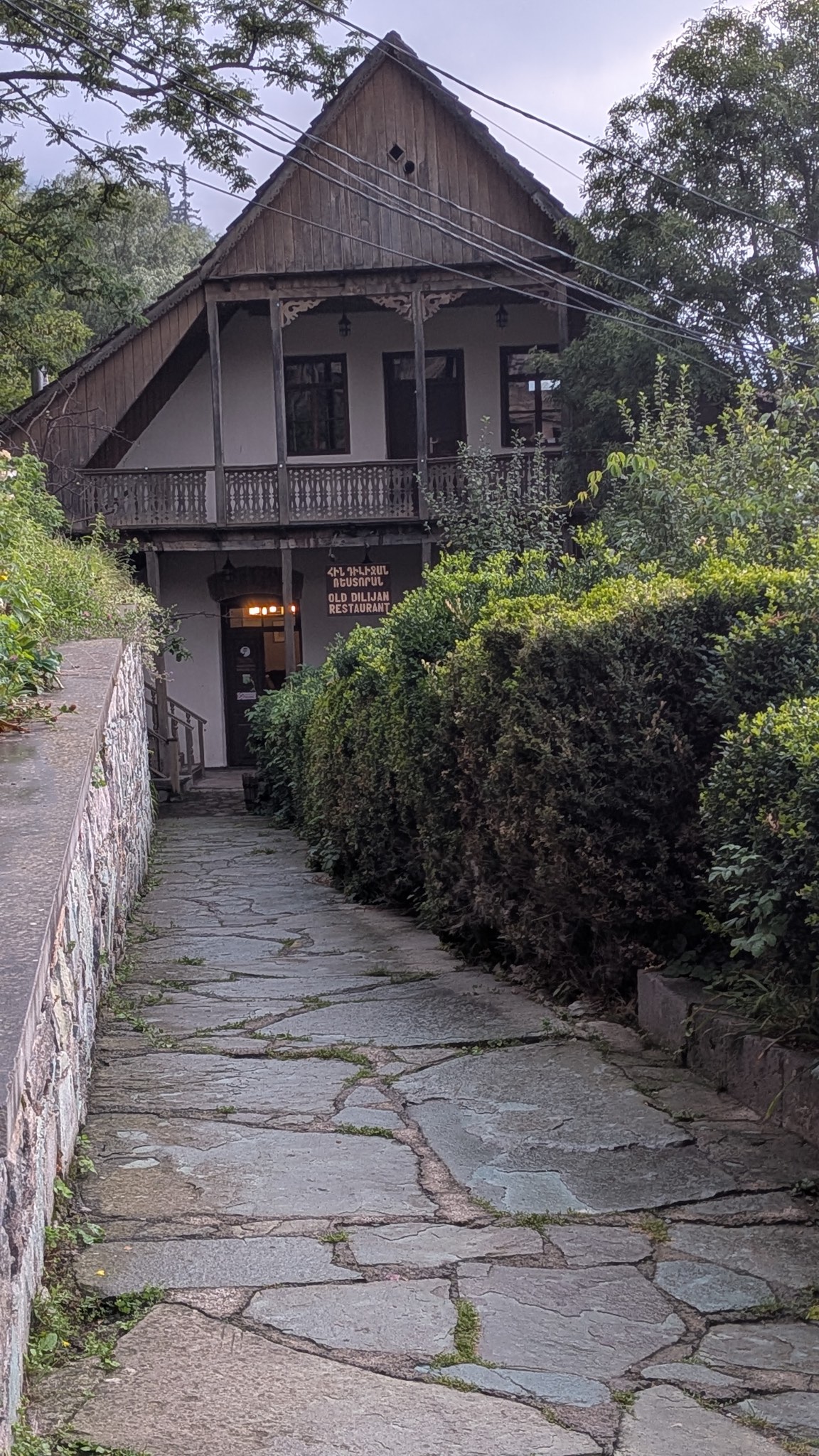
The Sevan delay ate into the schedule hard, and by the time we were back on the road, Dilijan, Armenia's answer to a Swiss alpine town, all forested hills and traditional wooden architecture, was reachable only late in the evening, well past when the tour was supposed to wrap up. I asked the driver for anything he could spare, and got a five-minute stop in Old Dilijan. It was enough. Misty, lightly raining, golden restaurant lights glowing behind carved wooden balconies, cobbled stone paths underfoot, Old Dilijan in the rain, even for five rushed minutes, still managed to feel like the most atmospheric stop of the entire day before we turned back for the long drive to Yerevan.
Practical tips for Geghard, Garni, Lake Sevan and Dilijan in one day
- Book it as a tour, not a solo drive: the route covers a lot of ground on winding roads, a group tour with a local driver keeps the day realistic.
- Geghard and Garni: wear proper shoes, Geghard's carved chambers and Garni Gorge's descent to the basalt columns both involve uneven stone.
- Lake Sevan boats: ask about life jackets and weather conditions before boarding, the lake sits at altitude and conditions can shift fast, as we found out.
- Dilijan: if it's on the same itinerary as Sevan, build in slack, it's easy for a delay earlier in the day to swallow your time here entirely.
- Food: if you're vegetarian, Armenian lentil dishes, salads and fresh lavash travel well as a reliable combination on group-tour lunches.
- Currency: Armenian Dram (AMD). Yerevan and the surrounding sights are generally inexpensive by European standards.
Four stops, one van, one language barrier turned shared laugh over lunch, and one properly frightening hour on a fogged-in lake, this was as full as a single day of travel gets. Geghard and Garni alone would have made the trip worth it; Lake Sevan just made sure I'll remember it.