Yerevan didn't feature heavily in my mental picture of Armenia before I landed, Geghard, Garni and Lake Sevan were the postcards I already knew. The capital turned out to be its own full day: a city that's simultaneously very Soviet and quietly reinventing itself, with a cathedral, a 572-step staircase and a giant sword-wielding mother figure all doing a lot of the talking.
The full day: Republic Square, the Cathedral, the Cascade, Tamanyan's Opera, Mother Armenia, and the night's musical fountains.
Morning fuel and Republic Square
The day started simply, croissants and coffee before heading straight into Republic Square, the true centre of Yerevan and the first proper look at the city's architectural personality. The square is ringed by grand Soviet-era buildings in a warm pink-toned stone, including the National History Museum and the Government House, both built with the kind of scale and symmetry that Soviet civic architecture always went for. Standing in the middle of it, it's a good spot to sit with what Armenia actually is: a country that spent decades as a Soviet republic, only regained independence in 1991, and still wears a lot of that architectural DNA openly, rather than trying to hide it.
A weekend flea market, and a country obsessed with chess
Nearby, a weekend flea market turned into an unplanned highlight, tables of secondhand books printed in the distinct, loop-heavy Armenian alphabet, souvenirs, and, over and over again, handmade chess sets. Chess isn't a niche hobby here; it's close to a national sport. Armenia has produced multiple world-class grandmasters, and the game is actually part of the school curriculum for children, which explains why a random weekend market can have this many chessboards for sale without it feeling like a coincidence.
Dram, ATMs and a 25th-anniversary currency redesign
Practical business next: withdrawing cash from an ATM in Armenian Dram (AMD), the local currency, and doing the mental math on its conversion to the Indian Rupee for anyone following along back home. Armenia had recently redesigned several of its banknotes to mark 25 years of the Dram as an independent currency, introduced in 1993 after the Soviet collapse, with updated security features and design touches, a small but telling detail about a country still actively defining its own national identity, one institution at a time.
Saint Gregory the Illuminator Cathedral
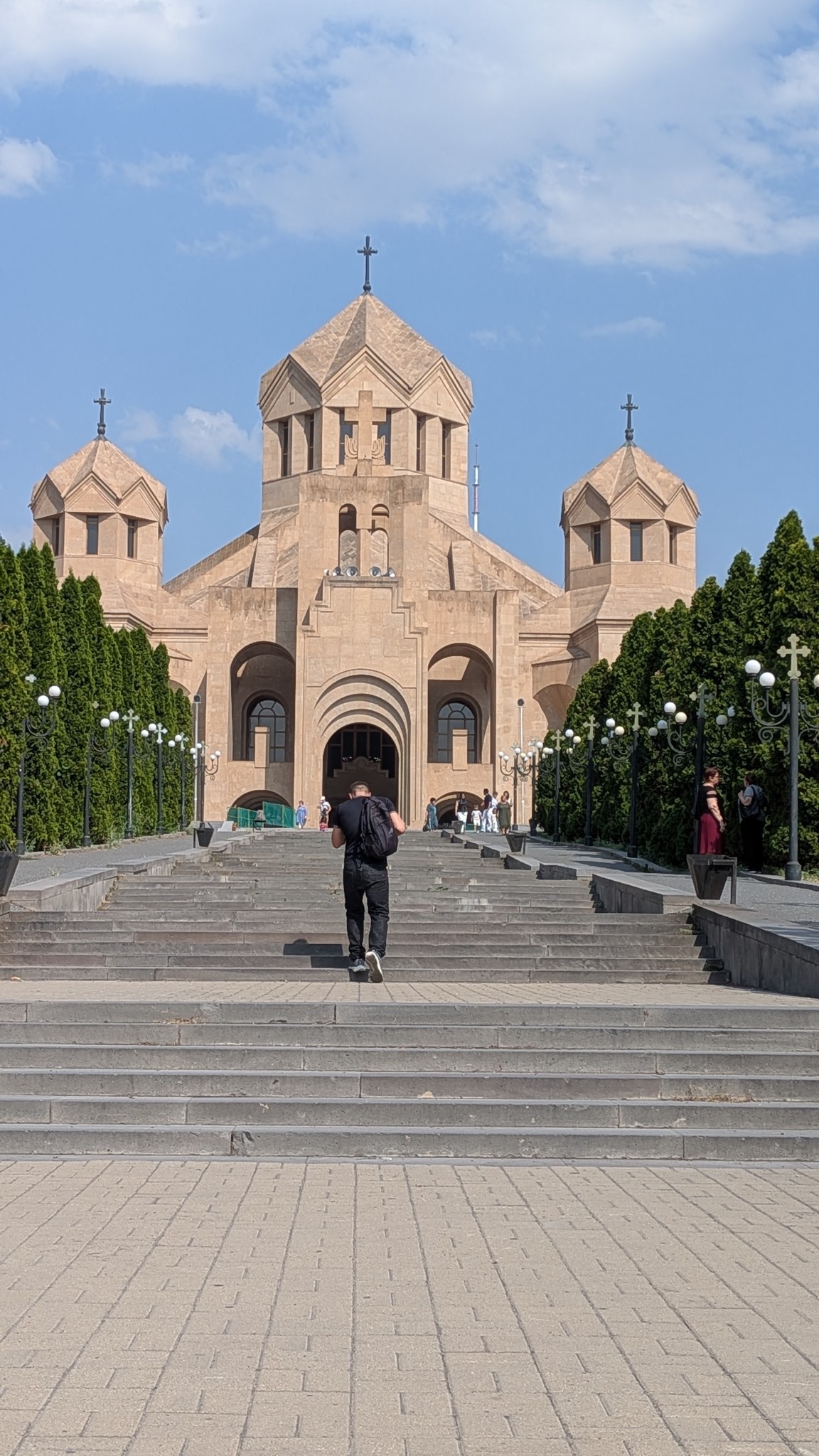
The Cathedral of Saint Gregory the Illuminator is enormous, modern by cathedral standards, and impossible to miss on Yerevan's skyline, its three tent-roofed towers visible from well outside the immediate neighbourhood. It's named for the man credited with converting Armenia to Christianity, and that conversion matters more than it might first sound: in 301 AD, Armenia became the world's first nation to adopt Christianity as a state religion, beating the Roman Empire to it by decades. The cathedral is also a good jumping-off point for one of Armenia's more remarkable cultural facts, its unique 39-character alphabet, created around 405 AD specifically so scripture could be translated into Armenian rather than relying on Greek or Syriac. A script invented to translate one book, still in daily use sixteen centuries later.
Black and pink stone: walking the Old Town
Walking through the older streets, the city's building material does a lot of the visual work: much of central Yerevan is built from volcanic tuff, quarried locally in distinct black and rose-pink tones, which is why the city has a genuinely unusual, two-tone character depending on which street you're on. Armenia also takes restoration seriously in a specific, almost archival way, when an old stone façade needs work, the original blocks are individually numbered, catalogued, and reset into the new structure in their original positions, rather than replaced wholesale with fresh-cut stone. It's slower and more expensive, but it means an old building stays, in a literal sense, made of its own original material.
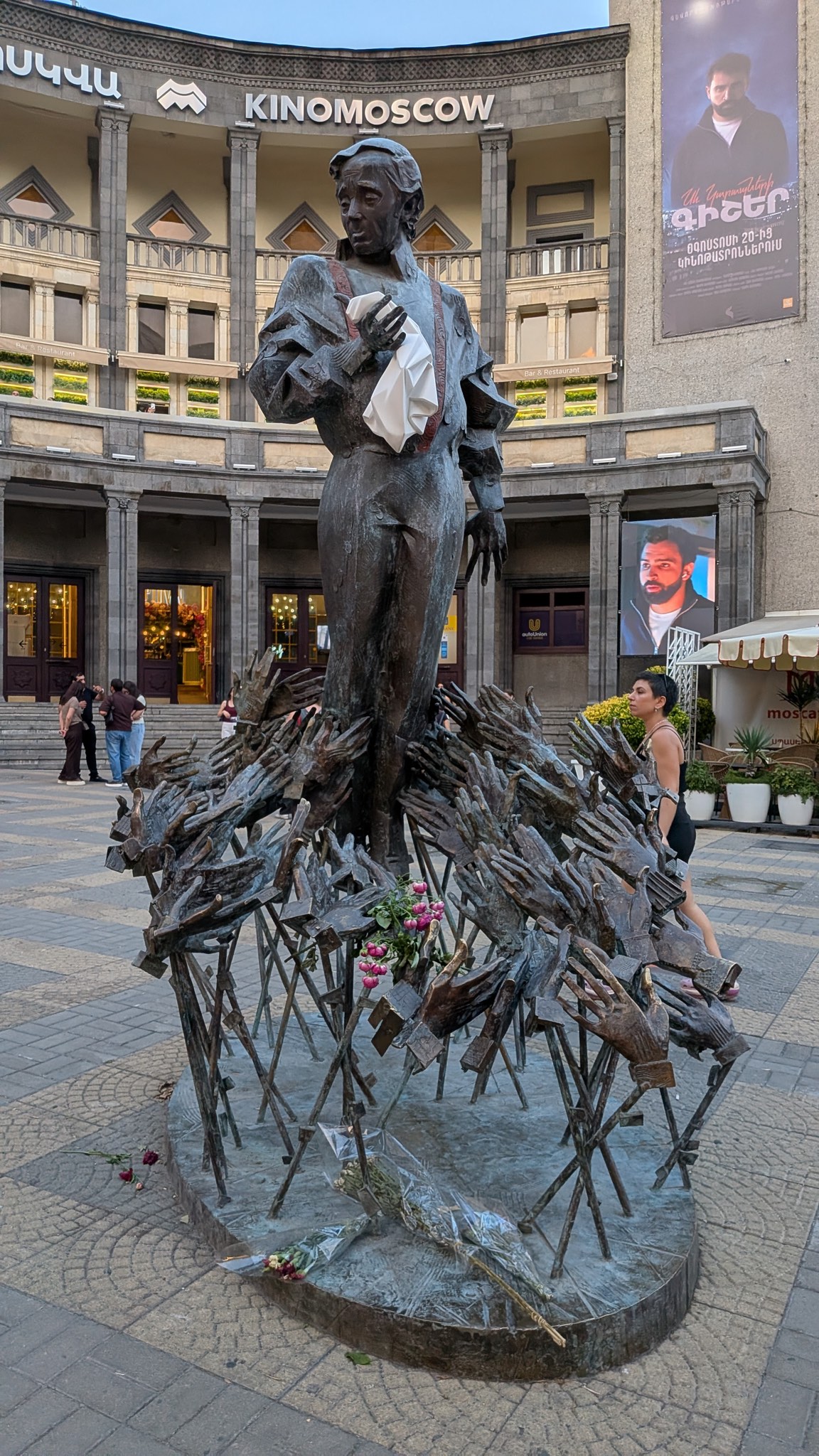
A short detour off this walk led to an unplanned landmark: a striking bronze statue outside the Moscow Cinema in the city centre, its base ringed with dozens of sculpted hands reaching upward toward the central figure, exactly the kind of oddly moving public art that Yerevan seems to have tucked into corners all over the place, well beyond its headline monuments.
A Soviet-style metro, and a Cold War rule that never left
Getting to the next stop meant riding the Yerevan Metro, and it's unmistakably Soviet in design, deep stations, heavy architecture, the whole aesthetic frozen somewhere around the 1980s. Filming inside apparently still runs into an old Cold War-era restriction on photography in the stations, a rule that's technically outdated but clearly still enforced by habit: a transit police officer stopped me for a quick, entirely good-natured chat about it mid-ride. No trouble, just a reminder that some Soviet-era instincts take longer to fade than the buildings they came from.
The Cascade: 572 steps, art, and a view of Ararat
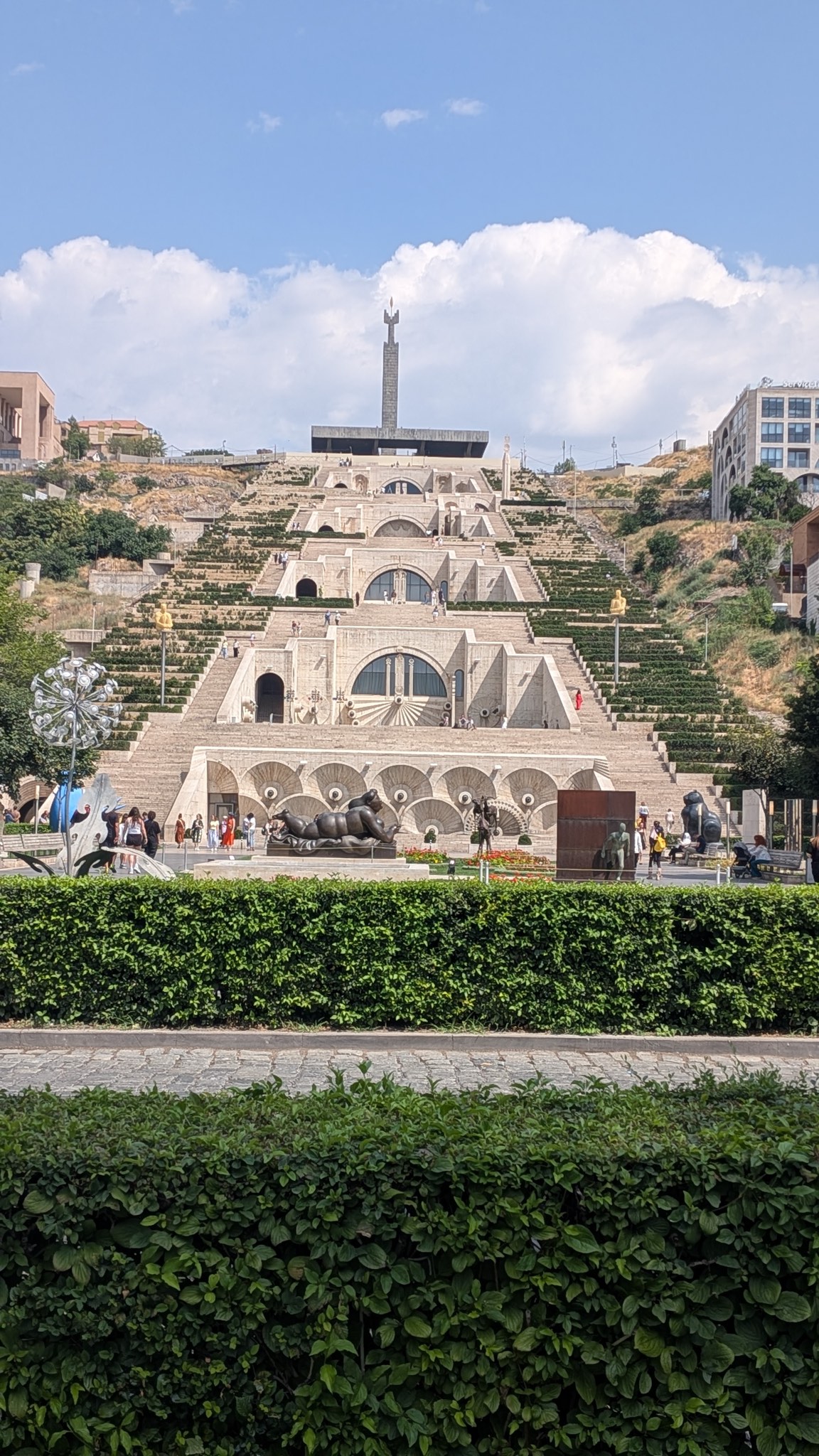
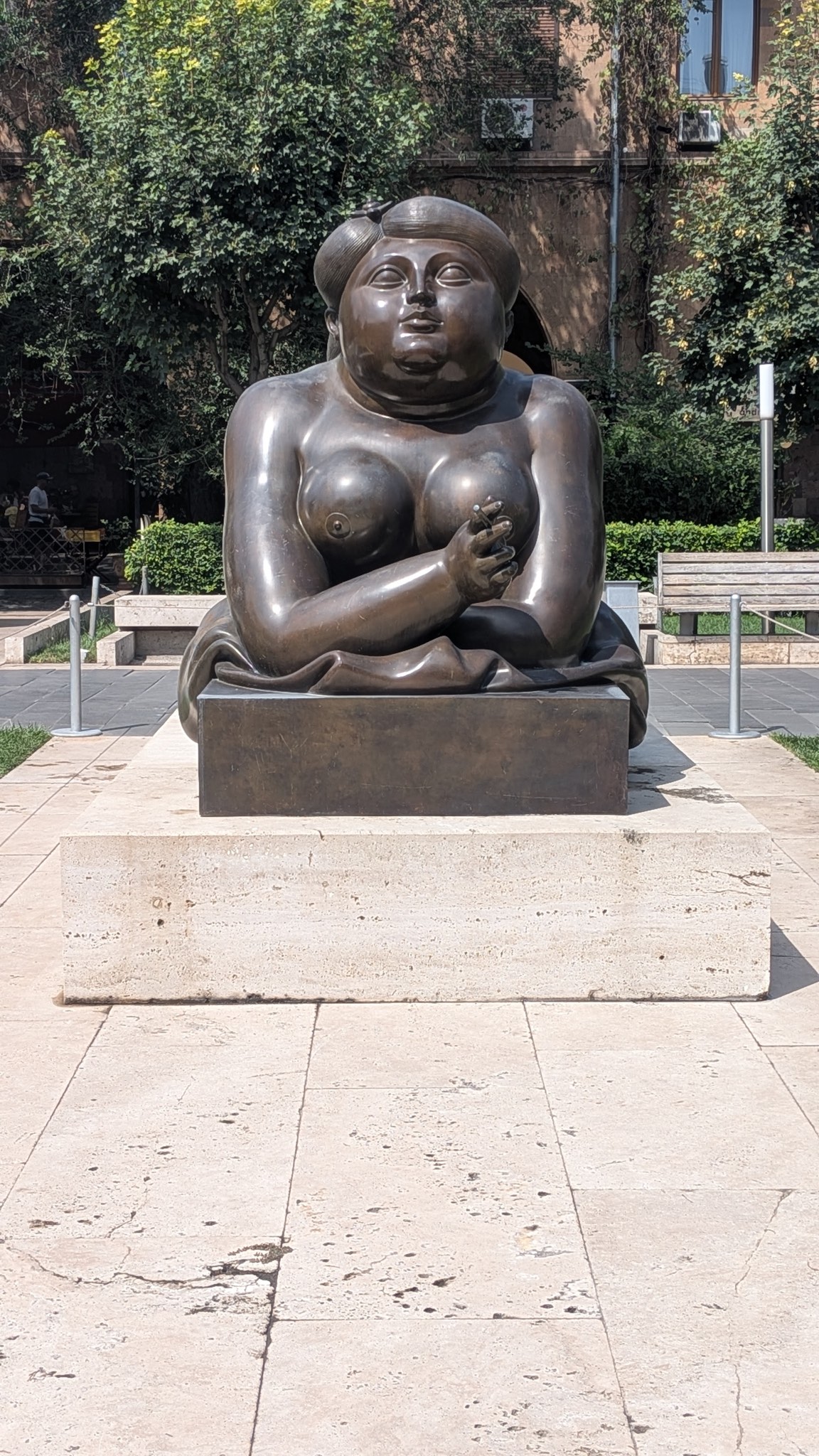
The Cascade Complex is Yerevan's most photographed structure for good reason, a giant tiered limestone staircase climbing the hillside north of the centre, doubling as an open-air art gallery and sculpture garden at ground level. Outdoor installations dot the plaza in front of it, including an oversized cat and a kiwi bird sculpture that have both become unofficial photo-stop mascots for visitors, alongside a rotating collection of contemporary bronze pieces. You can either ride the interior escalators up through several levels of gallery space, or do it the harder way and climb all 572 external steps to the top terrace. From up there, on a clear day, Armenia's most sacred symbol comes into view: Mount Ararat, the biblical resting place of Noah's Ark, visible across the border in Turkey, a mountain Armenians can see from their capital every day but haven't been able to set foot on since the border closed decades ago.
Tamanyan's Opera and a walk down Northern Avenue
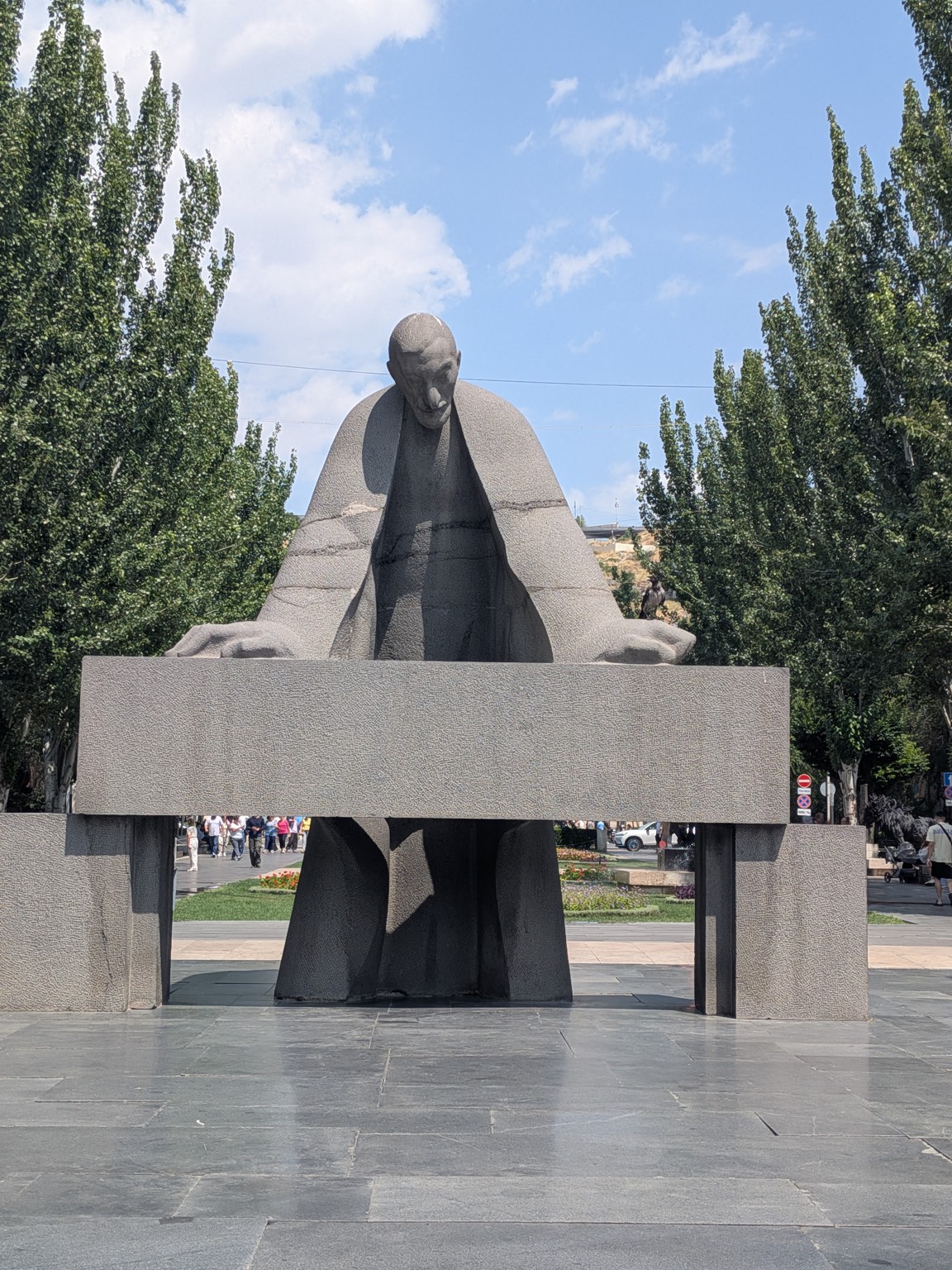
Yerevan's city centre owes its layout to one man: Alexander Tamanyan, the architect who designed the city's master plan in the 1920s, including the Yerevan Opera Theatre, a grand circular building that's still one of the city's cultural anchors. A large monument to Tamanyan himself, seated at an oversized drafting table, stands nearby, a fitting tribute to the person most responsible for how the modern capital actually looks. From there, it's a walk down Northern Avenue, Yerevan's pedestrian-only boulevard connecting the Opera to Republic Square, lined with cafés and luxury shopfronts. Underground shopping malls along the route lean surprisingly heavily into tech and drone stores, a small, specific detail that says something about where consumer interest in the city currently sits.
Mother Armenia: replacing Stalin on the hill
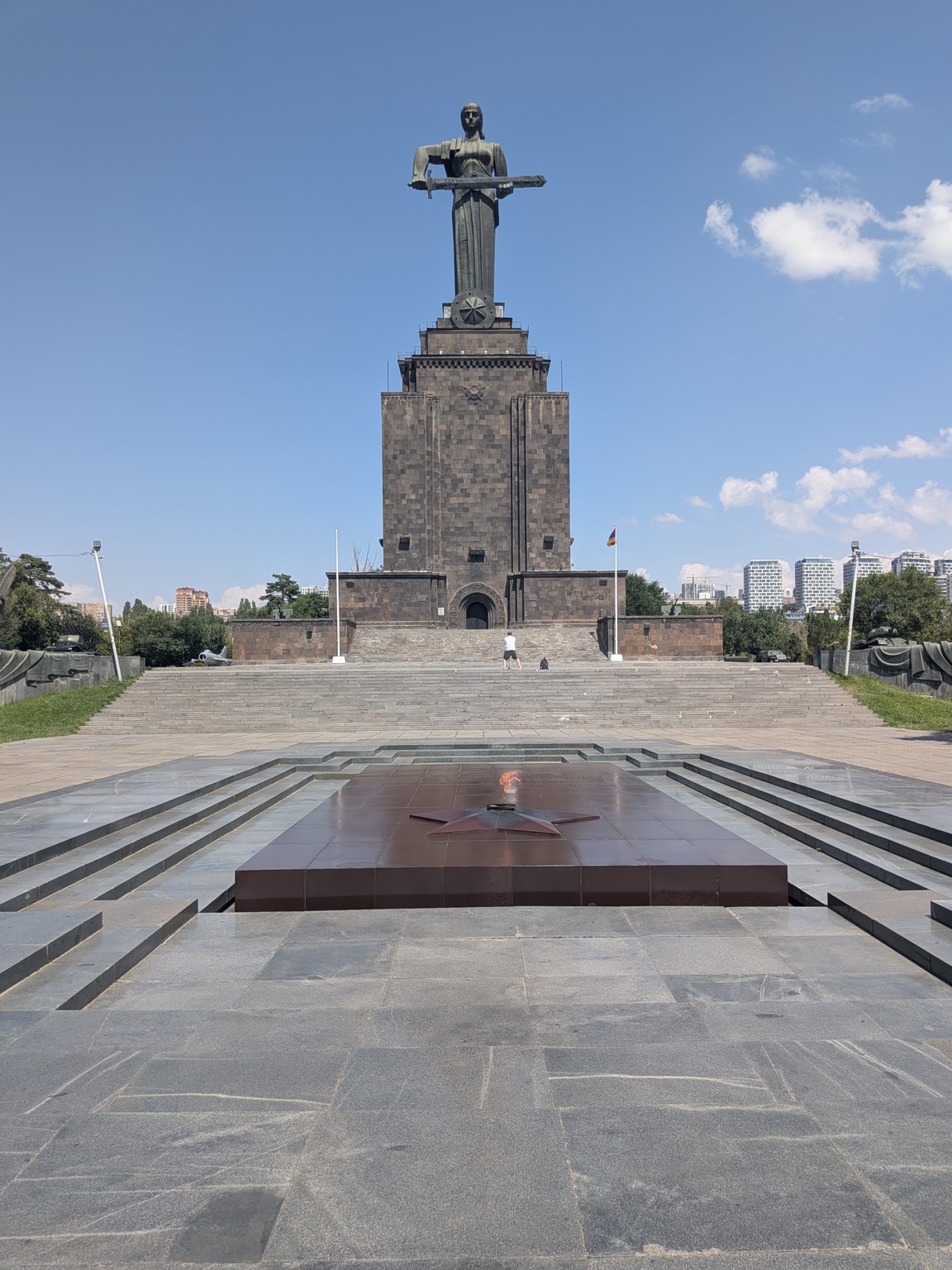
Up on the hill overlooking the city stands Mother Armenia, a towering statue of a woman holding a sword, guarding the capital from its highest ground. The statue's history is a small piece of Soviet political theatre in itself: this exact pedestal originally held a giant statue of Stalin, torn down during the de-Stalinization era of the 1960s and replaced with Mother Armenia in 1967, a literal swap of a Soviet strongman for a national protector figure, without moving the plinth an inch. The base now houses a military museum, with tanks and old armoury on display around the grounds, and an eternal flame burning at the front, looking straight back down over the city Mother Armenia is positioned to defend.
What a day in Armenia actually costs
Running totals throughout the day: Armenia is comfortably one of the more affordable countries I've travelled through recently, food, hostels versus hotels, and daily transport all came in well below what the same day would cost in most of Western Europe. For getting around without the metro, local ride-hailing apps GG and Yandex Go both work well and are worth having installed before you land, especially for longer hops like the trip out to Mother Armenia's hill.
Vegan dinner: basil lemonade and a lentil kebab wrap
Dinner was at a dedicated vegan restaurant, a genuinely good find in a country whose cuisine leans heavily on meat and dairy. A glass of basil lemonade alongside a lentil kebab wrap turned out to be one of the better meals of the trip: full of flavour, clearly not a token vegetarian afterthought on the menu, and proof that even a meat-forward food culture like Armenia's has good plant-based options if you know where to look.
Nighttime musical fountains at Republic Square
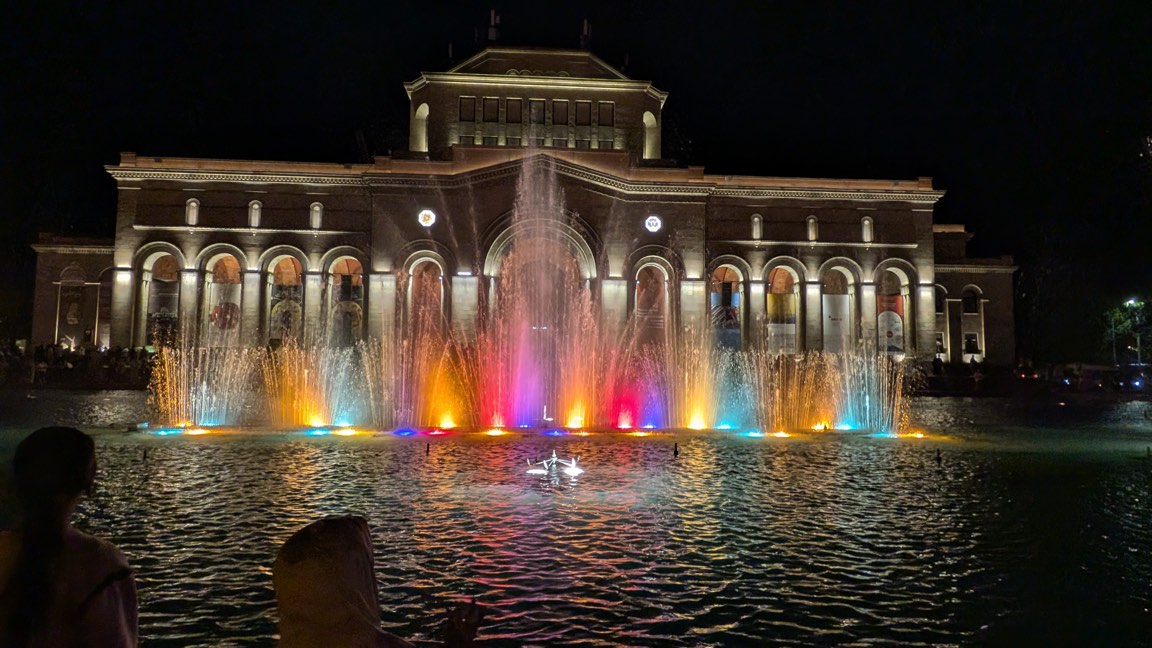
The day closed the way it started, back at Republic Square, but transformed. Around 10:30 PM, the square's buildings are lit up, the plaza fills with people out for the evening, and the centrepiece pool runs its synchronized musical fountains, jets of water timed to music and washed in shifting colour, right in front of the same Soviet-era façades from that morning. Seeing the same square in daylight and at night, hours apart, was a fitting bookend: grand and formal in the sun, genuinely lively after dark.
Practical tips for a day in Yerevan
- Morning: Republic Square, the weekend flea market (if your dates line up), and an ATM stop for Dram.
- Midday: Saint Gregory the Illuminator Cathedral, then a walk through the Old Town's volcanic-stone streets.
- Afternoon: The Cascade Complex, budget real time here if you're climbing all 572 steps, then the Opera, Tamanyan's statue and Northern Avenue.
- Evening: Mother Armenia and the military museum on the hill, then dinner and Republic Square after dark for the musical fountains.
- Getting around: The metro is cheap and very Soviet, just don't film inside the stations. GG and Yandex Go cover everything else.
- Currency: Armenian Dram (AMD). Yerevan is inexpensive by European standards for food, stays and transport.
Geghard, Garni and Lake Sevan were always going to be the postcard stops on this trip. Yerevan turned out to be the day that actually explained the country, a capital still working through what it means to be post-Soviet and fully independent at the same time, one repurposed statue plinth and one redesigned banknote at a time.