
Luxembourg was country number 44 for me, and going in, I mostly knew it as a punchline about banks and billionaires. What I got instead was one of the more genuinely pleasant capital-city days of this entire trip: a nation smaller than most Indian districts, running a public transport system that costs literally nothing, sitting on top of a canyon it's built two bridges and a funicular's worth of engineering around.
The full day: free buses, the Gelle Fra, Adolphe Bridge, the Palace, the Casemates, and Europe's most beautiful balcony.
Free public transport, for absolutely everyone
The day started at a Park & Ride facility outside the city centre, park the car, walk to a bus stop, and get on. No ticket machine, no tapping a card, no app. Luxembourg made all public transport nationwide completely free back in 2020, trains, trams and buses, for residents and tourists alike, everywhere in the country. It's the only nation in the world to do this at a full national scale, and riding into the capital without so much as thinking about a fare was a genuinely novel feeling after a summer of European transit apps and zone maps.
The Gelle Fra and Place de la Constitution
Place de la Constitution is where the day properly started, dominated by the Gelle Fra ("Golden Lady"), a gilded memorial obelisk honouring Luxembourgers who volunteered and died fighting in the two World Wars, despite the country's official neutrality in the first. She stands right at the edge of a cliff, and that positioning is the real payoff: turn around from the monument and you're looking straight down into a deep, green river valley, with the city's old fortifications and rooftops framing it on both sides. It's the kind of view that makes you understand immediately why this particular spot became the city's most photographed square.
Adolphe Bridge: a bridge with a bridge inside it
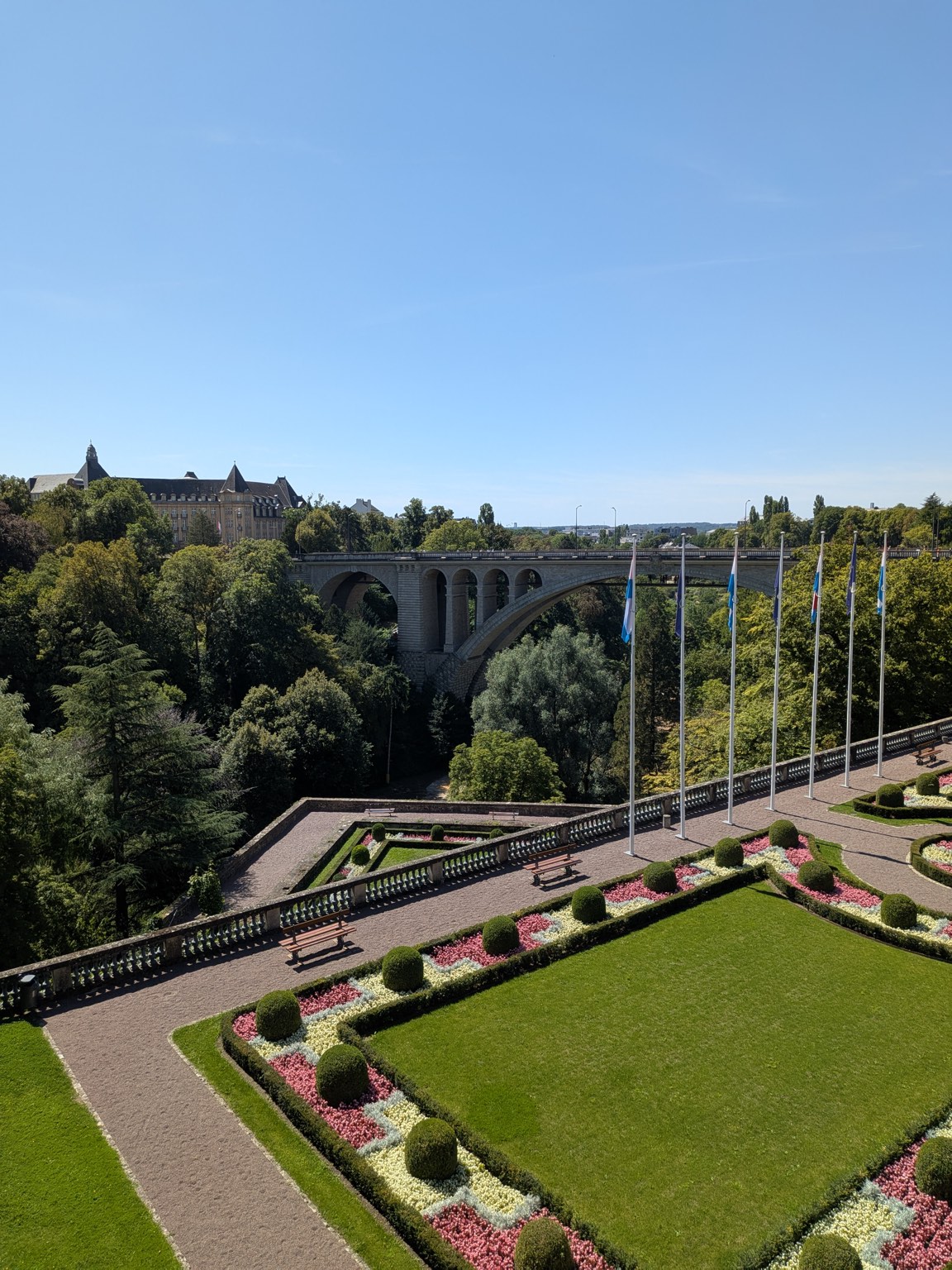
From there it's a short walk to the Adolphe Bridge, Luxembourg's best-known crossing and, for a while after it opened in 1903, the largest stone arch bridge in the world. What most photos don't show is that it's double-decked: the main road deck up top carries trams and traffic, while a second walkway runs underneath, tucked inside the structure itself, built specifically for pedestrians and cyclists to cross the gorge without competing with the road above. Walking both levels, over the top and then through the lower passage, gives you two completely different views of the same canyon in about ten minutes.
The Grand Ducal Palace and a rare kind of monarchy
The pedestrian streets running through the old town double as Luxembourg's high-end shopping district, and they lead straight to the Grand Ducal Palace, the official residence of the country's head of state. Luxembourg is the world's only surviving sovereign Grand Duchy, a monarchy one rank below a kingdom, currently under Grand Duke Guillaume, and one of the last places on earth where that specific title still means something politically rather than just ceremonially.
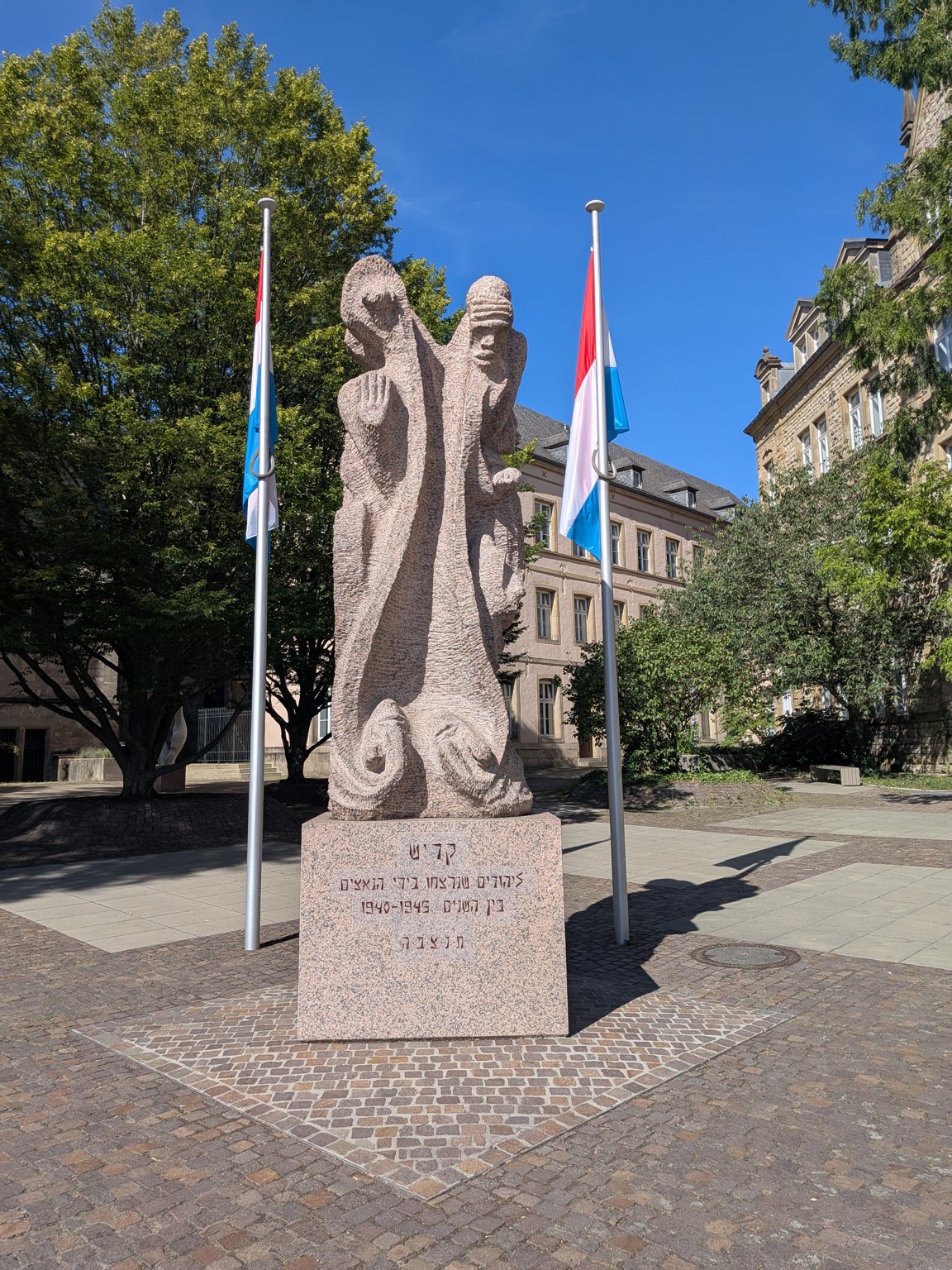
A quieter, heavier stop sat just off this same walk: a granite memorial inscribed in Hebrew, a Kaddish for Luxembourg's Jewish community murdered by the Nazis during the 1940-1945 occupation. It's easy to miss between the palace and the shopfronts, and it's exactly the kind of small, unglamorous monument that a city like Luxembourg, rich, orderly, easy to enjoy, quietly keeps in plain sight anyway.
The Bock Casemates: tunnels a whole nation grew out of
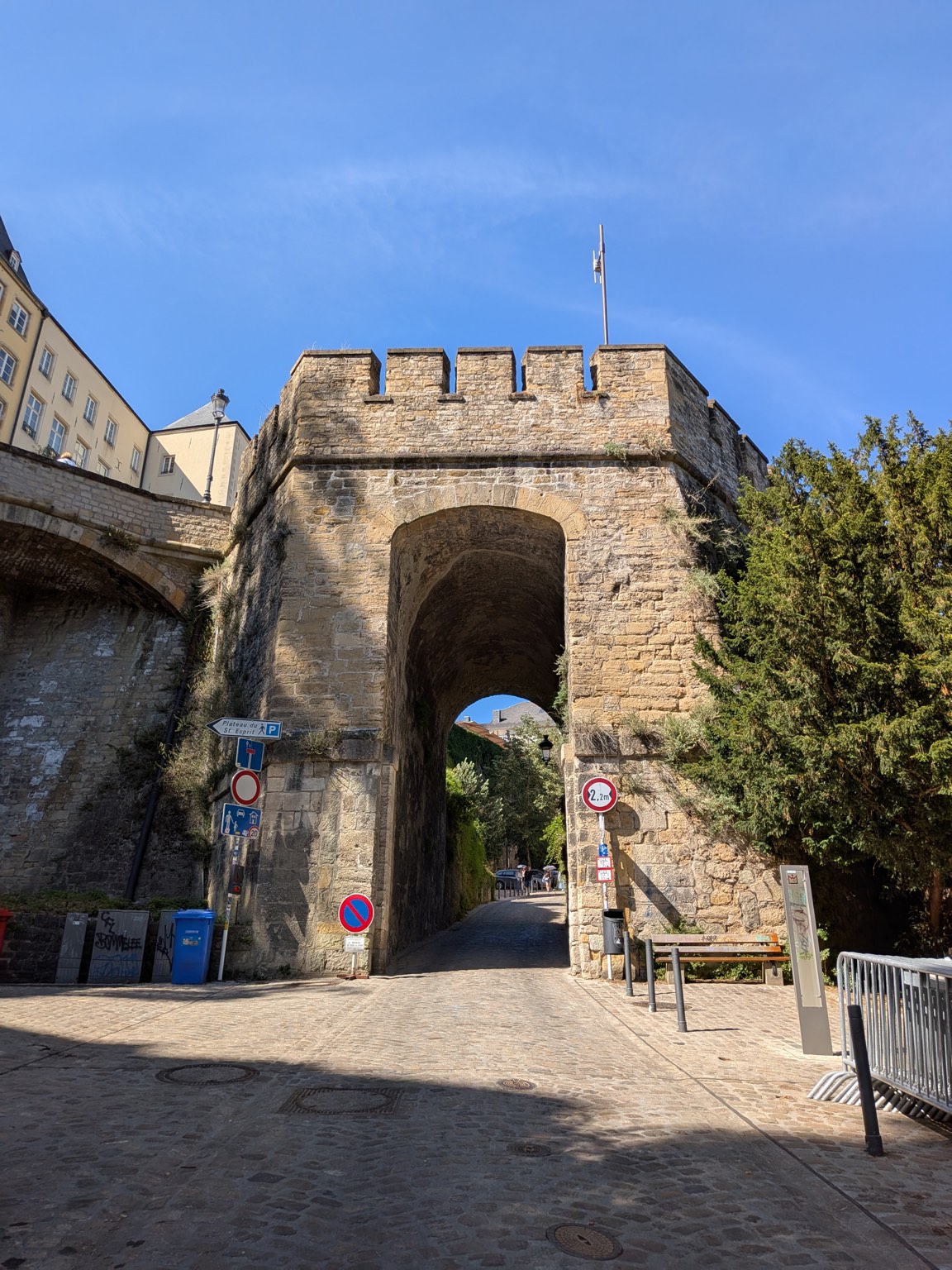
Luxembourg City's entire origin story lives underground, in the Bock Casemates, a network of fortified tunnels carved into the cliff rock, expanded over the centuries by the Spanish (and later the Austrians and French) into bomb-proof shelters, barracks and gun emplacements capable of holding thousands of soldiers and their horses at once. The story starts even earlier than the tunnels themselves: a small 10th-century castle built on this same rocky outcrop by Count Siegfried is the literal origin point of the city, and eventually the country, that grew up around it. Walking the fortress walls and gatehouses above ground gives a good sense of just how seriously this tiny rock outcrop was defended for a thousand years before it ever became the calm, wealthy capital it is today.
Chemin de la Corniche: "Europe's most beautiful balcony"
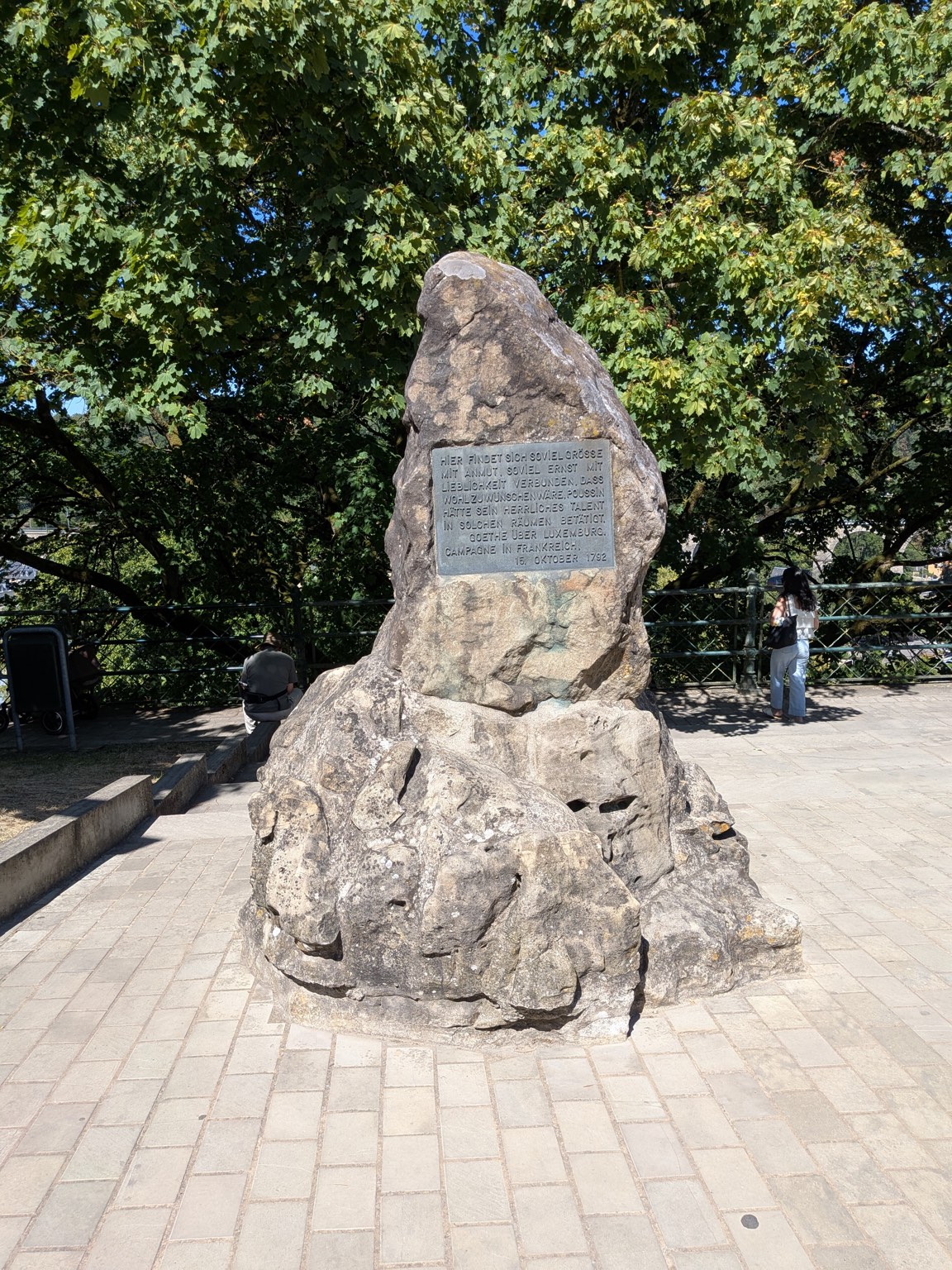
The Chemin de la Corniche is a pedestrian walkway that traces the old rampart line above the Alzette valley, and its nickname, "Europe's most beautiful balcony", isn't just tourist-board branding. Even Goethe apparently thought so: a stone memorial along the walk carries an 1792 quote from him praising the setting, remarking that the painter Poussin himself would have wished to put his talent to work capturing a landscape this composed. Standing at the same railing, looking down at the lower town's rooftops packed into the curve of the river below, it's hard to disagree with him more than two centuries later.
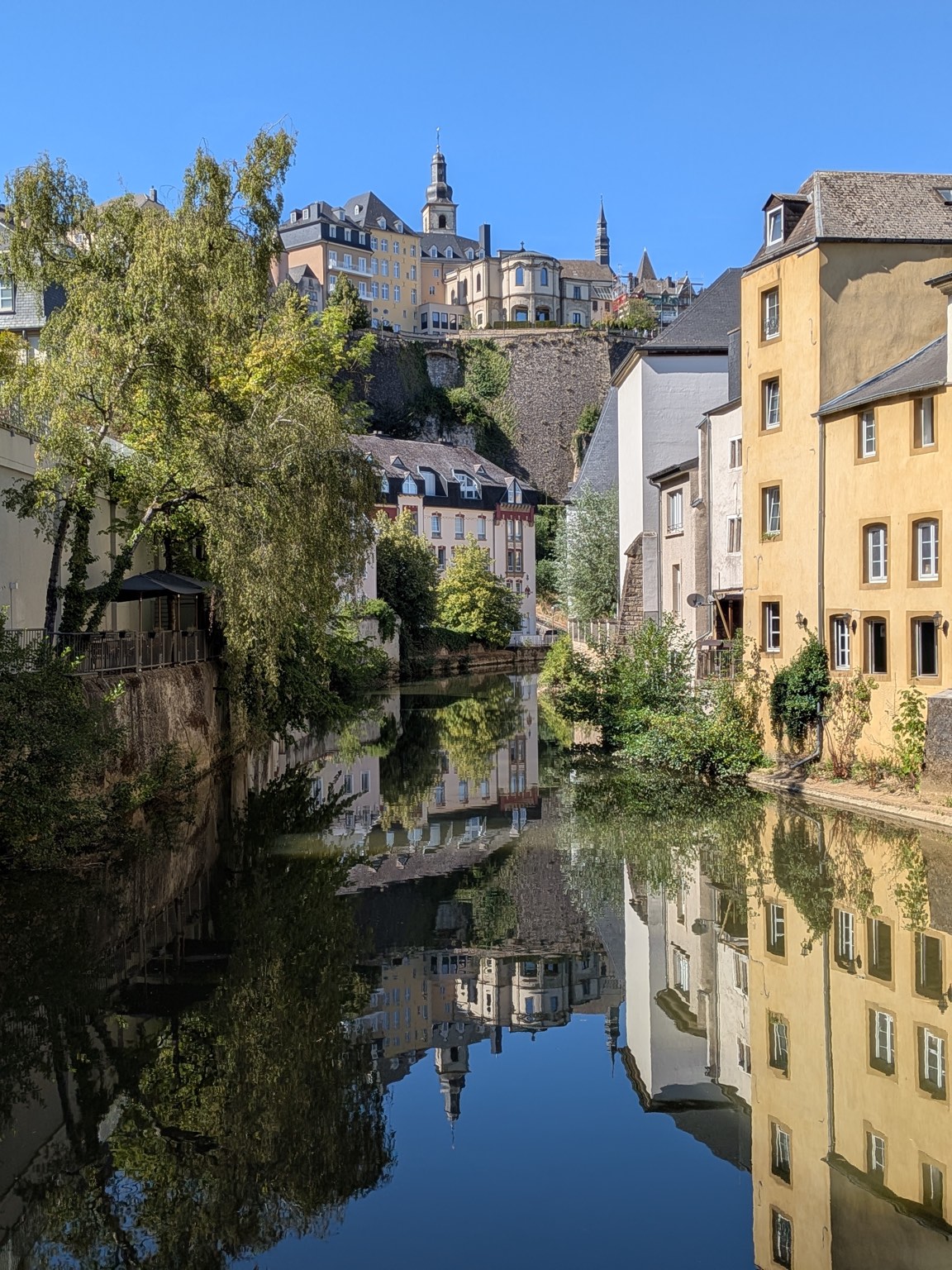
The walk down from the Corniche drops you straight into Grund, the peaceful riverside village sitting at the bottom of the same valley the balcony looks over. It's a genuinely different pace from the city above, narrow lanes, converted mill buildings, cafés right on the water, and the Alzette here is calm enough to throw a near-perfect reflection of the old town's spires and cliffside walls back up at you.
So why is Luxembourg actually this rich?
The short version: it didn't start as a banking story. Luxembourg's early wealth came from iron ore and steel, the south of the country sat on some of Europe's richest iron deposits, and steelmaking turned it into an industrial power well before it became a financial one. The pivot to banking, finance and, more recently, tech happened over the 20th century, helped enormously by EU institutions choosing Luxembourg as a home base and by tax and regulatory policy that made it an attractive place for international capital to sit. Today it's routinely ranked among the highest GDP-per-capita countries anywhere in the world.
What that means day-to-day is visible the moment you're on the street: a huge share of the people actually working in Luxembourg City commute in daily from France, Germany and Belgium, since the country is small enough that its economic pull reaches well past its own borders. Linguistically it's just as layered, Luxembourgish is the national language, but French and German are both official too, and it's completely normal to hear a conversation drift between all three depending on who's talking to whom.
What's next
This was day one of the Luxembourg leg, free transport, the Casemates and the Corniche done, the car still charged and ready to go. Day two took me further out of the city entirely: a waterfall in "Little Switzerland," a fairy-tale castle, and the actual village that gave the Schengen Agreement its name. Read that one here.
Practical tips for Luxembourg City
- Transport: All public transport is genuinely free nationwide, use the Park & Ride facilities to avoid parking hassle in the old town, then take the bus or tram in.
- Adolphe Bridge: Walk both levels, the road deck on top and the pedestrian passage underneath, for two different views of the gorge.
- Bock Casemates: Wear proper shoes; the tunnels involve uneven steps and low, narrow passages.
- Chemin de la Corniche: Best walked in the direction that ends in Grund, so the riverside village is your reward at the bottom rather than an uphill finish.
- Currency: Euro. Luxembourg is expensive for food and shopping, but the free transport offsets a meaningful chunk of a day's budget.
Forty-three countries in, I thought I had a decent sense of what "small but rich" usually looks like. Luxembourg still managed to surprise me, not with flash, but with a capital that's spent centuries being fought over and taxed and rebuilt, and has ended up, almost quietly, as one of the most liveable and best-engineered small cities in Europe.