
Santa Claus did not begin at the North Pole. The bishop behind the story worked in Myra on the Turkish coast, and I went to see his church, a cliff full of ancient tombs and a sunken city, all on one rainy day trip from Antalya.
A boat over the Kekova sunken city, the St Nicholas story in Demre, the rock tombs and Roman theatre at Myra, and what the tour cost.
A day trip beyond Antalya
The week before, I covered the city itself in my Antalya post, and this time I wanted to see what lies around it. This was a group tour, so the pickup came at half past six in the morning and a coach took us about 100 kilometres along the coast. It was already drizzling when I set out, and the rain followed us for most of the day.
On the way we stopped for coffee at a roadside café with the Taurus Mountains all around. They run along the edge of the Mediterranean in a long range, and to me they looked a lot like the Eastern and Western Ghats back home. I had expected a small group, but the coach was completely full. The drive there took about two hours.
Kekova and the sunken city
The first stop was a small harbour, where we boarded a boat. Plenty of restaurants line the harbour, and the boat had sun beds on the upper deck, which were of little use under such grey skies. Someone suggested a Titanic pose at the bow, and it did look the part.
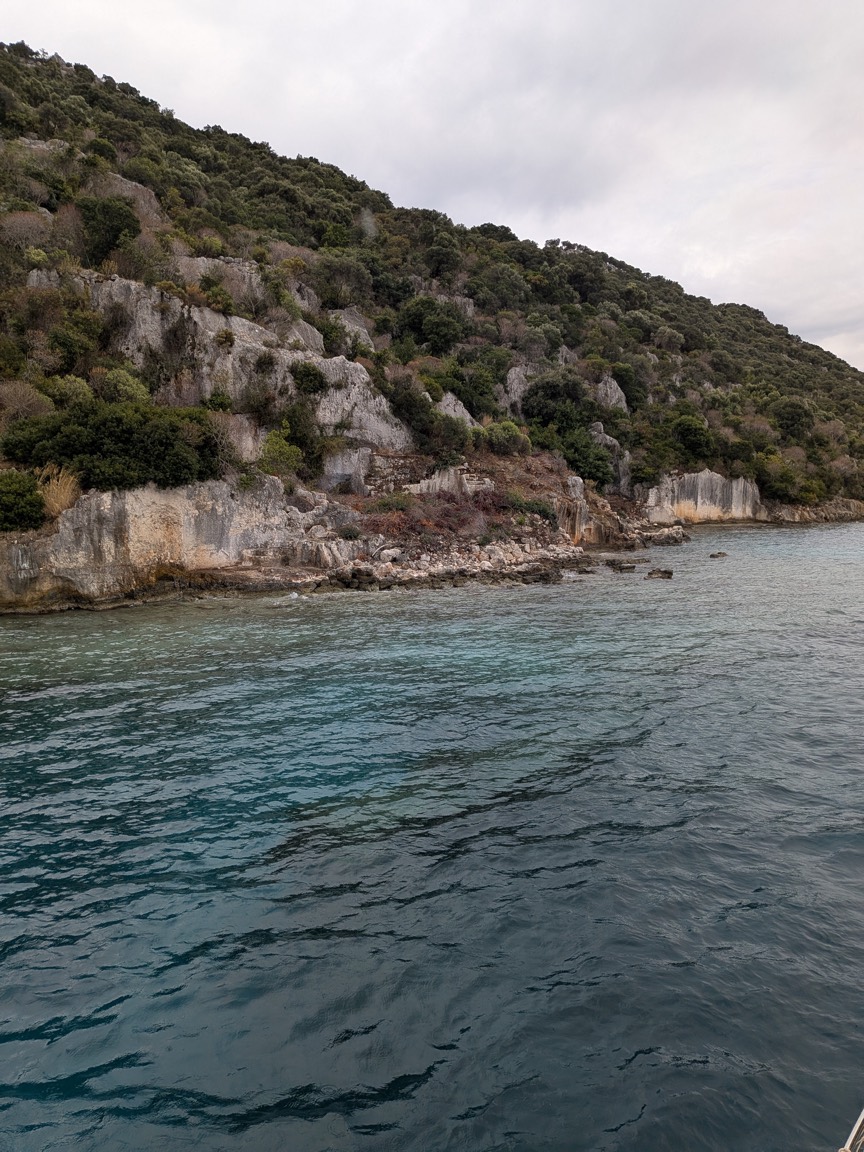
The point of the trip was Kekova, a city that sank into the sea after an earthquake. Indians will think of Dwaraka, and it was the first thing I thought of too, but this is a very different place with nothing like Dwaraka's history. Low rocky islands shelter the bay, and beyond them lies open sea. Ruins and old steps climb the hills, and the walls and house foundations carry on down into the water. Our guide pointed out what he said was a house with a bedroom under the surface, though with the cloud and rain I could not make out much. They say that in sunshine the water is clearer and far more beautiful. Some people were paddling kayaks instead, and from a kayak you see the ruins below more clearly.
Above the village of Kaleköy, whose ancient name was Simena, a castle stands on the hill. A coffee on board came to 250 lira, about ₹500.
Lunch on the tour
Lunch was included. The bread was lavash, which in Armenia is soft, but this was firmer. My main dish was a cheese version, essentially lavash with melted cheese, which I thought was very good. There were other vegetarian options too, such as beans and potatoes, though I had already had okra the day before. The rain eased off by the end of lunch, and I could finally put my sunglasses on.
Demre and the Santa Claus story
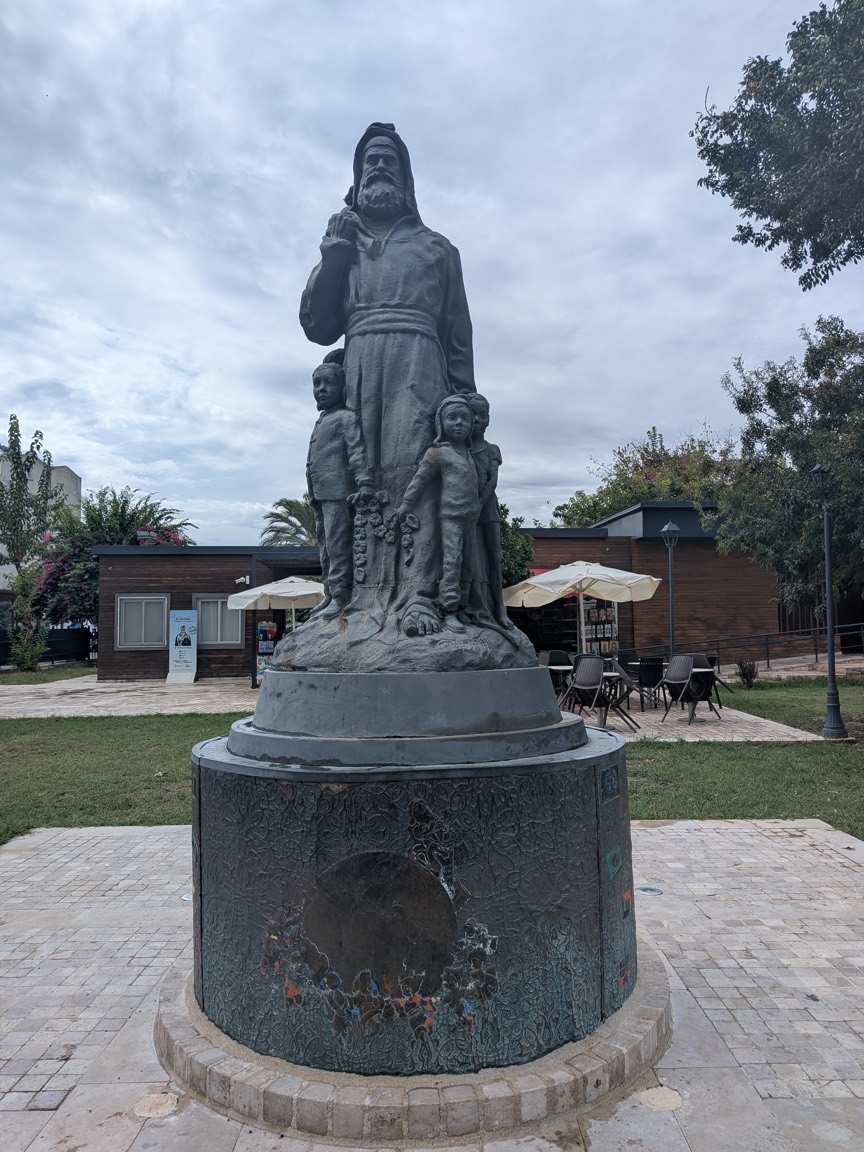
Next was the town of Demre, which is where the Santa Claus story comes from. The usual belief is that Santa gives children presents on Christmas night, and it has even started to catch on in India. Myra was an ancient city, and its bishop in the 4th century was Nicholas, later known as St Nicholas. He was known for helping children, which is where the gift-giving comes from. In Dutch his name became Sinterklaas, and over time that turned into Santa Claus in English. A statue of St Nicholas with children stands in the square outside the church.
St Nicholas Church is partly below ground level. Demre sits on top, and the church was dug out in excavations over many years, from the 1800s into the 1960s. It is now a museum and no longer holds regular services. It is still a very important place for Orthodox Christians, and visitors do come to pray inside. There are tombs here too, one of them called the Santa Claus tomb. According to one version of the story, his bones were taken to the Italian city of Bari, and I have also heard Venice named. Archaeologists say that the tomb in Demre is his, so I can't say for sure where he is buried, but he certainly served as bishop here.
The ticket was not part of the tour. It cost €17, which came to 939 lira or almost ₹1,800, and I paid for it myself. I could not work out why a site in Turkey charges in euros. There is a museum shop and plenty of souvenir stalls, with Santa Claus products everywhere.
Myra's rock tombs
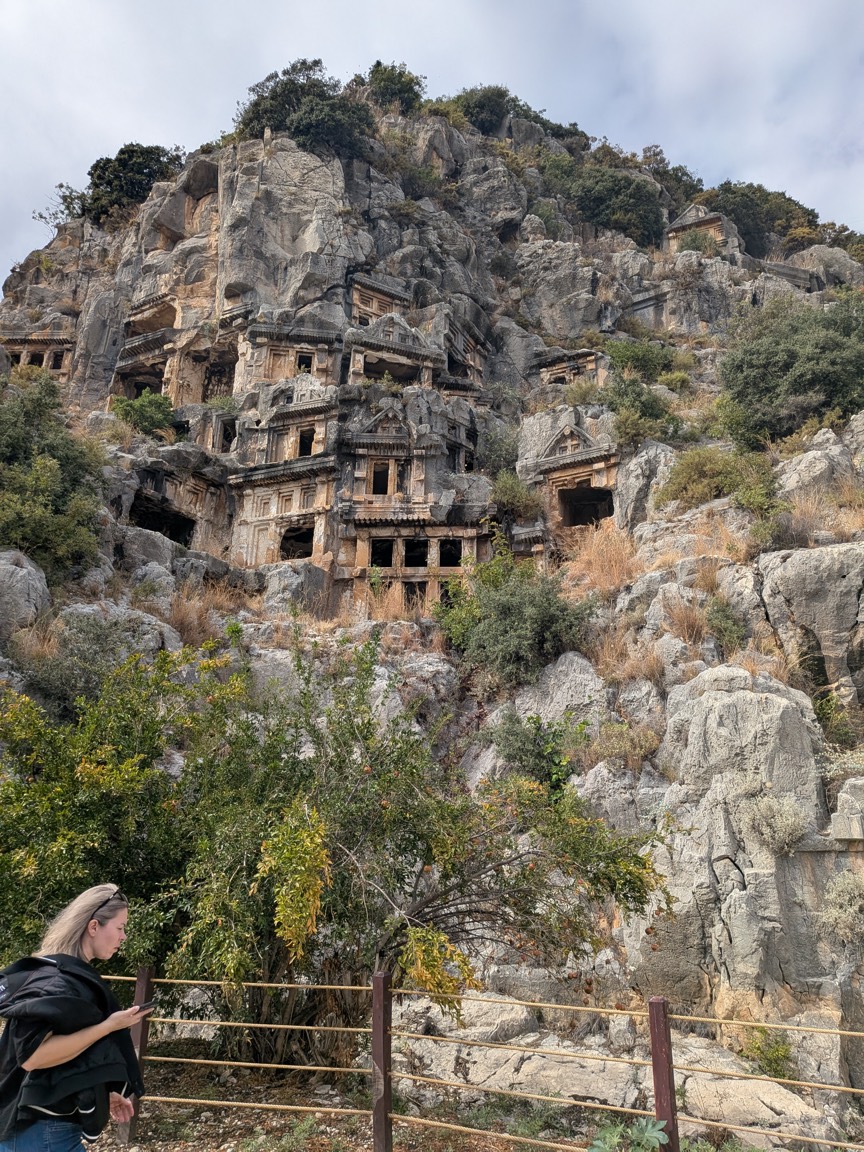
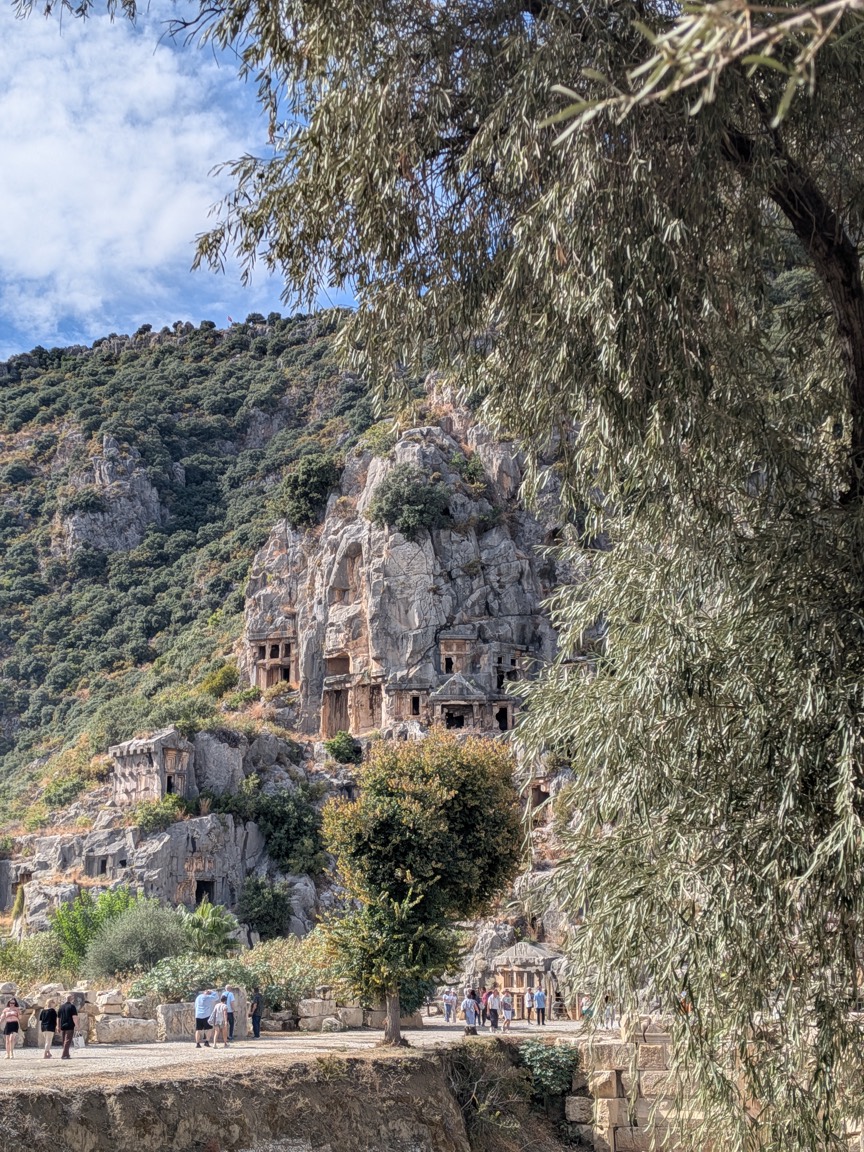
From the church we went to the ancient site of Myra itself. A whole cliff is carved with tombs, over a hundred of them, and anyone who has seen Petra will find it familiar. The scale is smaller, but the idea is the same. The dead of the city of Myra were placed in these tombs in the hillside, and some on the lower level have been excavated and restored, while the ones higher up have been left as they were found.
Originally the tombs were painted in yellow, blue and red, and the colours were still visible until about 1840. Today I could see yellow, a little blue here and there, and very little red. Many of the tombs date from Lycian times, between the 4th century BC and around AD 200 or 300, and the Romans carried on using them. Steps cut into the rock lead up to some of the tombs, and you can climb one and look out from inside. A pomegranate tree grows right beside the path, and stalls outside sell fresh pomegranate and orange juice. Drones are not allowed here.
The Roman theatre
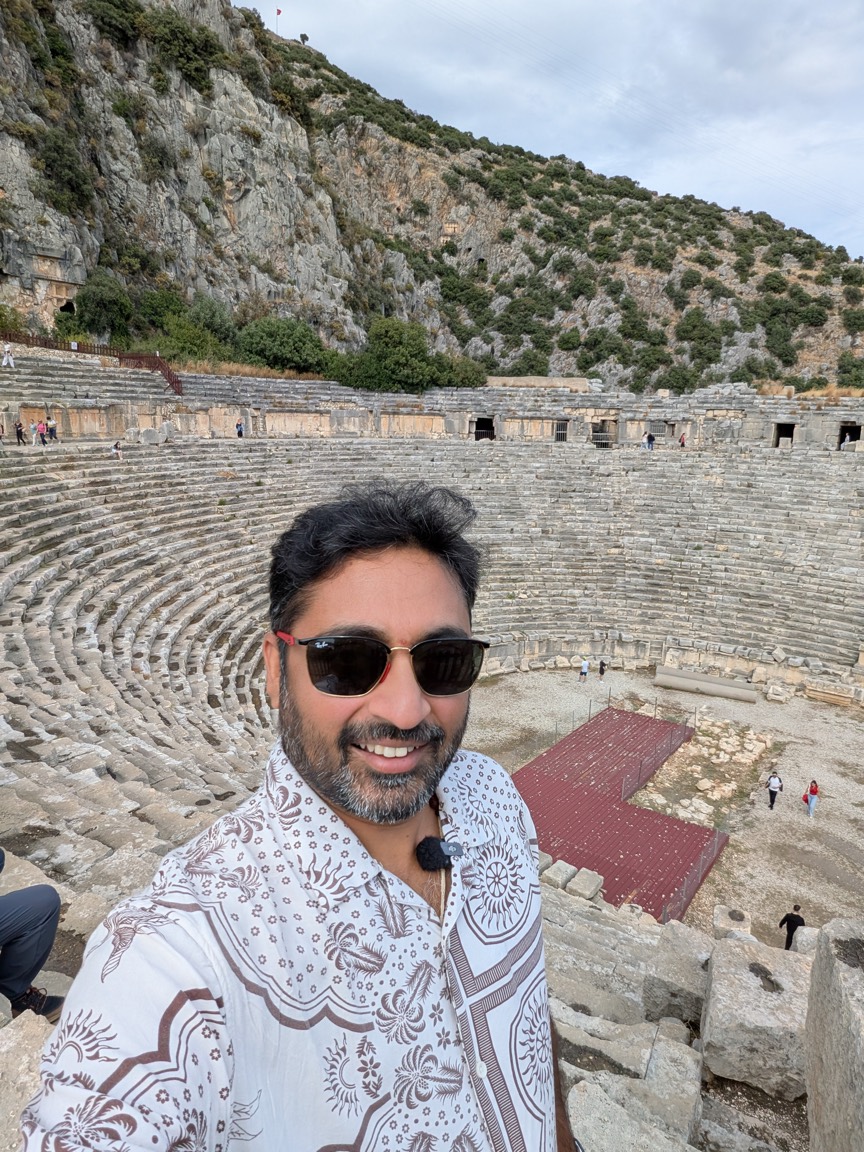
Right beside the tombs stands a large Roman theatre, with more tombs in the hillside behind it. I have seen bigger ones on this trip, but this one is still impressive. A major earthquake in AD 141 destroyed it, and it was rebuilt afterwards. I can't say exactly when it was first built.
The steps here have not been restored for safety, unlike the theatres I have shown before. Anything that broke has been left broken, so I watched my feet the whole way down. If you film reels or post on social media, keep your attention on safety first and the video second. At the bottom there is a stage, with the seating curving up behind it, and the front rows have seats for important guests. I sat in one, and from the centre of the stage even a normal speaking voice carries to the top.
You may wonder why so much of this had to be dug up. Over the centuries, rain washes soil down and covers whatever people stopped living in. This area also sits on a major earthquake zone, so the ground cracks and fills with sand, and the layers build up. Pieces of carved stone found during the excavations are laid out nearby, waiting for archaeologists to work out where they originally belonged.
The way back
The tour ticket for the theatre was included. Outside the exit are souvenir shops and juice stalls, and a jewellery stall selling pieces made with local stones. I also spotted a Honda Activa parked outside, the same scooter you see all over India. The tour ended there, and we drove back to Antalya in the rain, so I finished the vlog on the bus.
What the tour cost
The tour came to £53, around ₹6,200, which covered the transport, lunch and the Myra tickets. I spent nothing else on the day apart from the items below.
- Day tour from Antalya: £53, about ₹6,200, with transport, lunch and entry to Myra included.
- St Nicholas Church ticket: €17, which came to 939 lira, almost ₹1,800, and is not part of the tour.
- Coffee on the way: 250 lira, about ₹500.
Renting a car would probably work out cheaper, as car hire is inexpensive here. You would have to handle the driving and traffic yourself, though, while on a tour someone else does that and you can just concentrate on looking around.
That was my second Antalya vlog. I decide where to go next about three days before I travel, so I don't yet know where the next video will be.
Practical tips for Myra, Demre and Kekova
- Weather: bring a rain jacket, as the sunken ruins are easier to see in clear weather.
- Early start: my pickup was at 6:30 am, and the drive out took about two hours.
- Church ticket: St Nicholas Church costs extra, so carry some cash or a card.
- Shoes: the steps at Myra's theatre are original and uneven, so wear shoes with grip.
- Drones: they are not allowed at Myra.
- Kayaks: some people explored Kekova by kayak, which gives a closer look at the ruins under the water.