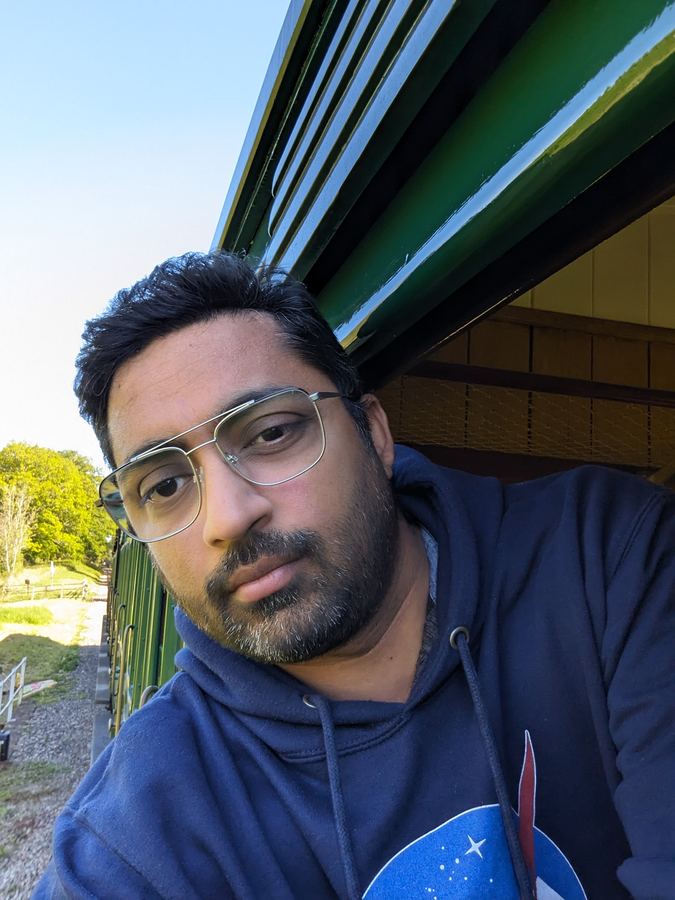
A Lithuanian king is said to have dreamed of a howling wolf and founded Vilnius because of it. In one foggy October day I walked through the Old Town, found a tiny country inside the city whose constitution includes a Sanskrit version, and took a bus out to a castle on a lake.
The Old Town, Cathedral Square, the Republic of Užupis, Trakai Island Castle, Gediminas Hill at night and a hostel room tour.
Arriving in Vilnius
Lithuania was my 46th country, and I had a full day to cover its capital. Winter was on its way, so the coats were out. Fog hung over everything and it was only about 2°C in the morning, rising to 3 or 4°C later. I had packed a hat but not gloves, which turned out to be the wrong way round, because my hands were freezing all day.
The Old Town and the Gate of Dawn
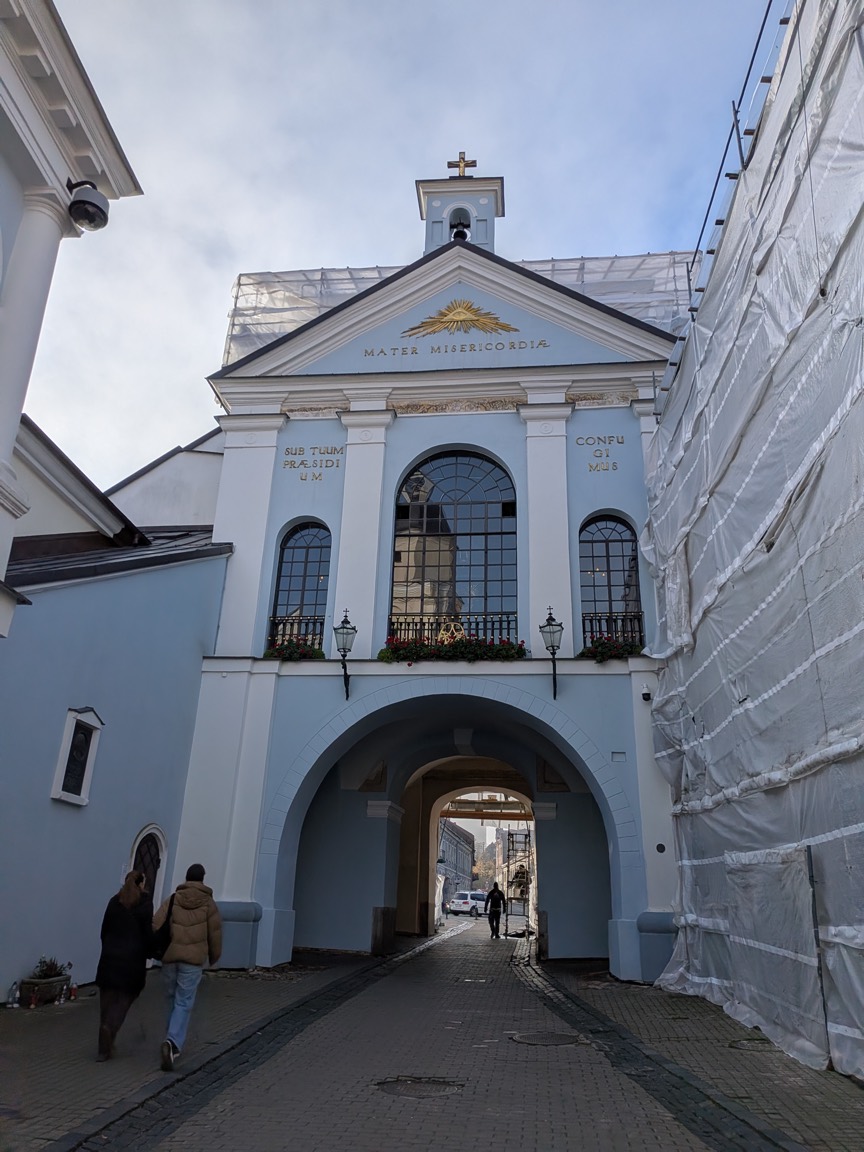
The Old Town once had many gates, but only one survives, the Gate of Dawn, so that was my first stop. It was wrapped in scaffolding for restoration when I got there, which is typical of my luck. Behind it the Old Town opens up and looks far better than the outside suggests. People stopped for a quick prayer as they passed through, and then the street runs straight on into the Old Town proper.
Lithuania has about 2.8 million people. It was once a Grand Duchy, a much bigger state than the country of today. I had just seen another grand duchy in my Luxembourg post, but Luxembourg still exists as one and Lithuania's disappeared. The country joined the Russian Empire in 1795 and declared independence in 1918, a movement in which a physician named Jonas Basanavičius played a leading role. There is a statue of him in the centre. In the Second World War the Germans occupied the country and killed many of its large Jewish population, which is why Vilnius was once called the Jerusalem of the North. After the war it was absorbed into the USSR, and in 1990 it became the first republic to break away. It soon joined the EU and NATO and adopted the euro. Locals told me that prices were lower in the days of the old currency and have risen since, though they also say that living standards are much better now.
Town Hall Square and a portal to Lublin
The next big space is Town Hall Square, named for the town hall on it. The building was closed for restoration, and what looks like the façade from a distance is a printed picture over the scaffolding. The square itself is a proper old market square, and it reminded me strongly of Lublin in Poland.
There is a portal here too, a screen that connects people in one city with another, like the portals in Doctor Strange. Lublin is linked to Vilnius, and I had stood at the one in Lublin earlier, when nobody was at the other end to wave back. This time people were on the screen, and they were dancing. Later it showed Manila, and I waved to the Philippines. I can't dance, so I skipped the dancing and stuck to waving. After dark I came back and found a beach in Brazil on the screen, where people waved and we ended up playing rock, paper, scissors across the world.
Architecture and the Einstein mural
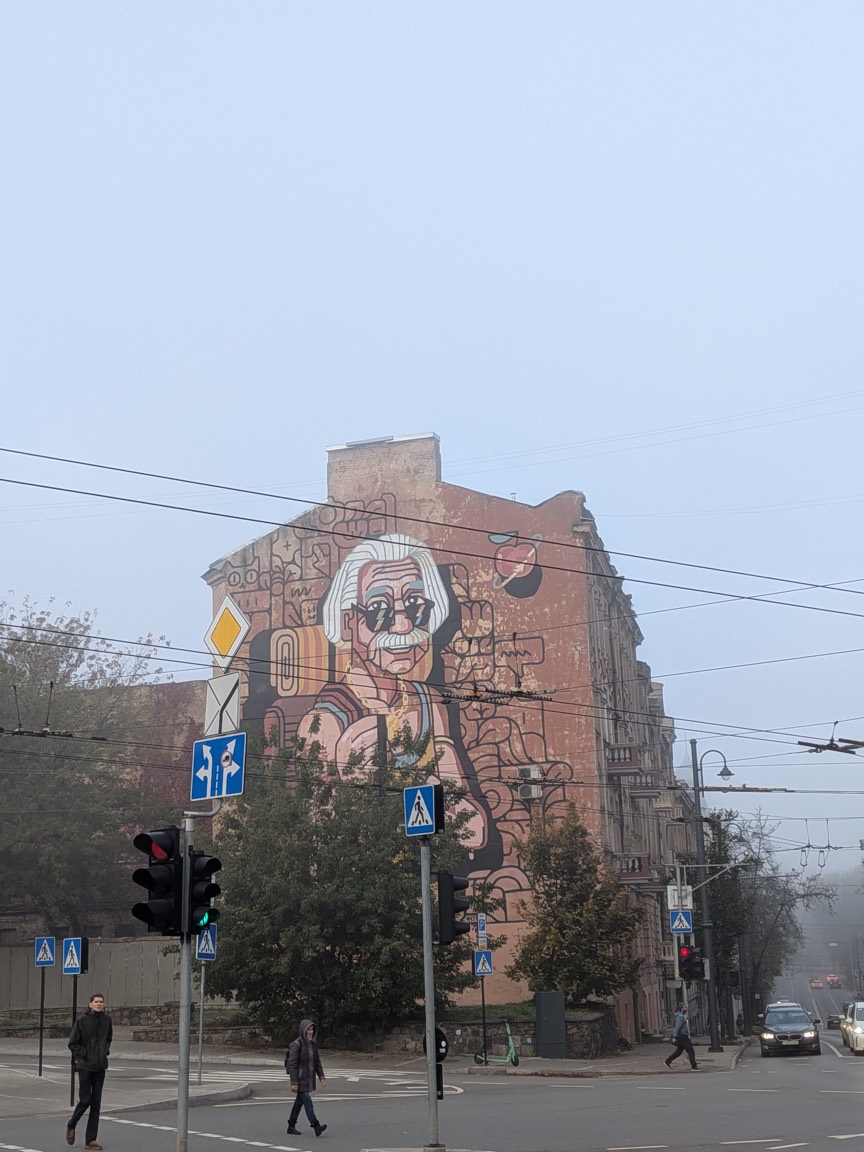
The buildings and churches here come in many styles. Most are Baroque, with some Gothic and Renaissance, and a few of the Orthodox churches look a lot like Russian ones. A large mural of Einstein covers the side of one building, wearing tinted glasses and a chain around his neck, and it makes a good landmark in the fog.
Cathedral Square
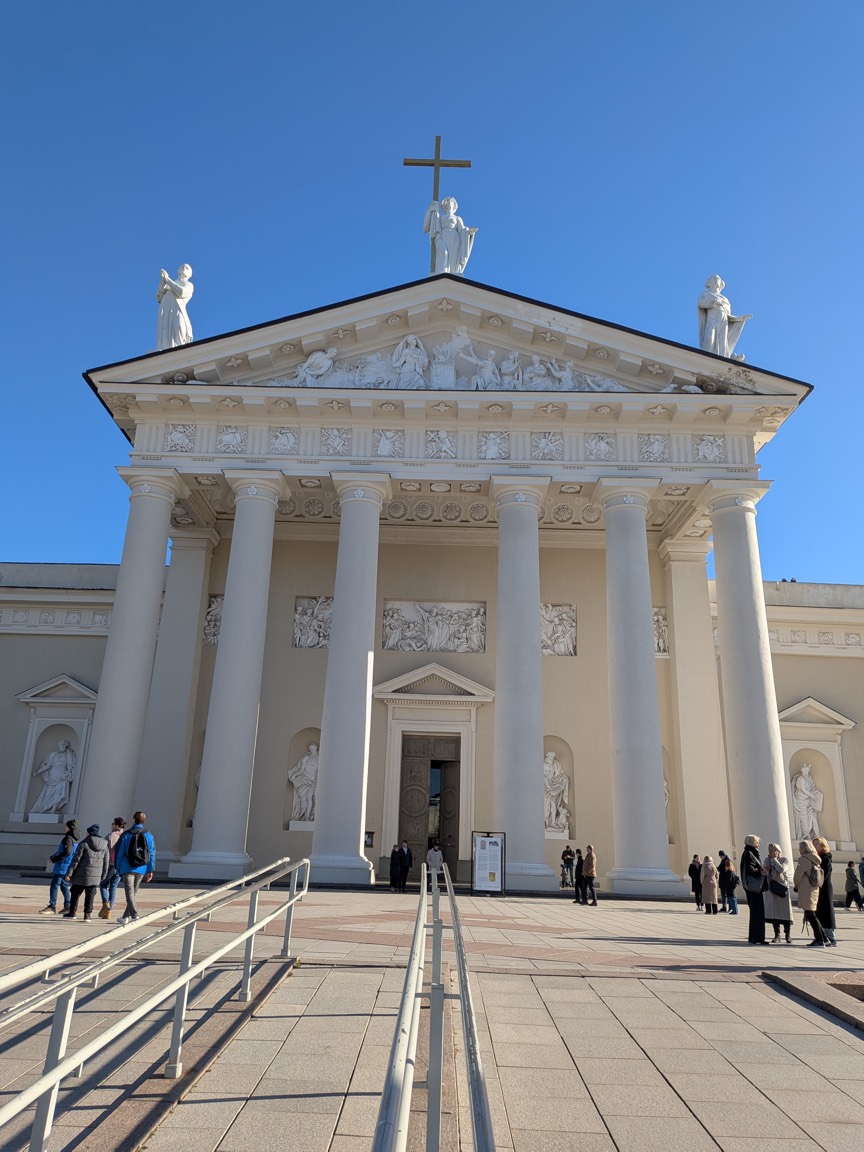
The other main square is Cathedral Square, with Vilnius Cathedral and its famous bell tower beside it. Lithuania was the last country in Europe to take up Christianity, which is the reverse of Armenia, the first Christian country, that I covered in my Yerevan post. Before that, people here worshipped pagan gods, and traces of that old world survive in the language, which brings me to the strangest link in this post.
The Sanskrit link
People say Lithuanian is one of the languages closest to Sanskrit, and the words I picked up bear that out. Fire is agnis in Lithuanian and agni in Sanskrit. God is dievas here and daiva in Sanskrit. A wolf is vilkas, close to the Sanskrit vṛkaḥ.
The old pagan religion points the same way. Among its gods was Perkūnas, the god of rain, thunder and lightning. In the Rigveda there is Parjanya, who rules over rain and thunder in the same way. I can't explain how the two traditions are connected, but they clearly are somehow.
I did not go up the bell tower, as I had already seen the city from the drone.
The Baltic Way and independence from the USSR
The road to independence started well before 1990, with years of protests. In 1989 people held a human chain that began in Tallinn, the capital of Estonia, and ended here in Vilnius. People simply stood and held hands, with no violence and no stones thrown at police, which makes a sharp contrast with the more chaotic protests in the news these days. I will cover where it started in my next video, from Tallinn, since that is where I am heading next.
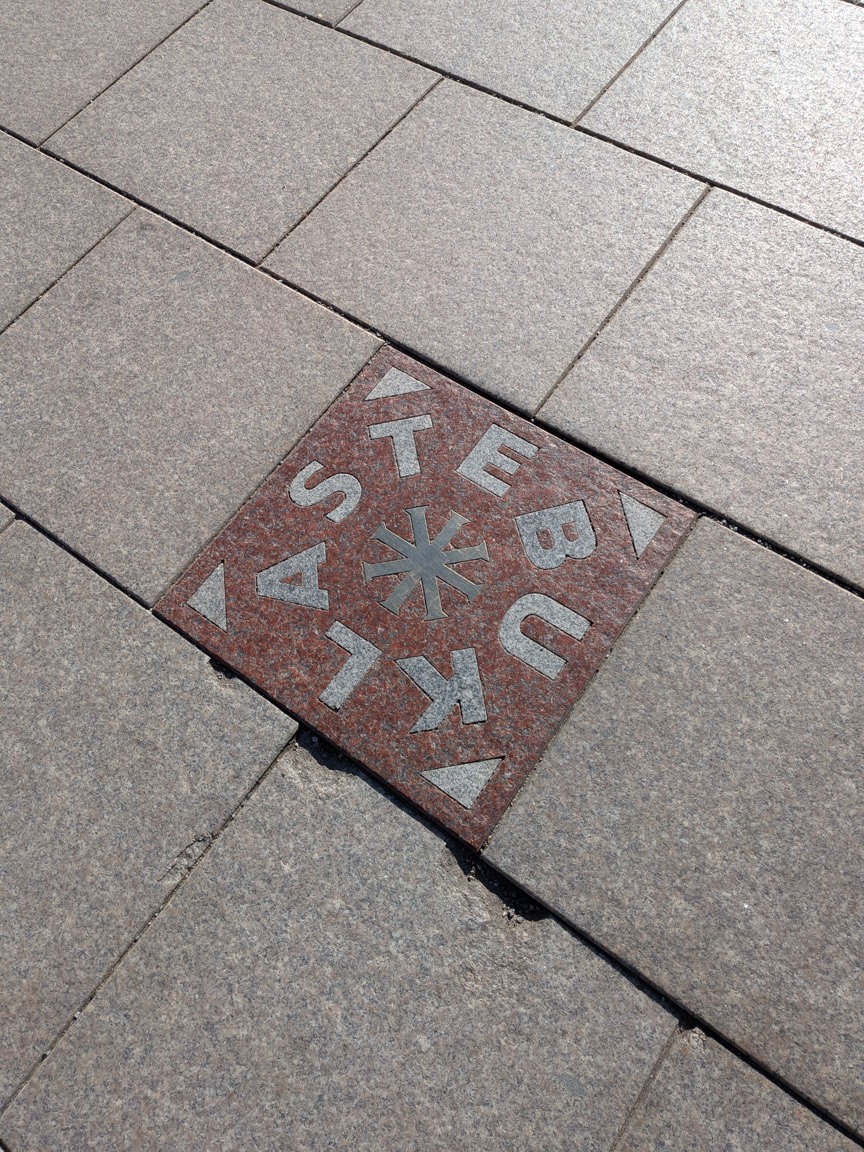
A tile in the paving of Cathedral Square marks the spot where the chain ended. It is called Stebuklas, the Lithuanian word for a miracle. People believe that if you stand on it, turn around three times and make a wish, the wish comes true. The wish of the people who stood here was granted, so the tile has a good record. I turned my three times as well.
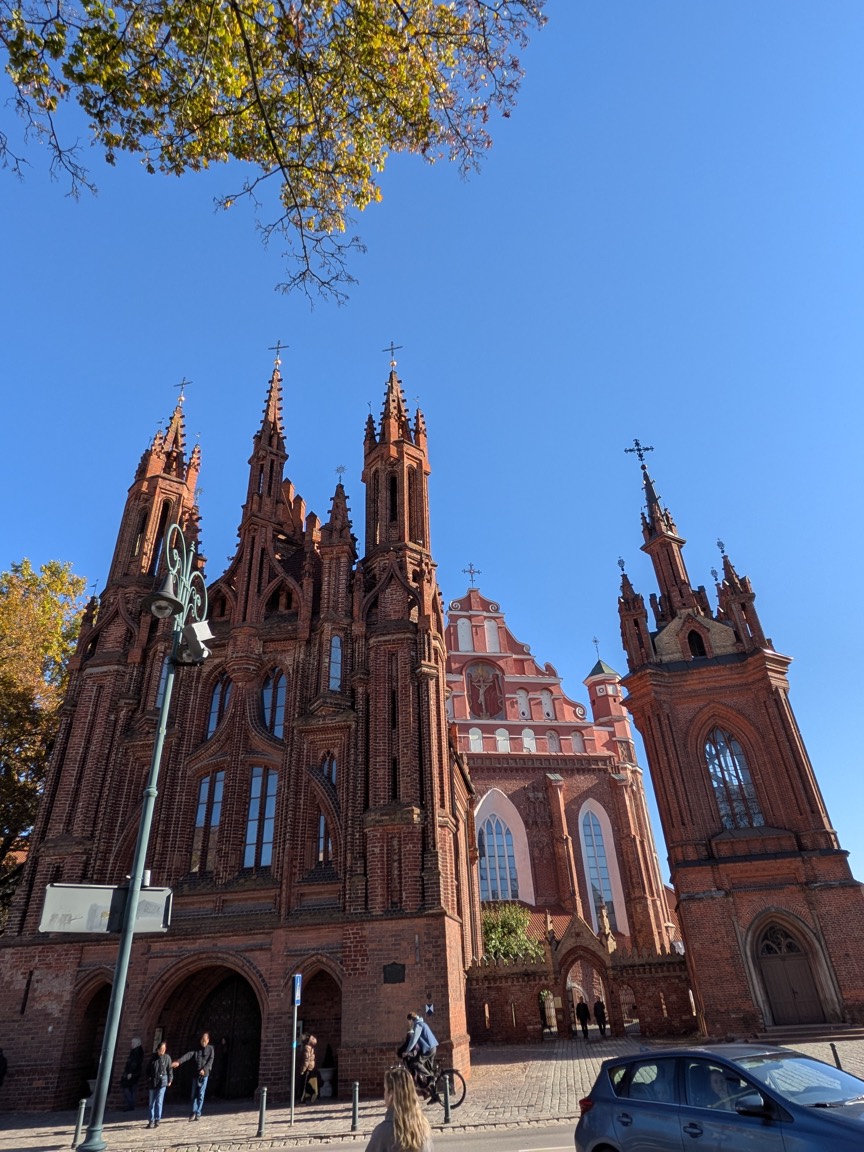
A short walk away is St Anne's, a church in red-brick Gothic.
The Republic of Užupis
Cross a small bridge over the river Vilnia and you enter another country. Užupis means "beyond the river". On 1 April 1997, and yes, it was April Fools' Day, a group of artists announced that the district was a republic. The area had been neglected, and the artists cleaned it up, filled it with art and declared independence. In 2002, on the fifth anniversary, an angel statue went up in the main square. The republic has its own flag, and its emblem is an open hand with a hole in the middle. As it was explained to me, the meaning is that if there is no corruption, nothing sticks to the hand.
You pass a mock border post to enter, with a souvenir shop that will stamp your passport. I left my passport alone, as I still have a lot of the world to cross, and had the stamp put on my receipt instead. The magnet I bought cost €3, which is a lot, as ordinary magnets are usually one euro or less. But this is a republic of artists, and artists never come cheap.
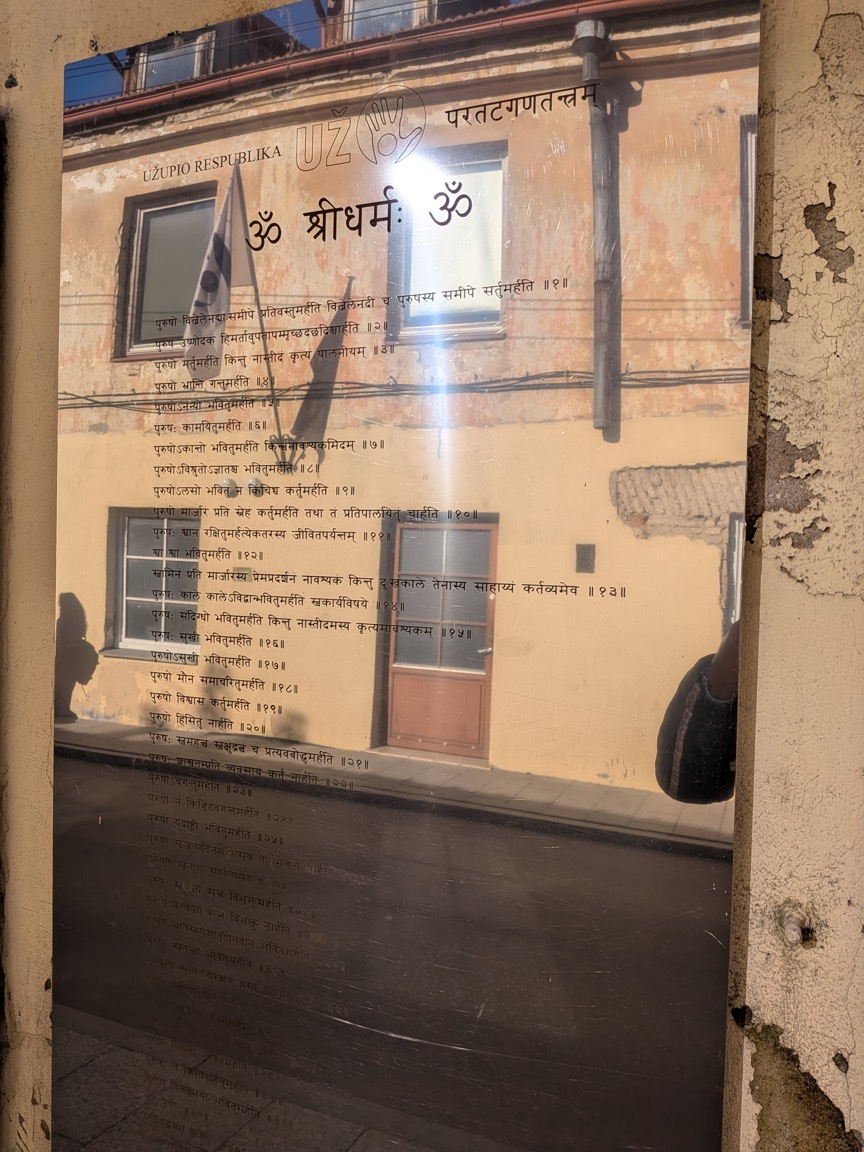
The heart of Užupis is its constitution, which is mounted on a wall in 45 languages, with 41 articles. Some of them made me smile:
- Everyone has the right to live by the river Vilnia, and the river has the right to flow by everyone.
- Everyone has the right to be happy, and everyone has the right to be unhappy.
- A dog has the right to be a dog.
- No one has the right to violence.
If the whole world followed these, we would all be a lot happier. Among the languages are English and Hebrew, and then Hindi and Sanskrit, the only two Indian languages I could find. The Sanskrit panel starts with "Om Shri Dharmah" and ends with "Om Tat Sat". A constitution in Sanskrit, in Lithuania, in a country the size of one neighbourhood, was a wonderful thing to find.
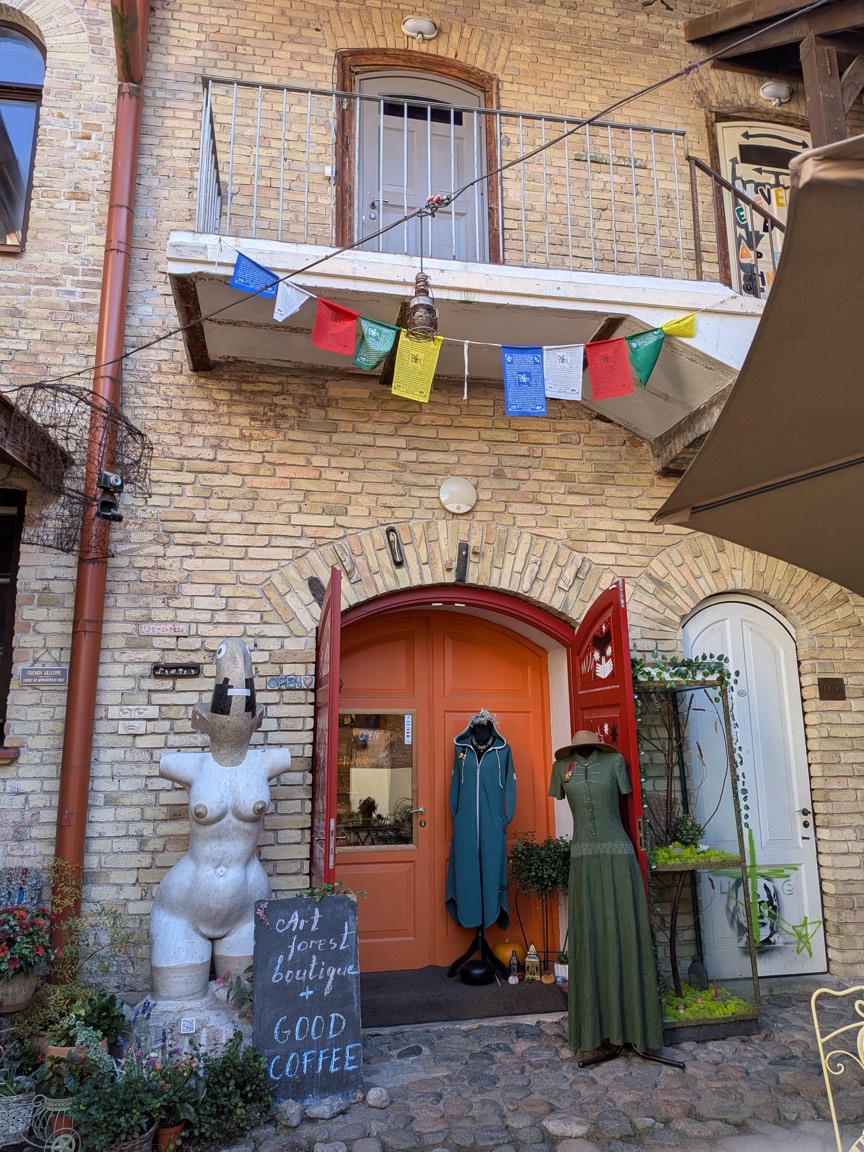
You will find a few other things around the district. A cat sculpture, known as the Užupis cat, has one ear with a ring on it. If you touch the ear and make a wish for courage, you get lots of it. I touched it, and I have decided to carry that courage all around the world, from Antarctica to Russia, Japan, China and Pakistan. The constitution also includes the right of a cat to decide whom it loves and whom it does not. There is a swing hanging from a bridge over the river as well, and a mermaid statue by it, and seeing the mermaid is supposed to bring good luck. The swing is for when the river is low. Right then the current was strong and it was about 3°C, so I did not climb on, and I will try again in summer.
Trakai Island Castle
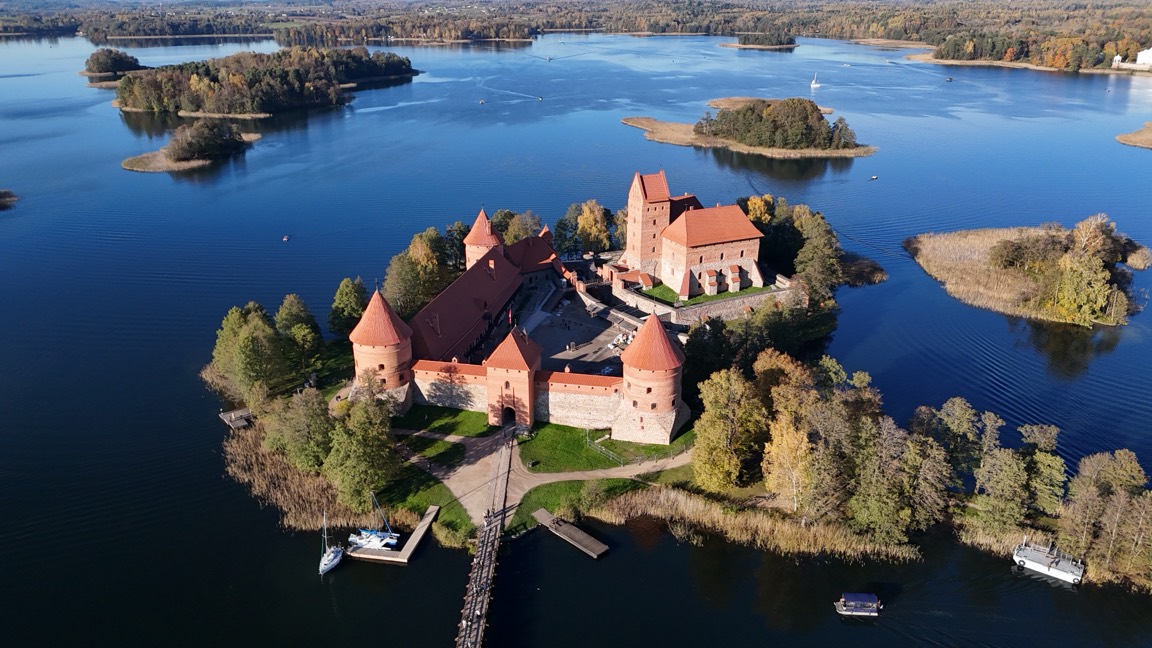
Trakai is around 25 km from Vilnius, and the castle was the one thing I wanted to see badly enough to skip lunch. Lithuania was a Grand Duchy, so it needed a grand ducal palace, and this is it. It sits on one of many islands in a lake, in the small town of Trakai. Do not be fooled by how old it looks: the original dates to the 14th and 15th centuries, but what you see now is a reconstruction. The castle was left to decay for a long time, and it was rebuilt in the 1950s. Today it is a museum of Lithuanian history. The ticket costs €14, and I did not go inside, because I know the history already, but if you are curious it is worth your time.
To reach the castle you walk across a long wooden bridge over the lake, onto one island, then across another bridge into the castle itself, and the walk is lovely. It looks like a fairy-tale castle. Look closely and you can see the older stones at the bottom and the newer red brick above. You can also take a boat on the lake, with paddle boats, pedal boats or bigger tour boats, and I'd have liked a slower day to do that.
The Karaim community
Trakai is also home to the Karaims. The Grand Duke Vytautas brought them from Crimea in the 1390s to guard his palaces, and the community has stayed ever since. They are a Turkic people, and their language belongs to the Turkic family, though I do not know how many still speak it. They practise Karaite Judaism, a branch of Judaism of their own, and are neither Christian nor Muslim. Their houses usually have three windows facing the road, one for God, one for the Grand Duke and one for the family. Many of the houses are painted blue, yellow, red and maroon.
Hot-air balloons float over this part of Lithuania, and I saw a couple behind the trees. A balloon ride over Vilnius is famous, and I'll try it another time. Getting here was a trek in its own right. The bus stop is about 2 km from the castle, so the round trip on foot was around 4 km on top of the bus.
Gediminas Hill after dark
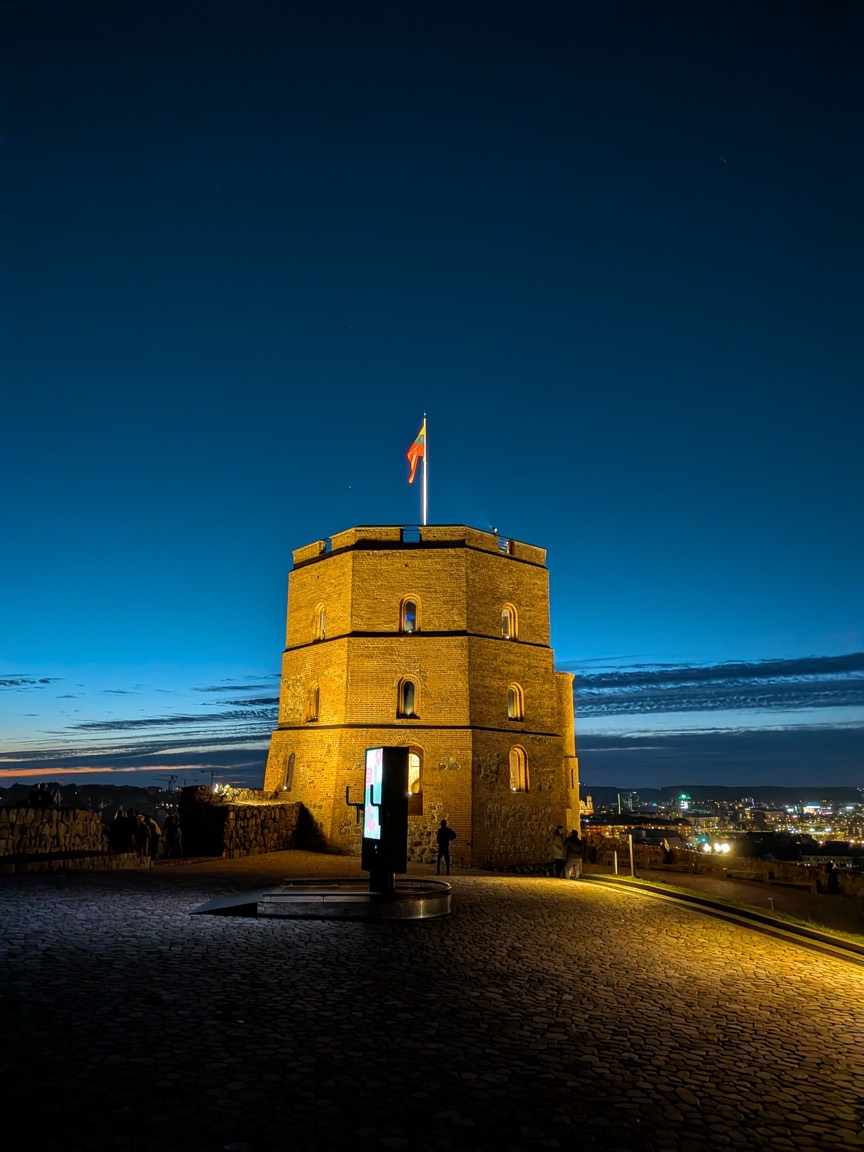
Back in Vilnius it was dark by the time I reached Gediminas Hill, the hill behind the Cathedral. A funicular goes to the top, and after the walking I had done, I took it. It costs €3 for up and down. The reason to come is the tower on top, Gediminas Tower. You can climb the tower for €8, but I decided my legs had paid enough already. The city looked beautiful from up there, with a bright moon above it, and the cathedral and bell tower were lit below.
The tower is named for Duke Gediminas, and it connects to the story I opened with. He went hunting, got tired, and lay down to sleep on this hill. In his dream a wolf stood and howled. A pagan priest explained that if he built a city on the spot, it would grow great, and so he founded Vilnius. Nobody knows how much of it is true, but it is the story people tell. A wolf sculpture stands up here, and I could not see it in the dark, so come in daylight if you want to find it. The wolf is vilkas in Lithuanian and vṛkaḥ in Sanskrit, which is another link to the language.
From the other side of the hill the view shows the new town, and the difference from the Old Town is obvious, with a bridge over the river in the middle. A statue of Gediminas stands at the bottom of the hill.
An Indian dinner in Vilnius
My breakfast that morning was a croissant and a coffee from a street stall for €1.70, and I ate nothing else until the evening. By then I was hungry enough to try an Indian restaurant with good reviews, which people also said was expensive. The ambience was lovely and the chairs were silver, so I felt like a maharaja.
I ordered a vegetable biryani and a cardamom and mint lassi, which I had never had. I asked whether it would be sweet, and they said it would not, and it was only slightly sweet, but I should have asked whether there was sugar in it. After one sip I lost my trust in it. The biryani smelled wonderful and reminded me of the Indian restaurant we went to in Cyprus. The taste was fine, a little better than Cyprus though not amazing, and it came with raita. The bill was €19, which is expensive but not extravagant. They also gave me a finger bowl to wash my hands, which you rarely see outside India.
At the restaurant I met a fellow traveller, Hemang, who said hello to my Telugu audience and ended up asking everyone to subscribe, which is the best way I've heard it done.
The hostel room
I stayed in a hostel-style place, and my room had two beds, though I was alone and used just one. There was a table with a chair and a reading lamp, a mirror and a fan, which I did not need in that cold. The corridor outside has two shared bathrooms, each with a shower and a toilet. The room came to €37 a night. A bed in a shared dorm was around €28 to €29, I think.
What it cost
- Breakfast: €1.70 for a croissant and a coffee on the street.
- Indian dinner: €19 for a vegetable biryani, a cardamom and mint lassi and raita.
- Gediminas Hill funicular: €3 for up and down.
- Užupis magnet: €3, when ordinary ones cost a euro or less.
- Room: €37 a night, with shared bathrooms.
- Not paid, for reference: Trakai Island Castle is €14 and the Gediminas Tower climb is €8.
I enjoyed Vilnius a lot, and I hope the video shows why. My next stop is Tallinn, in Estonia, which I will leave for the next video.
Practical tips for Vilnius and Trakai
- Gloves: in mid-October it was around 2 to 4°C, and a hat was not enough.
- Trakai: it is around 25 km from the city, and the walk from the bus to the castle is about 2 km each way.
- Gediminas Hill: the funicular saves your legs, and the view at night is worth it.
- Užupis: go in daylight to read the constitution, and ask before you pay for souvenirs, as prices can be high.
- Lassi: if you order one, ask whether it has sugar and not whether it is sweet.
- Restoration: the Gate of Dawn and the town hall were covered in scaffolding on my visit.